

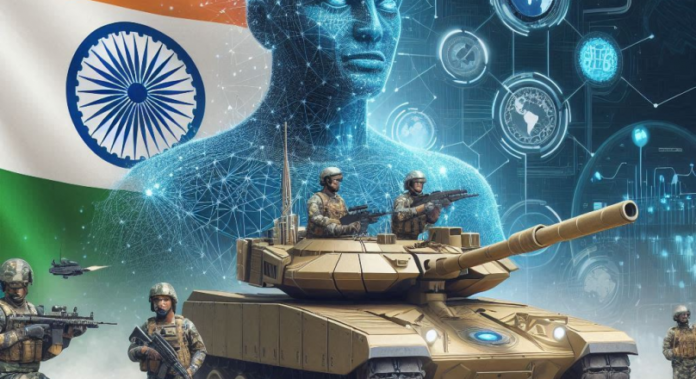
AI cannot remain a peripheral digital tool. It must become the organising architecture that integrates India’s defence industry, armed forces and research institutions into a single operational ecosystem. The real question is not autonomy in weapons, but sovereignty in systems.
A credible military power rests on a credible indigenous industrial base. India’s defence industry has seen a transformation with the private players expanding their role, though integration remains uneven. Yet structural challenges of integration and credibility remain. Production cycles remain inconsistent and suboptimal. Quality control varies across vendors and production series. Lifecycle integration between factory output and field performance is limited. Artificial intelligence, properly embedded, can serve as corrective tissue. The shift required is from viewing AI as an application layer to treating it as an infrastructural layer.

In defence manufacturing, reliability is a strategy. In an era of precision and disruptive technology, algorithmic monitoring of tolerances can sharply reduce defect rates. Micro-variations in temperature, stress or vibration patterns often precede mechanical failure. When analysed consistently, such data allows intervention before quality is compromised. For India’s aerospace and missile sectors, where tolerances are unforgiving, reliability matters more than quantity. Even marginal reductions in defect rates translate directly into operational credibility.
AI cannot remain a peripheral digital tool. It must become the organising architecture that integrates India’s defence industry, armed forces and research institutions into a single operational ecosystem. The real question is not autonomy in weapons, but sovereignty in systems
The same logic applies to production infrastructure. Predictive maintenance systems can forecast machine fatigue in defence factories, reducing sudden shutdowns that disrupt delivery schedules. In an ecosystem where timelines are already stretched, stabilising output becomes a strategic imperative.
Quality assurance remains a persistent vulnerability. AI-enabled optical inspection and anomaly detection systems can identify microscopic defects, detect failure patterns across batches, and enforce uniform production standards. For a country aspiring to become a net exporter of defence equipment, quality is not optional; it is foundational. Digital traceability linking components, operators and production environments strengthens both auditability and accountability.
Supply chains represent a second layer of vulnerability. India’s defence production remains interdependent with global suppliers for electronics, propulsion elements, critical sensors and specialised materials. AI-driven dependency mapping can identify critical choke points across electronics, propulsion systems, sensors and specialised materials. Scenario simulation enables planners to anticipate which programmes would stall under disruption and where diversification is feasible. In a geopolitical climate where export controls and sanctions are tools of statecraft, such foresight becomes strategic insurance. It is in operational sustainment that these efficiencies convert into tangible combat readiness.

In defence manufacturing, reliability is a strategy. In an era of precision and disruptive technology, algorithmic monitoring of tolerances can sharply reduce defect rates. Micro-variations in temperature, stress or vibration patterns often precede mechanical failure. When analysed consistently, such data allows intervention before quality is compromised
India’s armed forces operate across extreme terrain, from high-altitude deployments to extended maritime patrol zones. Logistics planning under these conditions is traditionally conservative, often leading to costly redundancy or episodic shortages. AI can alter this balance. By integrating historical consumption patterns with terrain data, climate cycles and mission tempo, forecasting models can refine provisioning decisions with greater precision. The result is not merely efficiency, but alignment between manufacturers, suppliers and operational units around predictive demand. A force that sustains readiness without overextending its logistical base preserves strategic flexibility without overstretch.
Sustainment, more than acquisition, determines long-term combat power. MRO of platforms presents a similar opportunity. Modern combat systems generate large volumes of diagnostic data. AI systems can analyse this data in real time to detect anomalies, recommend corrective actions and extend service life. The result is higher availability rates and better asset utilisation. For a military required to maintain presence along multiple fronts simultaneously, incremental gains in availability compound into tangible force capacity. Beyond industry and logistics lies the domain of decision-making.

The multidomain battlespace demands information superiority and decision dominance. There is an overload of data generated by sensors, drones, satellites, humint and cyber networks. The key is not collection but synthesis, interpretation and generating options in real time for decision making. AI can fuse inputs from sensors, satellites, unmanned systems, HUMINT and cyber networks into a coherent operational picture. AI has the capacity to correlate patterns, identify anomalies and prioritise emergent threats and their priorities. When integrated with Intelligence Preparation of the Battlespace (IPB) and the Military Decision-Making Process (MDMP), it shortens the interval between detection, assessment and response.
Supply chains represent a second layer of vulnerability. India’s defence production remains interdependent with global suppliers for electronics, propulsion elements, critical sensors and specialised materials. AI-driven dependency mapping can identify critical choke points across electronics, propulsion systems, sensors and specialised materials
AI can also be an enabler of tri-service synergy. Such integration requires shared AI architecture, disciplined data governance and hardened digital infrastructure. AI cannot compensate for weak institutional design. The question of technological sovereignty runs through all these domains. Reliance on externally developed AI systems introduces operational uncertainty. Algorithms trained on foreign datasets may reflect assumptions that do not translate to India’s terrain or threat environment.
AI must strengthen decision-support without diluting accountability. Clear frameworks defining human control and accountability are necessary to prevent ambiguity. Military institutions adapt best when technological integration is accompanied by professional education. Officers must understand not only what systems can do, but where they can fail.
A coherent national approach is required. Procurement must allow modular upgrades, and data standardisation must be mandatory. Cross-service interoperability and data standards must be harmonised and non-negotiable. Industry, research institutions, and operational commands must function within a shared strategic framework rather than in sequence.
India’s strategic competition is unlikely to be decided by isolated technological breakthroughs; it will instead be decided by institutional coherence and industrial depth. Artificial intelligence, treated as an integrative industrial architecture rather than a digital showcase, offers a pathway to both.
A coherent national approach is required. Procurement must allow modular upgrades, and data standardisation must be mandatory. Cross-service interoperability and data standards must be harmonised and non-negotiable. Industry, research institutions, and operational commands must function within a shared strategic framework rather than in sequence
The central choice facing India is not whether to adopt AI in defence manufacturing. It is whether to embed it structurally across its defence ecosystem or confine it to the margins. In a security environment defined by sustained pressure and technological acceleration, that distinction will shape long-term strategic balance.
This transformation mandates investment, institutional reforms and cultural adaptation. It involves striking a balance between innovation and ethics, speed and ambition and security with realism. Such transformation must integrate manufacturing, sustainment and decision-support into a coherent, innovation-driven defence ecosystem that is both resilient and strategically credible. In an era defined by AI dominance and technological rivalry, it is coherence, not isolated innovation, that will determine India’s long-term strategic autonomy.

The author, a PVSM, AVSM, VSM has had an illustrious career spanning nearly four decades. A distinguished Armoured Corps officer, he has served in various prestigious staff and command appointments including Commander Independent Armoured Brigade, ADG PP, GOC Armoured Division and GOC Strike 1. The officer retired as DG Mechanised Forces in December 2017 during which he was the architect to initiate process for reintroduction of Light Tank and Chairman on the study on C5ISR for Indian Army. Subsequently he was Consultant MoD/OFB from 2018 to 2020. He is also a reputed defence analyst, a motivational speaker and prolific writer on matters of military, defence technology and national security. The views expressed are personal and do not necessarily carry the views of Raksha Anirveda
