

The Victory No One Heard
There are wars that end with treaties—and those that end by quietly disappearing. India’s long battle against Left Wing Extremism (LWE) belongs to the latter. No surrender ceremony. No final headline. And yet, one of the most entrenched internal security threats has been reduced to near extinction.
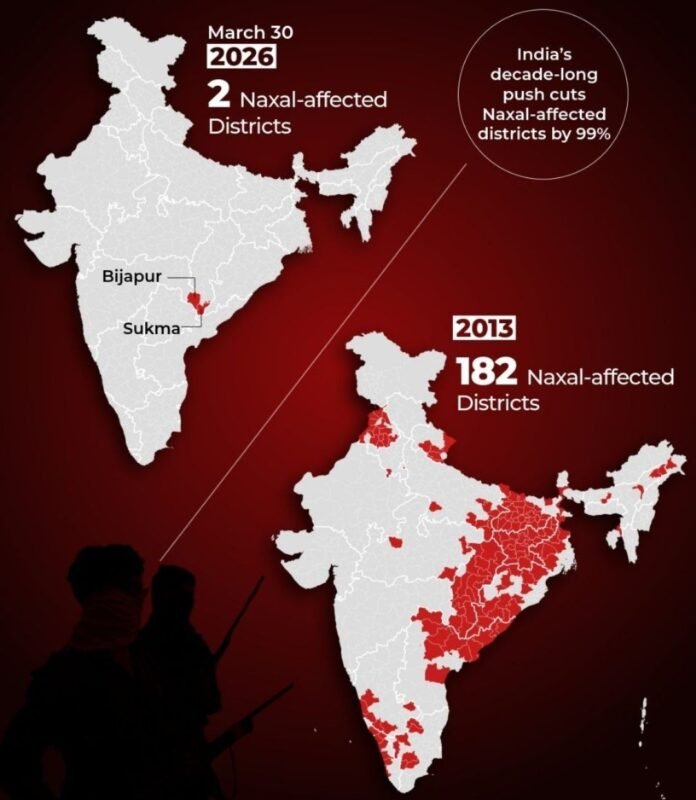
In 2013, India’s internal security map told a stark story. The “Red Corridor” stretched like a deep scar across the country—from the Nepal border down to Andhra’s forests—covering 182 districts. This was not a scattered insurgency; it was a connected geography of disruption, spanning Chhattisgarh, Jharkhand, Odisha, Bihar, Maharashtra, and parts of Andhra Pradesh and West Bengal. The “Red Corridor” cut across India like a fault line, spanning resource-rich but governance-poor regions. It was an alternate ecosystem. Parallel courts, coercive taxation, recruitment pipelines, and ideological indoctrination had created a shadow state in India’s heartland.

The “Red Corridor” cut across India like a fault line, spanning resource-rich but governance-poor regions. It was an alternate ecosystem. Parallel courts, coercive taxation, recruitment pipelines, and ideological indoctrination had created a shadow state in India’s heartland. This was not just a security challenge—it was a geography of absence, where the state had receded and insurgency had filled the vacuum.
This was not just a security challenge—it was a geography of absence, where the state had receded and insurgency had filled the vacuum.
Mapping the Scale of Decline
By March 31, 2026, that geography had been redrawn. The number of affected districts has fallen to just two—Bijapur and Sukma in Chhattisgarh. A 99% territorial contraction in just over a decade. This is not a routine decline. It is one of the most significant internal security transformations in modern India.
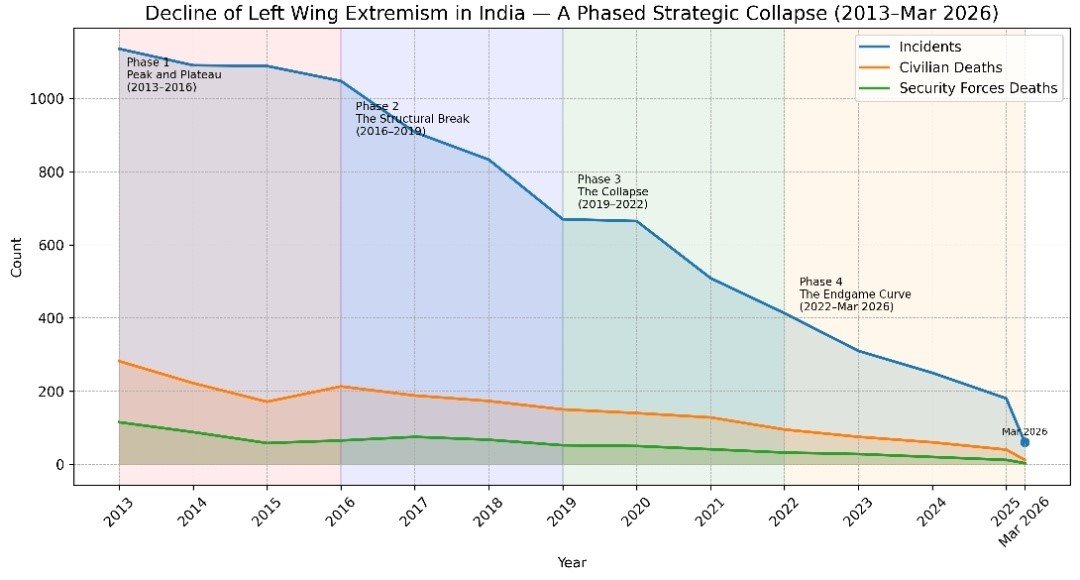
“From a corridor to a cul-de-sac—the Red movement did not just retreat; it collapsed inward.” The data tells a compelling story:
- Peak spread: 182 districts (2013).
- Current footprint: 2 districts (2026).
- Violent incidents: Reduced by over 80–90%.
- Civilian and security casualties: Down dramatically.
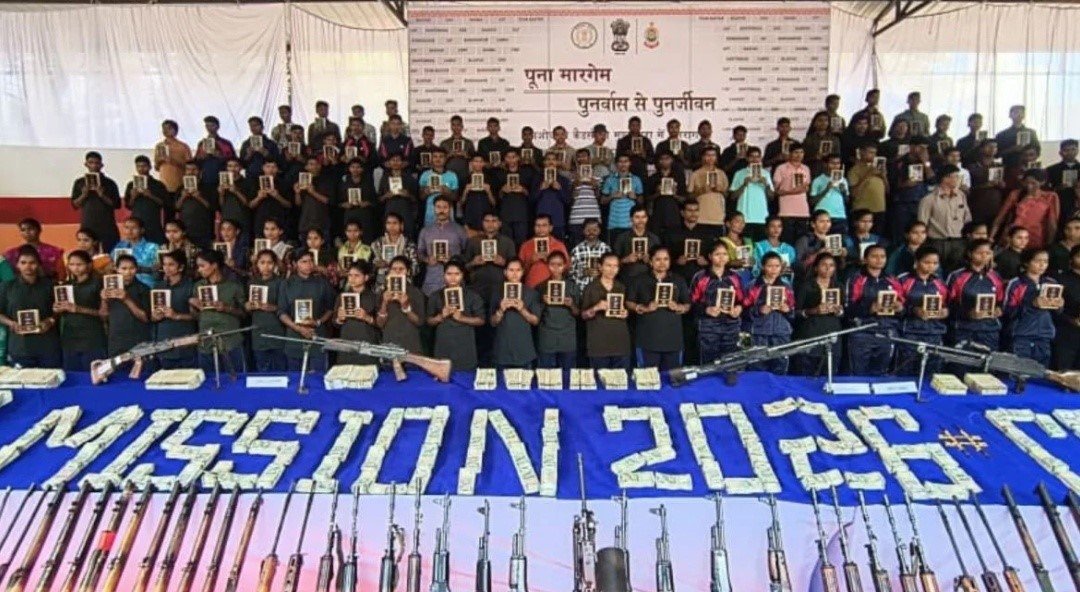
- Surrenders: Increased consistently year-on-year.
But numbers alone cannot capture the depth of this shift. What has truly changed is control—of land, narrative, and legitimacy.

Breaking the Backbone
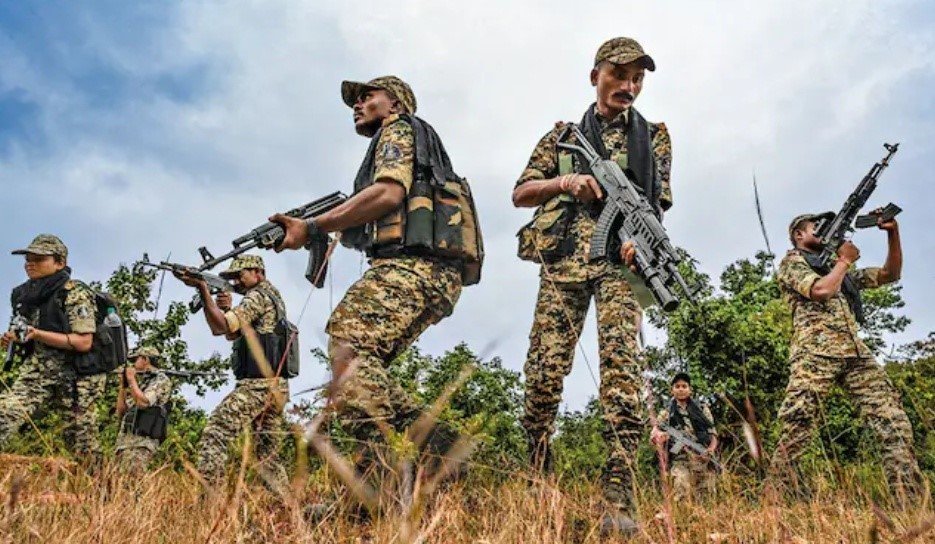
The first decisive shift came in the nature of operations. Earlier approaches were episodic—large operations followed by withdrawal. This allowed insurgents to melt away and return. The new doctrine was different: clear, hold, dominate. Specialised forces like CoBRA units, backed by state police, moved toward:

- Intelligence-led precision strikes.
- Leadership decapitation strategies.
- Permanent area domination.
- Deep-penetration patrols in forest strongholds.
By March 31, 2026, that geography had been redrawn. The number of affected districts has fallen to just two—Bijapur and Sukma in Chhattisgarh. A 99% territorial contraction in just over a decade. This is not a routine decline. It is one of the most significant internal security transformations in modern India.
Technology added a crucial edge. Surveillance inputs, better communications, and improved logistics enabled forces to operate where insurgents once had uncontested advantage. The result: insurgent leadership networks were disrupted, mobility was restricted, and safe havens began to shrink.
“This was not a spike of success—it was a decade of discipline.”
Development as a Weapon System
Security operations created openings—but development sealed them. Over the last decade:
- Thousands of kilometres of roadsconnected isolated habitations.
- Mobile connectivity expanded exponentially, breaking communication isolation.
- Banking and welfare delivery systems penetrated deep rural belts.
- Schools, health centres, and administrative outpostsre-established state presence.
This was not routine development—it was strategic integration. “Where the road reaches, the gun retreats.” Insurgency thrives in isolation. By collapsing that isolation—physically and economically—the state removed the very conditions that sustained extremism.
Technology added a crucial edge. Surveillance inputs, better communications, and improved logistics enabled forces to operate where insurgents once had uncontested advantage. The result: insurgent leadership networks were disrupted, mobility was restricted, and safe havens began to shrink. “This was not a spike of success—it was a decade of discipline.”
Winning the Human Terrain
Perhaps the most critical shift occurred not in forests, but in perception. For decades, tribal communities were caught between fear of insurgents and distrust of the state. That equation began to change through:
- Targeted welfare delivery.
- Land and rights recognition.
- Local recruitment into police and auxiliary forces.
- Surrender and rehabilitation policies.
The outcome was subtle but decisive: The insurgency began to lose its social oxygen. Recruitment declined. Informational cooperation improved. And slowly, the state ceased to be seen as an outsider.
The Last Two Districts
Today, the insurgency survives only in the dense forested belts of Bijapur and Sukma—areas that combine difficult terrain with residual ideological networks. But this is no longer a movement on the offensive. It is:
- Geographically boxed in.
- Operationally constrained.
- Organisationally fragmented.
Large-scale coordinated attacks have become rare. What remains is a defensive insurgency, attempting survival rather than expansion. Yet, this phase is also the most sensitive. History shows that insurgencies often attempt resurgence when pressure eases. The task now is not victory—but finality.
The Doctrine that Worked
India’s approach offers a clear doctrine for modern counter-insurgency:
- Clear – Hold – Build. Security forces action must be followed by administrative presence and development.
- Intelligence over Intensity. Precise targeting is more effective than large-scale force deployment.
- Infrastructure as Security. Roads, telecom, and banking are as critical as weapons.
- Localisation of Strategy. Local populations are not collateral—they are central.
- Continuity of Effort. Success required sustained focus across years, not episodic campaigns.
India did not end Left Wing Extremism with a single decisive blow. It did something far more difficult—it outlasted, out-governed, and out-adapted it. From 182 districts to 2 is not just a security achievement—it is a civilisational correction, where spaces once defined by fear have been reclaimed by opportunity.
What Ensures Irreversibility
The final challenge is ensuring that this success cannot reverse. This requires:
- Continuous governance presence.
- Economic opportunity in tribal regions.
- Vigilant intelligence networks.
- Political and administrative consistency.
Because insurgency does not return with noise—it returns with neglect.
The Map that Changed without a Sound
India did not end Left Wing Extremism with a single decisive blow. It did something far more difficult—it outlasted, out-governed, and out-adapted it. From 182 districts to 2 is not just a security achievement—it is a civilisational correction, where spaces once defined by fear have been reclaimed by opportunity. There will be no victory parade for this success.
But perhaps that is fitting. Because the truest victories are the ones where, one day, the conflict simply ceases to exist—and no one remembers when it ended.

Lt Gen Rajeev Chaudhry (Retd) writes on contemporary national and international issues, strategic implications of infrastructure development towards national power, geo-moral dimension of international relations, and leadership nuances in a changing social construct. The views expressed are of the author and do not necessarily reflect the views of Raksha Anirveda
