

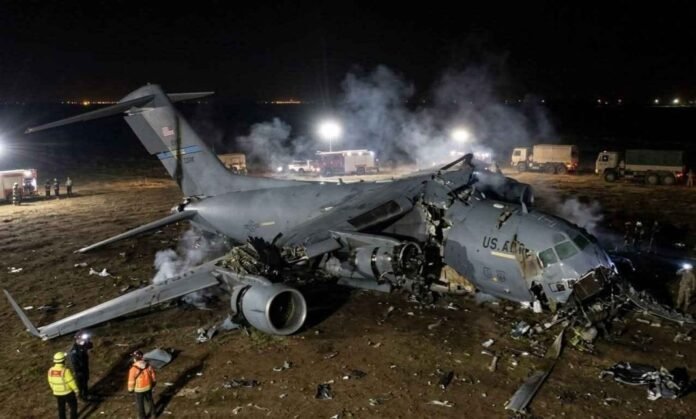
Washington: An Iranian missile strike damaged five US Air Force KC-135 Stratotanker refuelling aircraft on the ground at Prince Sultan Air Base in Saudi Arabia, two US officials told The Wall Street Journal.
The aircraft were parked on the flight line at the time of the strike and sustained damage but were not destroyed, according to the officials. The tankers are being repaired and are expected to return to service. No US personnel were killed in the attack, The Wall Street Journal reported.

President Donald Trump disputed those characterisations in a Truth Social post, saying, “The Base was hit a few days ago, but the planes were not “struck” or “destroyed.” Four of the five had virtually no damage, and are already back in service. One had slightly more damage, but will be in the air shortly. None were destroyed, or close to that.”
Trump singled out The Wall Street Journal by name, saying its reporting was “the exact opposite of the actual facts.”
US Central Command declined to comment on the strike.
Prince Sultan Air Base has served as a key hub for US aerial refuelling operations supporting Operation Epic Fury, the joint US-Israel campaign against Iran. An Iranian attack on the base March 1 led to the death of one US soldier, Sgt Benjamin Pennington, 26.

In addition to the five aircraft struck in Saudi Arabia, a KC-135 crashed in western Iraq last week. All six crew members aboard the downed aircraft were killed, the Pentagon announced. US Central Command has said the crash was not due to hostile or friendly fire and remains under investigation.
The US Air Force operates approximately 376 KC-135s across active duty, Air Force Reserve,and Air National Guard units, according to the Congressional Research Service. The Air Force has been gradually replacing the Stratotanker with the Boeing KC-46A Pegasus, which entered service in 2019 and has reached a fleet of 100 aircraft.

KC-46A deliveries were paused for several months in 2025 after cracks were discovered in multiple aircraft, and the programme continues to address technical deficiencies, including issues with its refuelling boom, according to the Department of Defence’s Director of Operational Test and Evaluation.

