
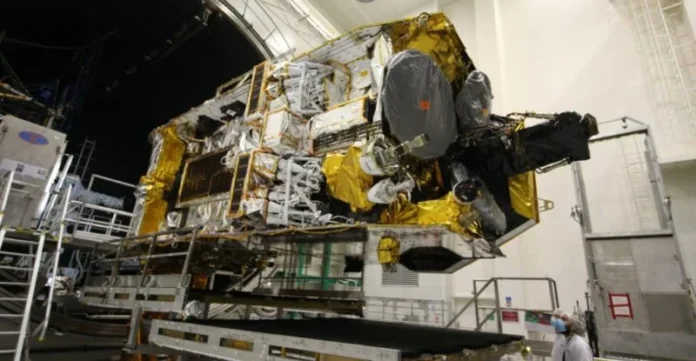
Toulouse. The first Airbus built Inmarsat–6 , I-6 F1, satellite has been shipped from Airbus in Toulouse to Tanegashima in Japan ready for launch.

The first satellite of the Inmarsat-6 series is due to be launched on an H-IIA launch vehicle built by Mitsubishi Heavy Industries (MHI) in December. Inmarsat–6 F1 is based on Airbus’ ultra-reliable Eurostar E3000 spacecraft and will be the 54th Eurostar E3000 launched. It will be the fifth Eurostar in orbit that is equipped with electric propulsion for orbit raising reinforcing Airbus’ position as the world leader in electric propulsion.
The reduced mass by using electric propulsion allows for a dual payload mission (Ka and L-band) with an exceptionally large next generation digitally processed payload giving greater flexibility to Inmarsat, the leading provider of global mobile satellite communication services.
François Gaullier, Head of Telecom Systems at Airbus said: “Inmarsat-6 F1 features one of the most sophisticated digitally processed payloads we have ever built and delivers remarkable flexibility, capability and capacity. As a long serving supplier to Inmarsat, having built the Inmarsat-4 and Alphasat satellites, Airbus is proud to continue helping keep Inmarsat at the top of its game with this step change in capability brought by Inmarsat-6.”
Inmarsat-6 has a large 9m aperture L-band antenna and nine multibeam Ka-band antennas, and features a high level of flexibility and connectivity. The new generation modular digital processor provides full routing flexibility over up to 8000 channels and dynamic power allocation to more than 200 spot beams in L-band. Ka-band spot beams will be steerable over the full Earth disk, with flexible channel to beam allocation.

With increased capacity and flexibility, the satellite will enable Inmarsat to offer more advanced L-band services including very low cost mobile services and IoT applications to existing and future customers in the mobility sector on land, at sea, and in the air. Inmarsat-6 will complement and enhance the L-band services offered by ELERA (*) and embark a Ka-band mission to augment Inmarsat’s globally available high-speed broadband service – Global Xpress.
Investments made by Airbus in platform and payload technologies used on Inmarsat-6 are supported by the European Space Agency and national agencies, in particular the UK Space Agency and CNES. Inmarsat-6 will have a launch mass of 5.5 tons, spacecraft power of 21 kW and a design life of more than 15 years.