

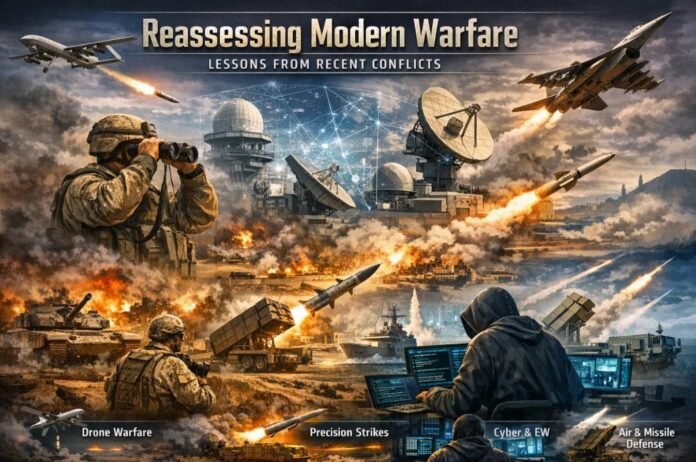
The nature of warfare is undergoing a profound transformation. In the contemporary security environment, adversaries may not necessarily share land borders, yet they possess the capability to strike with precision across vast distances. This reality makes it imperative for nations to reassess their war-fighting strategies and revisit long-standing military doctrines.
Future conflicts will likely be decided by the side that can establish air superiority, technological dominance, and rapid operational capability. In such a scenario, the mobilisation of land forces may increasingly depend on first achieving control of the air domain. Modern warfare rewards intelligence, surveillance, reconnaissance (ISR), precision-strike capabilities, and network-centric operations rather than relying solely on heavy armoured formations.

A review of several recent conflicts provides valuable insights into this evolving battlefield.
Lessons from Recent Conflicts
Armenia-Azerbaijan War
The Armenia-Azerbaijan conflict demonstrated how the battlefield has changed with the introduction of drones and loitering munitions. Conventional air defence systems that were effective in earlier decades proved vulnerable against modern unmanned platforms. Cost-effective drones were able to identify and destroy tanks, artillery, and logistics infrastructure with high precision.
The Armenia-Azerbaijan conflict demonstrated how drones and loitering munitions have changed the battlefield. Conventional air defence systems that were effective in earlier decades proved vulnerable against modern unmanned platforms. Cost-effective drones were able to identify and destroy tanks, artillery, and logistics infrastructure with high precision
The conflict highlighted how relatively inexpensive unmanned systems can neutralise traditionally dominant armoured forces and alter the balance of power.

Russia-Ukraine War
The ongoing war in Ukraine illustrates that future conflicts will not rely solely on artillery or ground forces. Instead, they will involve hybrid warfare, combining multiple domains simultaneously, including:
- Drone warfare
- Missile and long-range strike capabilities
- Artillery and rocket systems
- Cyber operations
- Electronic warfare
- Information and psychological operations
- Economic pressure and sanctions
This conflict has also demonstrated the importance of industrial capacity and sustained production, as prolonged wars require continuous replenishment of ammunition, missiles, and equipment.

Israel-Hamas Conflict and Wider West Asian Developments
Recent conflicts in West Asia highlight the growing importance of precision weapons and layered defence systems. Precision cruise missiles, long-range air-to-air missiles, and large numbers of low-cost rockets and drones have been used to overwhelm air defence networks.
The extensive use of cruise missiles, ballistic missiles, and drones in the region has underscored two critical realities:
- Modern strike capabilities can reach targets far beyond immediate borders.
- Vital infrastructure remains vulnerable without comprehensive and layered air defence systems.
The Ukraine war illustrates that future conflicts will involve hybrid warfare, combining multiple domains simultaneously, including Drone warfare, Missile and long-range strike capabilities, Artillery and rocket systems, Cyber operations, Electronic warfare, Information and psychological operations, and Economic pressure and sanctions
Another major lesson is the global economic impact of regional conflicts. When wars involve missile exchanges and disruptions to strategic infrastructure, the consequences extend well beyond the immediate combatants.
Strategic Implications
These conflicts collectively demonstrate that future wars will demand scale, speed, and technological integration. Nations must prepare not only for conventional military engagements but also for multi-domain operations that include cyber, economic, and information warfare.
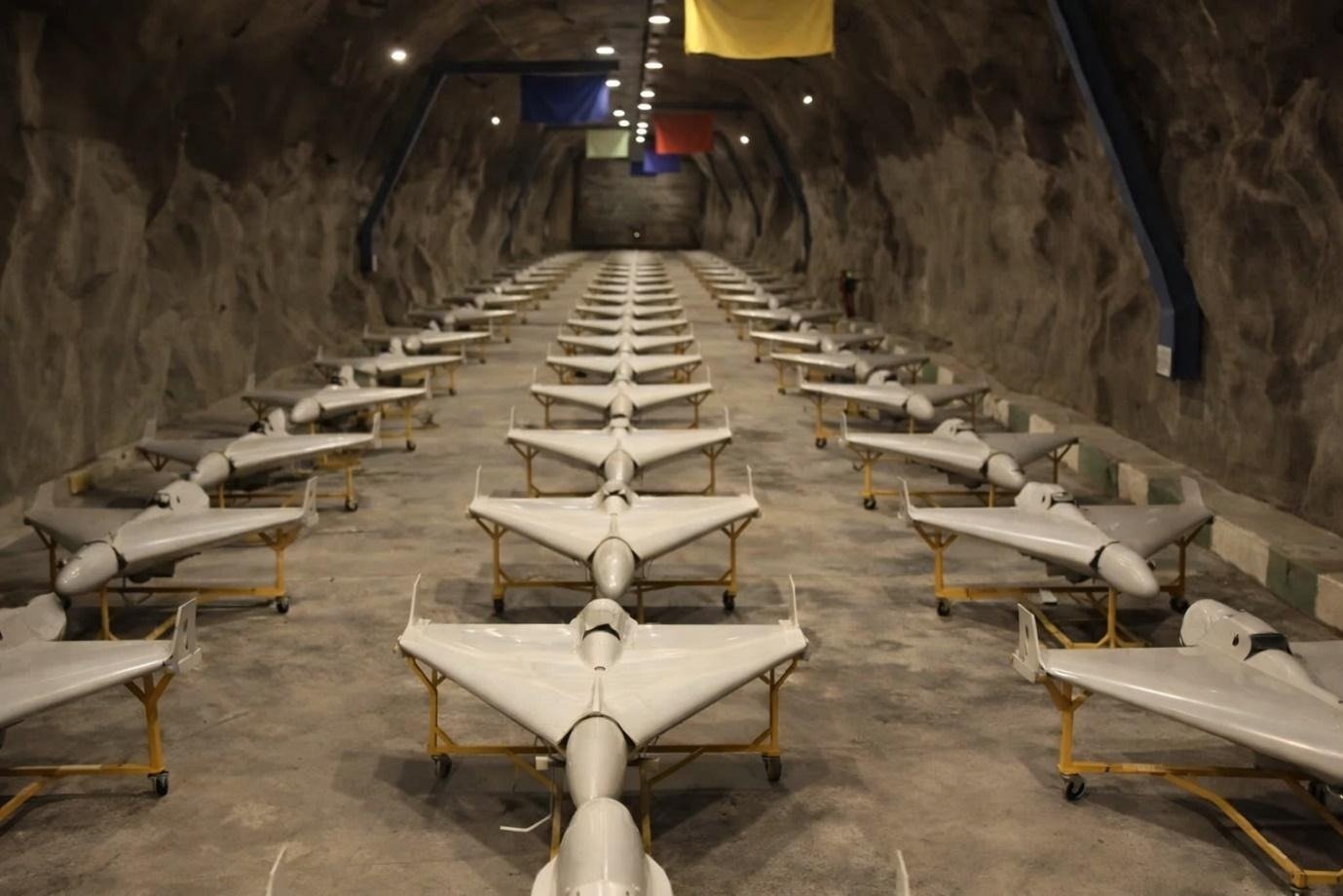
To prepare for such an environment, several strategic priorities emerge:
- Scalable Production of Key Weapon Systems
Future conflicts will require the ability to produce and deploy critical systems in large numbers, including:
- Cost-effective loitering and kamikaze drones
- Medium-range rocket artillery systems
- Cruise missiles and ballistic missiles
- Missile interceptors for air defence
Mass production capability is essential to sustain long conflicts and overwhelm adversary defences when required.
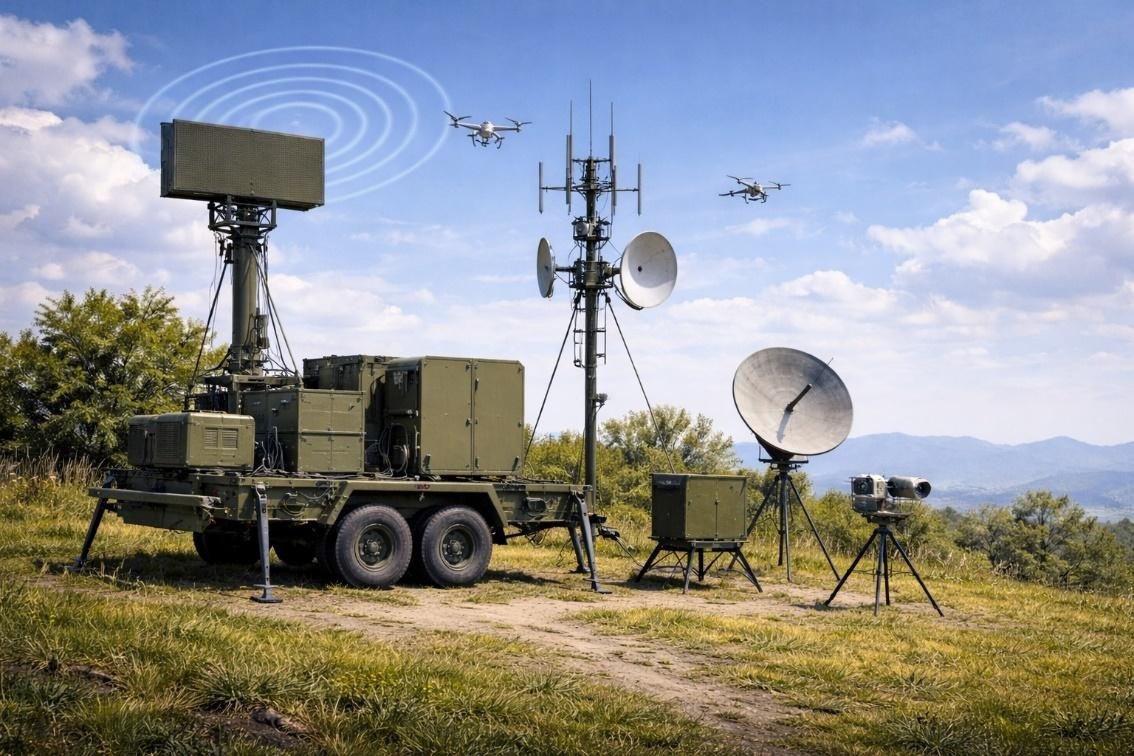
- Strengthening Air Defence and Counter-Drone Systems
Protecting critical infrastructure will require robust and layered air defence networks supported by:
- Radar systems
- Passive RF detection technologies
- Effective jammers
- Comprehensive counter-drone solutions
- Integrated missile interception systems
Recent conflicts in West Asia highlight the growing importance of precision weapons and layered defence systems. Precision cruise missiles, long-range air-to-air missiles, and large numbers of low-cost rockets and drones have been used to overwhelm air defence networks
Civilian and strategic installations must be prioritised based on their national importance.
- Advancing Electronic and Cyber Warfare Capabilities
Electronic warfare and cyber operations are now central components of modern conflict. Disrupting enemy communications, navigation systems, and digital infrastructure can significantly degrade operational capability without direct kinetic engagement. Further, countries should have effective protection systems in place against enemies’ cyber attacks and deny the enemy the ability to leverage electronic spectrum to their advantage.
- Building a Resilient Defence Industrial Base
A geographically diversified manufacturing ecosystem is essential to maintain production during wartime. This includes:
- Distributed manufacturing facilities
- Strategic bunker storage for weapons and ammunition
- Secure supply chains for critical components
- Building airstrips and rail networks wherever needed to support military logistic requirements
Encouraging capable private enterprises to participate in defence production can significantly enhance national capacity. A quick rethink to expedite licensing and remove bureaucratic bottlenecks is a necessity.
- Investing in Emerging Technologies
Future investments should focus on next-generation technologies such as:
- Directed energy weapons (DEW)
- Advanced electronic warfare systems
- Autonomous and AI-enabled platforms
- High-power laser-based defence solutions
- Camouflage and concealment with Radar and Thermal absorption capabilities
A major lesson from regional conflicts is their global economic impact. When wars involve missile exchanges and disruptions to strategic infrastructure, the consequences extend well beyond the immediate combatants. Modern wars can create significant disruptions to energy supplies, logistics, and global markets
Rapid research, development, and production cycles will be essential to maintain technological superiority.
- Ensuring Strategic Resilience
Modern wars can create significant disruptions to energy supplies, logistics, and global markets. Nations must therefore take steps to ensure smooth functioning for sustained, prolonged conflicts.
Conclusion
Recent conflicts across different regions have revealed that warfare is no longer confined to traditional battlefields or limited by geography. Precision strike capabilities, unmanned systems, cyber warfare, and economic pressure have fundamentally reshaped the character of war.
Success in future conflicts will depend on technological superiority, industrial capacity, resilient infrastructure, and the ability to operate across multiple domains simultaneously. Nations that adapt their doctrines, invest in modern capabilities, and build scalable defence industries will be better prepared for the challenges of the next generation of warfare.

Wing Commander Harikumar is an Indian Air Force veteran with 22 years of expertise spanning radar systems, aircraft maintenance, and aircrew. After taking voluntary retirement in 2018, he transitioned to the defence industry, leading international business development and strategic partnerships. He is currently President – International Business at BBBS Pvt Ltd with extensive global defence market exposure.
