

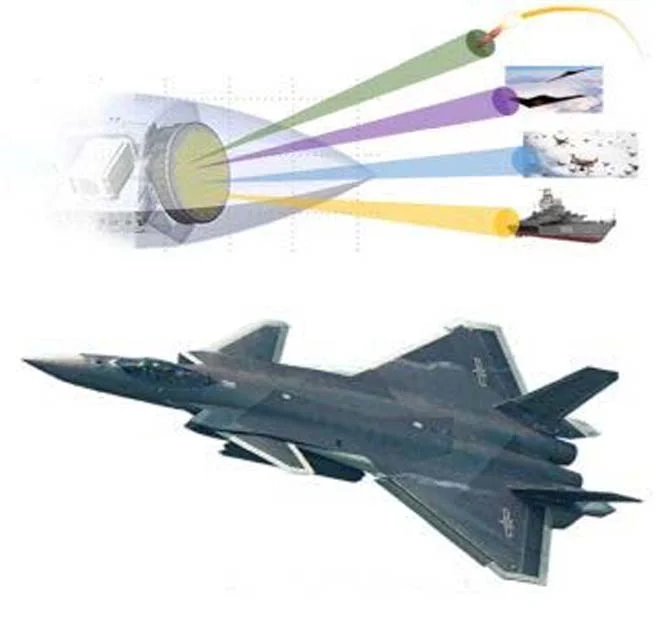
New Delhi: DRDO has made significant progress in Photonic Radar development and would soon realise the integrated Photonic Transmit Receive modules along with Photonic Distribution Network. Photonic Radar can detect stealth objects with better accuracy than traditional radars.
Photonic Radars uses a photonic system to generate much higher bandwidth signals, enabling radar that can detect smaller objects more precisely, and even be used to monitor patient vital signs in hospitals. Radar works by beaming radio frequency signals out and analysing how they bounce back, revealing the location, shape and speed of an object of interest, like a plane. Frequencies of a few hundred megahertz are most commonly used, which return images with a resolution on the scale of meters.

Using higher frequencies could allow radar to capture finer detail, but that also widens the bandwidth. This requires far more powerful signal processing, in turn blowing out the cost and complexity of the system.
Photonic radar can help solve that problem. This technology still beams out microwaves, but the signals are generated and processed using lasers instead, giving them a much higher frequency over a wider bandwidth
In the new study, the researchers developed an advanced photonic radar system that produced signals with a bandwidth of 11 GHz, centred on the frequency of 34 GHz. Importantly, the electronic components driving this operate at frequencies of just 40 to 80 MHz, keeping the system’s requirements simple. The resulting radar images have a much finer resolution, down to just 1.3 cm (0.5 in).
In tests, the photonic radar was able to image small objects, measuring just 3 x 4 cm (1.2 x 1.6 in), as they moved on a rotating plate. In another, the researchers imaged a commercial drone, and were even able to see the blades as they spun. In addition to the usual object detection that radar is used for, the team says that the new photonic radar could also be used as a non-invasive way to monitor patient vital signs, such as breathing and heart rate. Ultimately, the device could fit onto a photonic chip that’s small enough to incorporate into electronic devices like a smartphone.

Next up, the team plans to test the new system on cane toads and eventually humans.

