

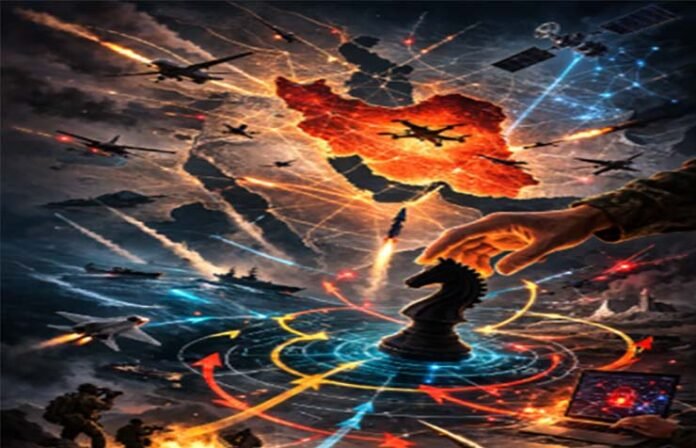
Modern warfare no longer rewards mass alone. For much of the twentieth century, armies aimed for victory through overwhelming firepower and sustained destruction. That approach reflected the industrial age, when production capacity and the ability to mobilise large forces decided the outcome of wars.
The modern battlespace is different. Precision weapons, persistent surveillance, non-kinetic warfare, and networked command systems have made agility and manoeuvre warfare far more crucial. The evolving Middle East conflict reflects this reality.

After US–Israeli strikes aimed at decapitating key assets, Iran’s response revealed a system built to withstand such shocks. Through dispersed command structures, regional allies, and what Iranian strategists call Mosaic Defence, operational authority shifted outward when the centre was hit.
The war thus spread rather than collapsed. Instead of seeking a decisive victory through destruction, the conflict became a contest of endurance and dispersed pressure. In this emerging model of manoeuvre warfare, resilience, dispersion, and the ability to sustain prolonged costs while targeting multiple vulnerabilities of the US became far more decisive.
Despite overwhelming technological superiority, attritional pressure has struggled to cause systemic collapse. Iran, though weaker materially, has maintained operational resilience by exploiting dispersion, mobility, and multi-domain disruption. The broader lesson is hard to ignore. In the twenty-first-century strategic environment, manoeuvre warfare offers a more adaptable and enduring framework than traditional attrition warfare.
Attrition warfare originated from the twentieth-century industrial mindset. Industrial capacity, logistical support, and sustained firepower determined the pace and outcome of campaigns. Even today, attrition remains appealing for technologically advanced powers.

Advanced intelligence networks, satellite reconnaissance, and precision weapons allow for systematic targeting of an opponent’s military infrastructure. Missile depots, radar networks, air defence batteries, and logistical hubs can be targeted repeatedly without deploying large ground forces. This approach lowers political risk while maintaining ongoing pressure.
The modern battlespace is different. Precision weapons, persistent surveillance, non-kinetic warfare, and networked command systems have made agility and manoeuvre warfare far more crucial. The evolving Middle East conflict reflects this reality
Yet, attrition contains an inherent vulnerability. It assumes that the adversary’s military system is sufficiently concentrated and identifiable for systematic destruction. When an opponent deliberately disperses its capabilities and decentralises command authority, the attritional cycle becomes far less effective. Strikes may destroy individual assets, yet the broader operational system remains intact.

Iran’s strategic posture exemplifies such adaptation. Over the past four decades, Tehran has intentionally developed a military structure aimed at complicating attritional targeting. Command authority is distributed among multiple operational nodes. Missile systems are mounted on mobile platforms instead of fixed silos. Drone units operate from scattered locations rather than large airbases. Even command facilities are often hardened or buried underground.
The objective is not to defeat a technologically superior adversary through conventional confrontation. Instead, it is to deny the adversary an ability to impose decisive results. By spreading risk across numerous nodes and maintaining mobility, Iran reduces the strategic impact of precision strikes. Damage occurs, yet the overall military system survives.
This approach reflects the core logic of manoeuvre warfare. Manoeuvre warfare is a state of mind bent on shattering the enemy morally and physically by paralysing and confounding him, by avoiding his strength, and aggressively exploiting his vulnerabilities.
Rather than seeking the physical destruction of every enemy formation, the manoeuvre aims to fracture the coherence of the adversary’s operational system. Speed, unpredictability and dispersed initiative create dilemmas for the opponent’s command structure. Resources are misallocated, responses become reactive, and the operational picture grows increasingly uncertain.
After US–Israeli strikes aimed at decapitating key assets, Iran’s response revealed a system built to withstand such shocks. Through dispersed command structures, regional allies, and what Iranian strategists call Mosaic Defence, operational authority shifted outward when the centre was hit
In the contemporary battlespace, this logic is strengthened by the emergence of the “kill web” concept within multi-domain operations. Unlike the traditional kill chain, which follows a linear process of detection, identification, and engagement, a kill web links sensors, decision nodes, and strike platforms across multiple domains.
Information flows through a distributed network rather than a single hierarchy. This setup enables forces to identify, track, and engage targets dynamically from multiple directions. As a result, the adversary faces pressure from multiple domains simultaneously, often before a coherent response can be organised.
Iran’s operational behaviour increasingly reflects elements of this distributed logic. Iranian missile forces, maritime units, drone operators, and regional proxy networks operate across a broad geographic area while contributing to a common strategic goal.
The result is fragmented but ongoing pressure that forces technologically advanced adversaries to be dislocated by rapidly emerging situations along multiple fronts. Neither side wins nor loses, but for Iran, not losing is winning, and for the US, not winning is losing.
Despite overwhelming technological superiority, attritional pressure has struggled to cause systemic collapse. Iran, though weaker materially, has maintained operational resilience by exploiting dispersion, mobility, and multi-domain disruption. The broader lesson is hard to ignore
Seen in this broader context, Iran’s strategy becomes easier to understand. Tehran recognises that direct confrontation with the United States would favour American technological dominance. Instead, it expands the battlespace across various domains and regions.
Maritime harassment in the Gulf, missile launches, drone operations, and regional proxy networks collectively extend the operational environment. Iranian-backed groups operating from Lebanon, Iraq, and Yemen further increase this dispersed pressure, forcing adversaries to monitor multiple theatres simultaneously.
The strategic goal is endurance rather than immediate battlefield victory. By pushing a stronger adversary into a fragmented and prolonged conflict, Iran increases the economic, political, and psychological costs of continuous engagement. This leads to the US strategic fatigue and political discontent. The global credibility of a superpower and its role as a net security provider in the Gulf lies exposed.
Within manoeuvre warfare, non-kinetic actions serve as powerful instruments of dislocation. Cyber intrusions can delay decision-making or corrupt targeting data. Electronic warfare can blind surveillance systems or disrupt communications between units. Information operations can erode public support or create confusion about the true state of the battlefield.
When combined with kinetic actions such as missile or drone strikes, these methods generate multidimensional pressure. The adversary is forced to respond simultaneously to physical attacks, network disruptions, and information shocks. The cumulative effect is operational paralysis rather than simple destruction.
Doctrinal adaptation must therefore accompany technological modernisation. Networked surveillance, precision strike capabilities, and joint operations are essential, but they must be integrated within a manoeuvrist mindset
For India, the implications of these developments are significant. The future battlefield will be characterised by dispersed forces operating within an information-rich environment. Surveillance systems will quickly detect movement, and precision weapons will target static concentrations. In such conditions, rigid force structures become liabilities.
The traditional doctrine of defence and firepower based on attrition needs to be replaced with one focused on dislocation, denial, and domination. Deterrence by punishment is insufficient unless it causes dislocation- physical and psychological- to induce paralysis. It is not enough to counter the enemy’s strength with more strength; it is wiser to identify their key vulnerabilities and strike at those decisive points.
India’s strategic geography underscores the importance of manoeuvre thinking. Threat zones extend from the Himalayan frontier to the Line of Control and the maritime chokepoints in the Indian Ocean.
Each environment demands mental agility rather than static deployment. The maritime front is particularly suited for manoeuvre warfare, which influences the mind through strategic dislocation rather than physical presence.
Doctrinal adaptation must therefore accompany technological modernisation. Networked surveillance, precision strike capabilities, and joint operations are essential, but they must be integrated within a manoeuvrist mindset.
In such an environment, victory will favour forces that can manoeuvre across domains, fracture an opponent’s cohesion, and reshape the battlespace faster than the adversary can adapt
Units must be capable of operating independently while remaining connected to a broader operational network. Thus, functional commands must find favour over integrated theatre commands.
The development of resilient command systems is equally important. Distributed decision nodes, redundant communication networks and cross-domain integration will reduce vulnerability to precision strikes or cyber disruption.
The directive style of command is central to command in manoeuvre warfare. The leadership traits of an offensive mindset and a belief in success, rather than fear of failure, are essential.
For rising powers such as India, the challenge lies not just in acquiring advanced weapons but in developing doctrines capable of effectively utilising them. Military power in the twenty-first century will depend less on sheer volume and more on the ability to control tempo, information, and operational surprise.
In a world where sensors see farther, missiles travel faster, and networks connect every domain of the battlefield, the ability to dislocate the enemy has become more valuable than the ability to destroy him.
In such an environment, victory will favour forces that can manoeuvre across domains, fracture an opponent’s cohesion, and reshape the battlespace faster than the adversary can adapt.

The author, a PVSM, AVSM, VSM has had an illustrious career spanning nearly four decades. A distinguished Armoured Corps officer, he has served in various prestigious staff and command appointments including Commander Independent Armoured Brigade, ADG PP, GOC Armoured Division and GOC Strike 1. The officer retired as DG Mechanised Forces in December 2017 during which he was the architect to initiate process for reintroduction of Light Tank and Chairman on the study on C5ISR for Indian Army. Subsequently he was Consultant MoD/OFB from 2018 to 2020. He is also a reputed defence analyst, a motivational speaker and prolific writer on matters of military, defence technology and national security. The views expressed are personal and do not necessarily carry the views of Raksha Anirveda
