

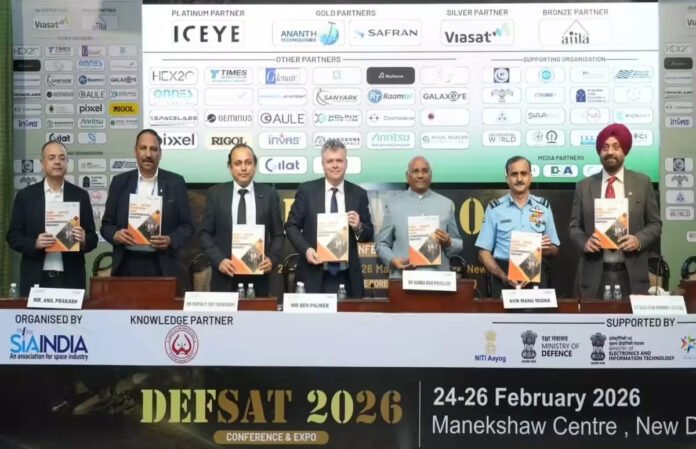
New Delhi. In modern warfare, Space is fast emerging as the backbone. Thus, the focus on orbital security, cyber–space integration, resilient defence architecture and industrial scale gains importance to strengthen India’s security posture. The success of last three editions has positioned DEFSAT as a defining platform accelerate dialogue on defence modernisation and India’s expanding space ambitions.
The DEFSAT 2026 (February 24-26) on its inaugural day witnessed an unprecedented turnout with 600 registered military leadership, government officials, diplomats, global industry representatives, startups, academia, and strategic experts. The scale and diversity of participation showed wider resonance of its theme – “Space at the Core of National Security” and reflected a shared recognition: space is foundational to defence planning. Being held at the Manekshaw Centre, the three-day conference and exposition foreground a critical strategic reality: an estimated 70–80% of modern military operations today rely on space-based capabilities, underscoring the rising centrality of space in India’s national security architecture.

“Scale follows utilisation certainty. When government procurement creates predictable, multi-year demand for satellite communications, mobility bandwidth, disaster-response capacity, and Earth observation analytics, industry gains the confidence to invest in production, automation, and workforce expansion. Predictable demand, replicated suppliers, and deeper industrial discipline, that is how mission excellence becomes industrial scale,” remarked Dr Subba Rao Pavuluri, President, SIA-India.
Lt Gen (Dr) P J S Pannu (Retd.), Chairman, Defence Space Committee, SIA-India, framing the issue in operational terms, stated, “Future conflicts will be fought beyond physical battlefields — in space, cyber, and the invisible spectrum. As proxy wars and non-contact warfare expand across regions, space assets will become both the greatest enablers of security and the most contested targets. The nations that secure and protect their space capabilities today will define the balance of power tomorrow.”
“Space is no longer a distant frontier or a symbol of technological prestige; it is the decisive high ground of modern warfare and national power. The nation that secures its interests in orbit safeguards its sovereignty on Earth. From precision strikes to real-time intelligence, from secure communications to strategic deterrence, every critical function of modern defence now depends on resilient space capability. If we fail to protect and strengthen our space architecture, we risk strategic blindness and operational paralysis. In the 21st century, safeguarding space is not an option, it is a national imperative,” emphasised AVM Manu Midha, Director General, Defence Space Agency (DSA).

Noting the scale of engagement at DEFSAT 2026, a senior representative from the Chief of Integrated Staff Committee (CISC), said, “Assured access to space, protection of orbital assets, and rapid reconstitution capability must form the backbone of India’s defence preparedness. DEFSAT reflects a collective understanding of this strategic imperative.”
Dr Vinayak Godse, CEO, Data Security Council of India (DSCI), highlighting the cyber dimension, added, “Orbital assurance has become a core pillar of national security. Our economy, military preparedness, and digital transactions are deeply dependent on space-enabled infrastructure. As digitalisation accelerates, securing the space–cyber continuum is not optional — it is foundational to strategic stability.”

Addressing the opening plenary session at the DEFSAT 2026 conference, Ben Palmer, President of Viasat Commercial, said, “Without assured, resilient global SatCom, we would all be in dark. Societies cannot function without reliable access to space.” He described satellite communications as the “dual use oxygen” that supports missions ranging from weather forecasting to early warning systems and highlighted the strategic importance of assured spectrum access and resilient satellite communications.
Palmer underscored the role of these technologies in safeguarding national security and sustaining economic stability. Stressing on the necessity of assured connectivity across alternate orbits and radio frequency bands, he said, “We’re looking at ways to ensure govts have access to assured connectivity via alternate orbits and alternate radio frequency spectrum. We are innovating to deliver cyber and EW resilience, access to different spectrum and new ways to deliver these key enabling capabilities.”
Acknowledging the Indian government’s approach to space sovereignty as “long term, strategic and wise, Palmer said that India’s resistance to market dominance by others in international fora helps maintain freedom of choice. “The grand strategic approach which the Govt of India is adopting to assure its space sovereignty is impressive. This isn’t just about ‘Make in India’ and assuring freedom of operation, it’s also about the responsible, pragmatic approach that India has adopted,” he said.
DEFSAT 2026, with record engagement across stakeholders, clearly demonstrates that space security is now firmly at the core of India’s strategic, technological, and industrial future. Over the next three days, the DEFSAT Exposition will emerge as a major technology showcase, reflecting the breadth of capabilities across the Indian and global space ecosystem, with participation from over 30 industry stalwarts including ICEYE, Ananth Technologies, Safran, Viasat, Aiila Innovations, GalaxEye, Pixxel, Times Microwave Systems, SkyServe, Aule Space, Sanyark Space Technologies, Agmatel, HEX20, Cosmoserve, Spacelabs, Onnes Cryogenics, Tantrayut Telecommunications Pvt. Ltd., RDVW Support, Chipspirit, Rigol Technologies, Glenair Inc., Anritsu India Pvt. Ltd., Raamtel Solutions Pvt. Ltd., Apical Telecom, Geminus Space, Rangsons Aerospace Pvt. Ltd., Invas Tech, and XDLINX Space, among others.
Anil Prakash, DG, SIA-India, commented, “This year’s theme, “Space at the Core to National Security,” will provide timely direction and insight, and will meaningfully contribute to strengthening India’s journey as a defence space powerhouse to Aatmanirbharta and Viksit Bharat. With over 90 distinguished speakers leading 12 engaging panel discussions, DefSAT-2026 will undoubtedly enrich our collective understanding and further strengthen collaboration across the defence-space ecosystem.”
Supported by several key strategic and institutional partners, including Centre for Land Warfare Studies as a knowledge partner and NITI Aayog, Ministry of Electronics and Information Technology, Government e-Marketplace (GeM), CERT-In, National Maritime Foundation, ELCINA, T-Hub, Geospatial World, Aeronautical Society of India, Astronautical Society of India, and Research and Information System for Developing Countries among other supporting partners, DEFSAT 2026 on its opening day emphatically made it clear that space security is a central pillar to India’s strategic, technological and industrial future.

