

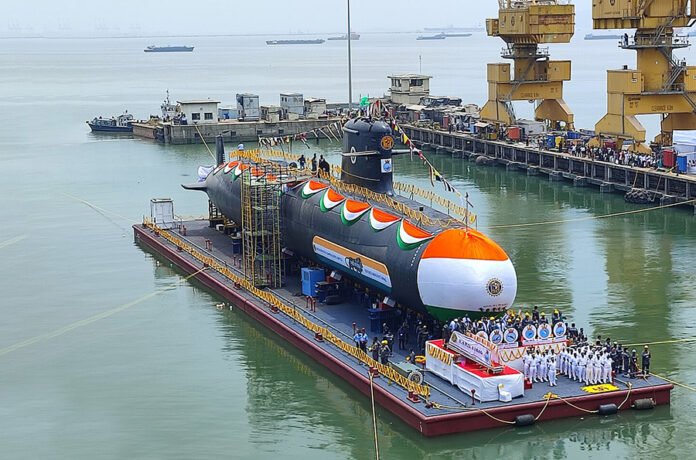
New Delhi: Initiating the process to acquire submarine-launched land attack cruise missiles (LACMs) for Indian Navy’s conventional submarine fleet, the defence ministry has issued a Request for Information (RFI) earlier this month. The RFI seeks industry responses for missiles capable of engaging land targets at ranges from a minimum of 50 km to beyond 500 km, with high accuracy and survivability. The missile is required to be compatible with standard 533 mm torpedo tubes used by the Navy’s existing conventional submarines and weigh under 1,500 kg, including the launch capsule.
The RFI document points out that the missile required is intended to provide “long range strike capability against land targets” and should be capable of engaging targets “with high probability of kill” while being launched from conventional submarines. It further specifies that the missile should be capable of operating in contested environments, including GPS-denied conditions, and incorporate terrain-following capability, waypoint navigation and anti-jamming features.

Currently, the Navy’s conventional submarines are equipped with submarine-launched anti-ship cruise missiles such as the Russian-origin Klub system and the SM39 Exocet, designed primarily for maritime strike roles. However, it does not have an operational submarine-launched land-attack cruise missile capability for engaging targets ashore, which the present requirement seeks to address.
Based on the Nirbhay cruise missile platform, the Defence Research and Development Organisation (DRDO) is working on an indigenous submarine-launched cruise missile (SLCM) programme. The missile, being developed in land-attack and anti-ship variants, underwent a developmental trial from an underwater platform in February 2023, covering about 402 kilometres. The test was aimed at validating critical underwater launch processes such as wing deployment after surfacing and engine start during flight.
According to sources in the defence and security establishment, the SLCM has been designed for compatibility with the Navy’s existing Sindhughosh (Kilo)-class and Kalvari-class submarines, while also keeping future platforms under Project-75I and the planned nuclear-powered attack submarine programme under Project 76 in view. The effort, they said, is to retain a common launch system across submarine classes rather than develop platform-specific solutions. The missile is likely to be lighter than the baseline Nirbhay system and is expected to cruise at subsonic speeds while carrying a payload of about 250 kilograms, including penetration-cum-blast or airburst warhead options, they added.
The SLCM’s navigation is expected to rely on inertial and satellite guidance during the mid-course phase, with terminal guidance through an RF seeker. The missile uses a two-stage configuration, with a solid rocket booster for launch followed by a turbofan engine for sustained cruise flight. DRDO is aiming to deliver the missile around 2028–2029, with its projected range broadly aligning with the Navy’s requirement for a long-range land-attack capability, the sources said. “The Navy is also exploring the possibility of integrating the indigenous missile with upcoming Project-75I submarines, though final integration will depend on platform-specific trials and certification,” the source added.


