

New Delhi: Ahead of the Defence Acquisition Council’s (DAC) scheduled meeting on February 12 under the chairmanship of Defence Minister Rajnath Singh, the Ministry of Defence (MoD) on February 10 put out a formal draft to revamp the defence acquisition procedure (DAP).
According to the MoD, the proposed draft aims to align India’s defence acquisition with the rapidly evolving geo-strategic landscape, growth of Indian economy, skilling of human capital, growth of private defence industry in the country and the technological imperatives of modern warfare. The draft would look to propel jointness, self-reliance, force modernisation, speed up the process of acquisition and scale up production by domestic industry.

In addition, the ministry has sought comments from industry and stakeholders.
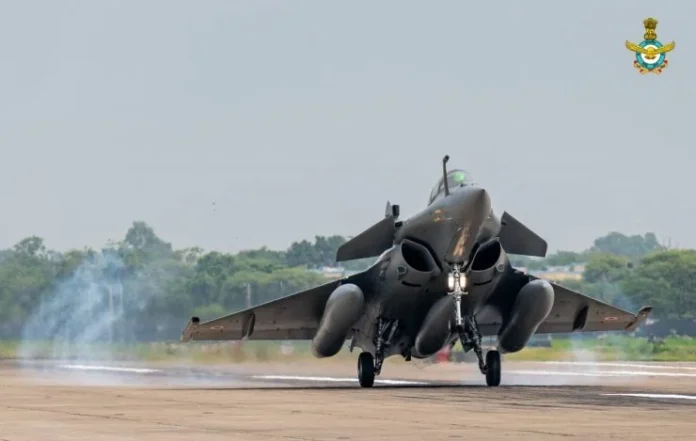
The Defence Acquisition Council (DAC) is expected to take a call on sourcing 114 Rafale fighter jets from France in today’ meeting. Separately, in a push towards latest technology, the DAC is also expected to approve long-endurance ‘pseudo satellites’ for surveillance.
It may be noted that last month, the Defence Procurement Board, headed by the Defence Secretary Rajesh Kumar Singh, had approved the proposal to acquire 114 Rafale fighter jets from French plane maker Dassault. The Cabinet Committee on Security, chaired by Prime Minister Narendra Modi is expected to give a final nod on the proposal.
During the upcoming meeting between Prime Minister Modi and French President Emmanuel Macron, who will be in India from February 17 to 19, India and France are looking to seal the deal for the fighter jets.

The Indian Air Force had moved the formal proposal to the Ministry of Defence in September last year, seeking 114 more Rafale jets as part of its multi-pronged plan to expand its fleets of fighter jets. The IAF already flies 36 Rafale jets, while the Navy has ordered 26 marine variants of the same jet. Increasing its numbers would also reduce the maintenance costs. At the IAF base in Ambala, a Rafale flight training, and maintenance, repair and overhaul (MRO) facility is operational and the Air Force has the capacity – space, spares, tooling and trained manpower — to immediately take-in two squadrons.
To be acquired under a ‘Make in India’ scheme, Dassault Aviation partnering with an Indian firm, will integrate Indian weapons, missiles and ammunition on all 114 jets and provide secure data links to allow digital integration of these jets with Indian radars and sensors sending imagery to ground-based controllers. Dassault Aviation, the French manufacturer will also provide transfer of technology (ToT) for making air frames. Its suppliers, including engine maker Safran and avionics provider Thales, will also be a part of the ToT. Consequently, the indigenous content in these jets is expected to be between 55 per cent and 60 per cent once the transfer of technology for air frames, engines and avionics is completed.

According to sources, the DAC is also looking at solar- powered High-Altitude Pseudo Satellite Vehicle (HAPS) – a high-end version of an unmanned aerial vehicle (UAV) that can operate in the stratosphere for long duration for surveillance and reconnaissance. It can operate at an altitude of about 20 km, much higher than the flight path of commercial planes. While the DRDO and Bangalore-based NewSpace Research and Technologies (NRT) have their respective versions, the National Aerospace Laboratories (NAL) has already tested one.

