

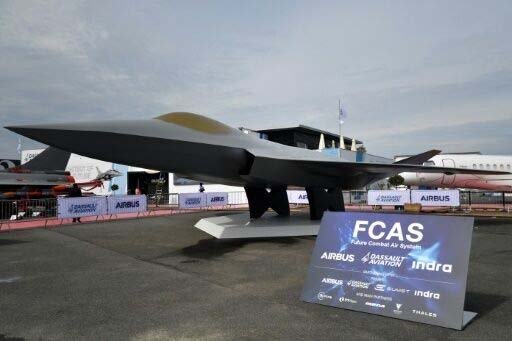
Paris: Airbus is open to a “two-fighter solution” to break the deadlock on the future air-combat system that France, Germany and Spain are developing, Chief Executive Officer Guillaume Faury said, as work on the next-generation fighter (NGF) that’s part of the programme has stalled amid infighting between Airbus and Dassault Aviation.
The Future Combat Air System programme, or FCAS, is at “a difficult junction,” Faury said at the Airbus full-year earnings press conference in Toulouse, France, on February 19. Work is divided into multiple areas, and Faury said other than the future fighter segment, other pillars such as the combat cloud, remote drone carriers and engine are “working well and making good progress.”

“The deadlock of a single pillar should not jeopardise the entire future of this high-tech European capability, which will bolster our collective defence,” Faury said. “If mandated by our customers, we would support a two-fighter solution, and are committed to playing a leading role in such a reorganised FCAS delivered through European cooperation.”
The programme for a sixth-generation air combat system, first announced in 2017, has been dragging for years amid disputes over work share, leadership and issues around technology transfer.
Frustrations have mounted recently as a deadline by France and Germany to clarify the programme’s future by the end of 2025 slipped by without an announcement.
There are also questions “under a certain governance, on the ability to reach the objective of the program for the different customers,” according to Faury, who said it’s up to the programme clients to comment on the that issue.

German Chancellor Friedrich Merz said in an interview this week his country doesn’t currently need the same aircraft as France. Officials in Paris have stated from early on in the project that the nation requires a fighter able to operate from an aircraft carrier and fire nuclear weapons to ensure sovereign capabilities.

