

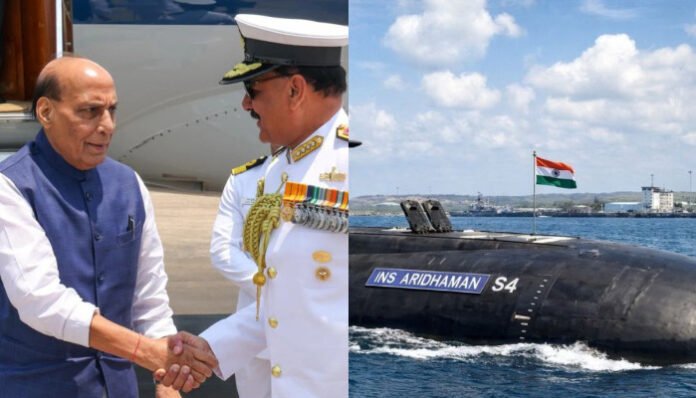
New Delhi: India’s maritime strength got a massive boost with the induction of the nation’s third nuclear-powered ballistic missile submarine (SSBN) and the fourth ship of Nilgiri class advanced stealth frigate INS Taragiri at separate functions presided by Defence Minister Rajnath Singh in Visakhapatnam.
The induction of Aridhaman significantly strengthens the nation’s sea-based nuclear deterrent capabilities.

The INS Aridhaman (SSBN 82) designated S4 Strategic Strike Nuclear Submarine is a 7,000-tonne vessel which was built under the Advanced Technology Vessel (ATV) project at the Ship Building Centre in Visakhapatnam. It is an upgraded variant of the Arihant-class submarine.
The submarine which was launched in 2021 has one seven-blade propeller powered by a Compact Light Water Reactor (CLWR). It can achieve a maximum speed of 12–15 knots (22–28 km/h) when on surface and 24 knots (44 km/h) when submerged. The CLWR is an upgraded form of the one that powers INS Arihant. The CLWR has exceptionally lower acoustic signature than the previous generation making it harder to detect by enemy vessels along with longer endurance.
The submarine has eight VLS tubes in its hump, as compared to four on her predecessors—INS Arihant, the lead ship of the class, and INS Arighaat. She can carry up to 24 K-15 Sagarika missiles (each with a range of 750 km, eight K-4 missiles (with a range of 3,500 km or K-5 missiles (with range of 6,000 km.
India’s nuclear-powered submarine project was initiated more than three decades ago, involving both private firms and Defence Research and Development Organisation with Russian help.

INS Taragiri was formally classified as the Project-17 Alpha Frigates (P-17A) built by Mazagon Dock Shipbuilders.
The battleship named after the Taragiri hill range in the Indian state of Uttarakhand, has been named after a Leander-class frigate which was in service with the Indian Navy between 1980 and 2013. The ship was laid down on September 10, 2020 and was launched on September 11, 2022.

The ship was initially expected to be commissioned in February 2026 but was later scheduled to April 3, 2026.

