

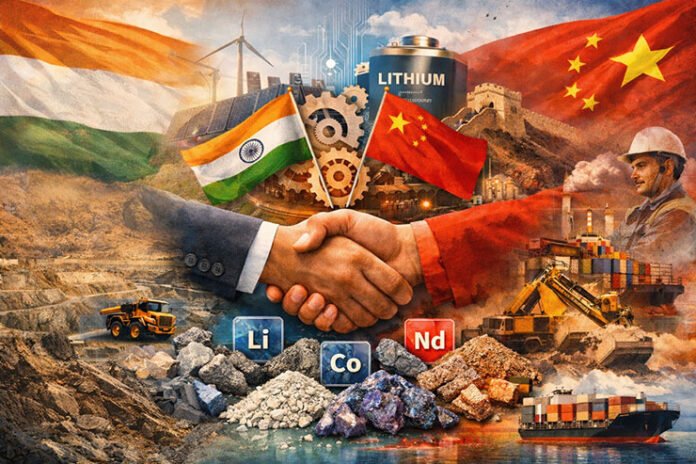
Critical minerals such as lithium, cobalt, nickel, graphite, and rare earth elements are indispensable for the energy transition. They fuel electric vehicles (EVs), battery storage, wind turbines, solar panels, and advanced electronics. The International Energy Agency’s (IEA) Global Critical Minerals Outlook 2025 reports that in 2024, lithium demand surged nearly 30%, far outpacing the 10% average annual growth of the 2010s, while nickel, cobalt, graphite, and rare earths grew 6-8%. This surge stems largely from energy applications, with the sector accounting for 85% of demand growth in battery metals.
Projections are stark: under stated policies, lithium demand could rise fivefold by 2040, graphite and nickel doubling, cobalt and rare earths increasing 50-60%, and copper facing a potential 30% supply shortfall by 2035 due to limited new projects, declining ore grades, and long lead times. By 2030, demand pressures could intensify further, with EVs driving much of the growth. In a world racing towards net-zero, secure and diversified supplies are essential to avoid shortages, price volatility, and stalled climate progress.

China accounts for 60-86% of refined supply for key minerals by 2035 projections, including over 60% for lithium and cobalt, and around 80% for battery-grade graphite and rare earth elements. In 2024-2025, China controlled over 90% of rare earth processing, 95% of battery-grade graphite, and significant shares in cobalt (77% processing) and lithium refining
China’s Enduring Dominance in Supply Chains
China maintains overwhelming control over critical mineral processing and refining. According to IEA data and related analyses, China accounts for around 60-86% of refined supply for key minerals by 2035 projections, including over 60% for lithium and cobalt, and around 80% for battery-grade graphite and rare earth elements. In 2024-2025, China controlled over 90% of rare earth processing, 95% of battery-grade graphite, and significant shares in cobalt (around 77% processing) and lithium refining.
This dominance extends to magnets, with China producing 94% of rare earth permanent magnets. Export restrictions have highlighted leverage: measures in 2025 targeted rare earths, processing tech, gallium, germanium, and others, though some (like October 2025 expansions) were suspended until late 2026 amid diplomatic pauses following the US-China engagements. Earlier curbs on gallium, germanium, and antimony to the US were also paused for a year from late 2025. These actions underscore how concentrated supply chains can become geopolitical flashpoints, disrupting global markets and raising costs for importers.
India faces acute exposure, importing 80-90% of rare earth magnets and related materials, mostly from China, with imports valued at hundreds of millions annually. Domestic EV and renewable targets amplify needs: battery and magnet demand is set to double or more by 2030, supporting 30% EV penetration goals and non-fossil fuel capacity ambitions
India’s Vulnerabilities and Bold Domestic Push
India faces acute exposure, importing 80-90% of rare earth magnets and related materials, mostly from China, with imports valued at hundreds of millions annually. Domestic EV and renewable targets amplify needs: battery and magnet demand is set to double or more by 2030, supporting 30% EV penetration goals and non-fossil fuel capacity ambitions.
Yet India holds substantial reserves, the world’s third-largest for rare earths at approximately 6.9 million tonnes (about 6-8% globally), behind China and Brazil. Recent assessments reveal 13.15 million tonnes of monazite containing 7.23 million tonnes of rare earth oxides across coastal and inland areas, plus 1.29 million tonnes in hard-rock deposits in states like Gujarat and Rajasthan.

Additional explorations by the Geological Survey of India have identified 482.6 million tonnes of rare-earth ore resources. Production, however, remains marginal — around 2,900 tonnes in 2024, less than 1% globally — due to technological gaps, regulatory delays, and limited private investment. To bridge this, India launched the National Critical Minerals Mission and expanded Khanij Bidesh India Limited (KABIL) for overseas assets. A ₹7,280 crore (about $802 million) scheme approved in late 2025 targets 6,000 tonnes per annum of integrated rare earth permanent magnet manufacturing, with production eyed by end-2026 or soon after.
Yet India holds substantial reserves of rare earths at 6.9 million tonnes (about 6-8% globally), behind China and Brazil. Recent assessments reveal 13.15 million tonnes of monazite containing 7.23 million tonnes of rare earth oxides across coastal and inland areas, plus 1.29 million tonnes in hard-rock deposits in states such as Gujarat and Rajasthan
Rare earth corridors are planned in Odisha, Kerala, Andhra Pradesh, and Tamil Nadu for mining, processing, and research. Diversification efforts include pacts with Brazil (February 2026 MoU on critical minerals and rare earths), France, Canada, Germany, and others for joint exploration, technology transfer, and supply security — explicitly aimed at reducing China dependence amid ongoing global ‘friend-shoring’.

The Risks of Pure Confrontation in a Finite World
While diversification is vital for strategic autonomy, framing critical minerals as a zero-sum rivalry with China risks mutual harm. Global demand outstrips supply growth in key areas, and environmental challenges in mining demand innovation. India’s exploding needs clash with China’s processing monopoly, but outright escalation could trigger shortages, inflate prices, and delay transitions for both. Recent suspensions of export curbs offer temporary relief, yet concentration persists. By 2035, China is projected to retain dominance in refined supplies, even as some mining diversifies (e.g., lithium top-three share falling below 70%).
A Pragmatic Path: Cooperation for Shared Resilience.
Cooperation could transform rivalry into synergy. Both nations confront common imperatives: surging demand, sustainable extraction needs, and recycling for post-2030 battery waste. China’s refining expertise and scale complement India’s reserves, massive EV/renewable market, and Global South diplomacy. Potential models include joint ventures in Africa (e.g., DRC cobalt, lithium projects) for shared investment and sustainable practices; technology exchanges for efficient processing and low-impact mining; co-developed recycling hubs; or bilateral forums with autonomy safeguards. Precedents in non-strategic trade suggest feasibility, perhaps via multilateral mechanisms, while India pursues diversification.
Tangible Mutual Gains and Global Benefits
For India, partnerships yield processing know-how, reduced import costs, and accelerated self-reliance. China gains stable access to India’s growing demand and mitigates Western diversification pressures. Globally, collaboration stabilises chains, curbs volatility, promotes equitable development in resource nations, and advances climate goals without bottlenecks.
Globally, collaboration stabilises supply chains, curbs volatility, promotes equitable development in resource nations, and advances climate goals without bottlenecks. As IEA projections warn of persistent concentration through 2035 and tensions after 2026 pauses, a zero-sum approach threatens progress
As IEA projections warn of persistent concentration through 2035 and potential tensions post-2026 pauses, zero-sum approaches threaten progress. India and China, as emerging giants with overlapping economic stakes, can choose a partnership. By transcending divides to jointly secure minerals, they foster innovation, stability, and a sustainable future for themselves and the world.
Conclusion
In the high-stakes arena of critical minerals, where demand for lithium, cobalt, nickel, graphite, and rare earths surges relentlessly — lithium potentially fivefold by 2040, graphite and nickel doubling, and copper risking a 30% shortfall by 2035 — the world cannot afford perpetual rivalry. China’s enduring dominance in processing (often exceeding 80-90% for key minerals) and recent export measures underscore the fragility of concentrated supply chains, yet partial suspensions and China’s own import dependencies reveal shared vulnerabilities. India, with its third-largest rare earth reserves and ambitious National Critical Minerals Mission, has rightly pursued diversification through pacts with Brazil (February 2026), Japan (exploration talks in Rajasthan), Germany, Canada, and others, while ramping up domestic processing via ₹7,280 crore schemes. These steps bolster strategic autonomy amid booming EV and renewable needs. Yet, as the IEA warns of persistent concentration and investment uncertainties, zero-sum competition risks shortages, volatility, and delayed climate progress. Pragmatic Indo-Chinese cooperation — through joint ventures in Africa, technology exchanges for sustainable mining and recycling, or bilateral mechanisms safeguarding autonomy — offers a superior path. India’s vast market and Global South ties complement China’s refining expertise, yielding mutual gains: reduced costs for India, diversified risks for China, and resilient global chains. In March 2026, with multilateral efforts like the US-led Critical Minerals Ministerial, including India, the moment is ripe. By transcending geopolitical divides to partner on minerals, India and China can drive innovation, equity, and a truly sustainable energy future — not just for themselves, but for the planet.

The writer is Special Advisor for South Asia at Parley Policy Initiative, Republic of Korea. He is a regular commentator on the issues of Water Security and Transboundary River issues in South Asia. The views expressed are of the writer and do not necessarily reflect the views of Raksha Anirveda
