
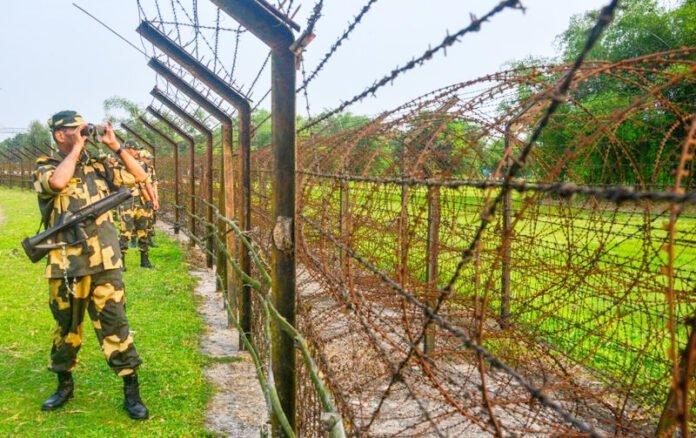
In an age when national security is represented by high-tech drones flying over rugged frontiers or 30-foot barbed-wire fences set up across barren landscapes, the threat does not exist on the border, but at the heart of the country. India’s porous borders with Bangladesh, Myanmar, Pakistan and Nepal have seen the entry of infiltrators who, once in the society, attempt to become part of the society, develop informal economies, construct identities, and use smuggling networks. This permeation does not follow a successful invasion. It takes the form of a complex internal security challenge that undermines economic stability, social harmony, and governance. With Prime Minister Narendra Modi reminding the citizens on the 2025 Independence Day that illegal infiltrators are stealing the bread and butter of the young generation and infringing on the tribal territories, a border management problem has become a national call to action. India needs a new approach to security: it needs to think less about responding to terrorist acts and more about safeguarding its internal security to ensure that the anti-national forces are eliminated.
The enormity of the situation is astounding. India’s 4,096-km-long border with Bangladesh in itself is a ferment of illegal crossings, made easier by riverine topography, thick forests, and colluding local systems. Hackers, once they cross the fence, become part of the city slums, rural economies, and even voters. According to intelligence reports, thousands of undocumented migrants use these routes every year, and they do so in the disguise of economic migrants but are related to organised crime. This has contributed to the demographic changes, ethnic polarisation and insurgency as witnessed in the 2008 Assam bombings, which were along ethnic lines as a result of groups using the weak border controls. The northeast frontiers with Myanmar provide an additional complicating element where the Free Movement Regime was suspended in 2024 to limit unregulated crossings, but the kinship connections between countries made this more difficult to enforce. These intrusions are not one-off events; they are the initial points of entry to a series of internal threats across the country.

The enormity of the problem is astounding. India’s 4,096-km-long border with Bangladesh is a ferment of illegal crossings, facilitated by riverine topography, dense forests, and colluding local systems. After crossing the fence, the hackers become part of the city slums, rural economies, and even voters
The symbiotic association of infiltration and informal economies lies at the centre of this internal security conundrum. Hackers usually find attractive unregulated areas, where money transfers and the absence of supervision are the ideal disguise. The cattle smuggled across the India-Bangladesh border, for example, is a multi-billion-rupee business. Syndicates smuggle thousands of cattle at night every year, often with the help of corrupt officials. This not only reduces local wages – pushing the Indian workers off the farms and jobs that require labour – but also finances larger criminal networks. Drug trafficking rings in Punjab are run by Pakistanis, using drones to drop weapons and narcotics, with annual seizures running over Rs 12,000 crore along the western and northeastern regions. The smuggling of fake Indian currency notes through the routes deactivates the formal economy, providing organised crime with possible terrorist connections. Since these activities take place in the informal sector that employs more than 80% of the Indian population, it becomes a breeding ground for such activities where infiltrators provide low-cost labour and drain resources destined for citizens.
Nepal and Myanmar human trafficking networks connect to sex trafficking and forced labour networks in metropolitan cities, and arms trafficking keeps insurgencies active in the Northeast. Smuggling of gold in the border regions of West Bengal, usually coupled with the cattle and weapons business, has provided illegal funds recycled into radicalisation movements
This economic complication is further complicated by the spread of fake identities, which makes infiltrators become ghost citizens who receive the services offered publicly without detection. Frauds with document forgery are also widespread: imitation of Aadhaar cards, PAN cards, voter IDs, even passports are copied with such simplicity and such frequency in border districts, which is becoming a common occurrence, most notably in Murshidabad in West Bengal. Audits have revealed tens of thousands of infiltrators who are enjoying subsidised food, healthcare and land allocations using these falsified documents. In Assam, the National Register of Citizens (NRC) roll call identified more than 1.9 million possible illegal immigrants, with decades-old forged records of residence. Verification is a Herculean endeavour due to ethnic and cultural closeness across borders, with the infiltrators mixing up with the locals, thus corrupting democratic procedures. This is not a simple administrative control; this is an open attack on national identity, giving the sleeper cells and espionage. Cases of illegal immigrants have been associated with other organisations such as Jamaat-ul-Mujahideen Bangladesh (JMB) and Lashkar-e-Taiba, who utilise these fabricated identities as carriers or informants to sensitive regions. This is also depicted in the Rohingya crisis, where the illegal refugees in Jammu live beside military installations giving red flags as to possible security violations. These dangers are increased by smuggling networks, which turn weaknesses on borders into those at a national level.
Nepal and Myanmar human trafficking networks connect to sex trafficking and forced labour networks in metropolitan cities, and arms trafficking keeps insurgencies active in the Northeast, including the United Liberation Front of Assam (ULFA). With the Act East Policy in Manipur, India has increased connectivity. However, it fuelled transnational crime, whereby infrastructure projects turned out to be channels of drug and weapon trafficking. Smuggling of gold in the border regions of West Bengal, usually coupled with the cattle and weapons business, has provided illegal funds recycled into radicalisation movements. These networks do not exist in isolation; they overlap with political complicity, as vote-bank politics in border states, protecting infiltrators, passing the cycle of exploitation and insecurity. There is no standardised policy in place to curtail this, as demonstrated by the disparity in crime patterns across borders, showing the necessity to adopt a specific approach to this other than a generic fencing approach.
To make matters worse, there is inadequate inter-agency coordination, leaving a gaping loophole in India’s security architecture. There are several stakeholders in border management, but silos still exist, and bureaucratic turf wars and outdated protocols make intelligence sharing difficult
To make matters worse, there is inadequate inter-agency coordination, leaving a gaping loophole in India’s security architecture. There are various stakeholders in border management, including the Border Security Force (BSF), the Intelligence Bureau (IB), the state police, and customs. The silos still exist, and it is the bureaucratic turf wars as well as outdated protocols that make intelligence sharing difficult. Integrated check posts are encouraged at the Land Ports Authority of India, yet there is a slow pace of implementation, particularly in responding to post-infiltration threats. As an example, although BSF takes the lead in physical security of the border, the inner agencies, such as the National Investigation Agency (NIA), have been unable to track down those who have entered the country after they have scattered. This fragmentation enables smuggling cartels to flourish with impunity, as in the unabated fake Indian currency notes and drug trafficking despite periodic crackdowns. The existence of ethnic affiliations in border communities further complicates the enforcement process as the local sympathies make the distinction between kinship and complicity hard to draw. Lacking the ability to coordinate smoothly, the vulnerabilities will only increase and the inner spaces will become the cocoon of anti-national factors.

To secure India’s future as the country marching towards Viksit Bharat by 2047, it is important to look inwards by ensuring not only solid boundaries but also systems that guard the homeland. A lack of action will allow these shadows to grow. It is high time to establish an integrated and beyond-the-border strategy
In response to this, India has to take an all-encompassing strategy that goes beyond boundaries and guarding. First, improve digital verification: introduce Aadhaar along with biometric border control, as well as AI-based anomaly detection that would allow identifying forged documents in the preliminary stages. Second, strengthen inter-agency structures by establishing a specialised National Border Security Council and requiring real-time information sharing and collaborative activities. Third, invest in border communities: economic development programmes which include locals in mainstream opportunities can decrease complicity in smuggling. Fourth, international pressure on neighbours: bilateral deals with Bangladesh and Myanmar on joint patrols and repatriation agreements are needed on the basis of successful agreements such as the 2015 land boundary agreement. Lastly, deal with root causes such as poverty in neighbouring countries by providing specific aid and by cracking down on the domestic political manipulations of the infiltrators.
To sum up, the problem of border infiltration ceases to be an external problem and becomes an internal security problem that undermines India’s sovereignty. It uses the loosely coordinated connections to establish long-term risks by connecting up to informal economies, forged identities, and smuggling networks. To secure India’s future as the country marching towards Viksit Bharat by 2047, it is important to look inwards by ensuring not only solid boundaries but also systems that guard the homeland. A lack of action will allow these shadows to grow. It is high time to establish an integrated and beyond-the-border strategy.


The writer is Special Advisor for South Asia at Parley Policy Initiative, Republic of Korea. He is a regular commentator on the issues of Water Security and Transboundary River issues in South Asia. The views expressed are of the writer and do not necessarily reflect the views of Raksha Anirveda
