

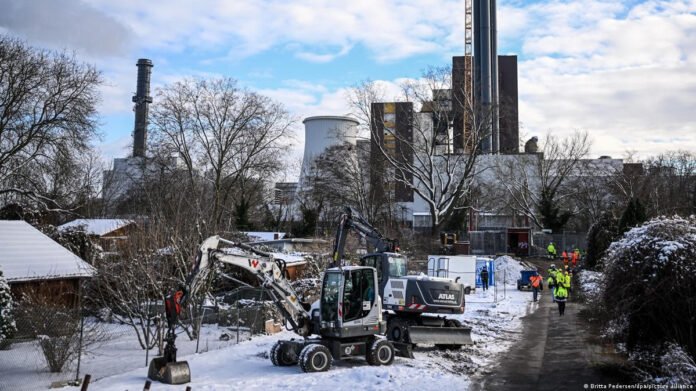
The blackout that plunged south-west Berlin into darkness in early January was not merely an infrastructure failure or an episodic security breach. It was a political act that compels democracies to address an unsettling and increasingly inevitable question regarding the changing character of violence spurred by climate change. The incident defies easy categorisation when a self-described environmental organisation sets fire to electrical infrastructure in the dead of winter, apologises only to ‘less affluent’ regions, and justifies the act as self-defence against fossil capitalism. Dismissing it as activism feels dangerously insufficient; labelling it terrorism feels too definite. Instead, a grey area emerges, which challenges current political, legal, and ethical frameworks.
The attack on a cable bridge near the Lichterfelde power plant, claimed by the far-left Vulkangruppe (Volcano Group), left tens of thousands of households without electricity and heat during freezing temperatures. Hospitals, care facilities, elevators, transportation lines, and mobile networks were all disrupted. The extent of the damage was considerable, but perhaps more disturbing is the moral justification offered by the perpetrators, who claimed that the goal was to attack fossil fuel infrastructure rather than inflict suffering on civilians. They reframed civilian hardship as collateral inconvenience in the service of a higher moral cause; in this logic, years of environmental degradation are recast as a previous act of violence, one that justifies retaliatory coercion.

The Berlin attack has crossed a crucial line from expressive dissent to coercive politics by purposefully undermining vital services and exploiting systemic weaknesses. It is the illegality that asserts moral exemption, coercion that poses as necessity, and violence that denies being violent
Beyond Terrorism, Beyond Protest
This is where language matters. Classical terrorism relies on mass fear, symbolic spectacle, and indiscriminate violence to coerce political outcomes. The Berlin attack does not fit neatly into that model. It was targeted, strategic, and justified through a moral narrative rather than overt intimidation. It cannot, however, be interpreted as a protest. This conduct aims for disruption and leverage, while protests seek visibility and persuasion. It crossed a crucial line from expressive dissent to coercive politics by purposefully undermining vital services and exploiting systemic weaknesses. A less dramatic, more subdued kind of eco-terrorism may be developing, one that is subtle in its framing rather than its effects. It is illegality that asserts moral exemption, coercion that poses as necessity, and violence that denies being violent. This makes it more challenging for democratic regimes to deal with. In addition to bodily harm, the moral line separating political persuasion from force is being eroded.
Berlin is not an isolated case. The same group was responsible for a 2024 arson attack on electricity pylons supplying the Tesla Gigafactory in Grünheide, causing production halts and hundreds of millions of euros in losses. Similar patterns are visible across Europe, including sabotage of power lines in France, repeated infrastructural disturbances associated with radical environmental groups, as well as a discernible shift from symbolic protest to economic standstill. Holidays and times when institutional readiness is lower are common times for these acts to be performed. They are cunning, professional, and well-timed. German authorities themselves acknowledge that such sabotage has become a periodic rather than an exceptional occurrence. This matters because repetition normalises escalation. What starts as an uncommon move, justified by urgency, has the potential to become a tactical blueprint that others can imitate, improve, and amplify. The bar for using infrastructure disruption always drops if it is acknowledged as a political instrument.
Berlin is not an isolated case. The same group was behind an arson attack in 2014 on electricity pylons supplying the Tesla Gigafactory in Grünheide, causing production halts and hundreds of millions of euros in losses. Similar patterns are visible across Europe, including sabotage of power lines in France
The Paradox of Climate Militancy
The political consequences of this trajectory are deeply paradoxical. Far from advancing the climate agenda, such actions risk delegitimising it. Public compassion quickly wanes when environmental militancy leads to frigid apartments, endangered patients, and halted livelihoods. The ideology that purports to work ‘in the public interest’ ultimately alienates the very people it is trying to mobilise.
More troubling still is the way these acts accelerate the ideological capture of climate change. As political leaders frame such attacks as left-wing extremism, climate action itself becomes entangled in partisan conflict. When an existential issue requires widespread agreement, it begins to resemble a factional project – coercive rather than collaborative, ideological rather than universal. This dynamic increases scepticism about climate change, not because the science is questioned, but rather because the politics around it seem antagonistic to daily life. For governments, the response is fraught with risk. When lives and essential services are threatened, a security response appears unavoidable. However, a counterterrorism-only strategy has its own risks. The militants’ assertion that democratic regimes are unable to respond to ecological collapse can be validated by harsh repression, which can also further radicalise fringe actors and blur the lines between peaceful environmental movements and violent offshoots. At the same time, treating such acts as mere vandalism or civil disobedience trivialises the harm inflicted on innocent bystanders and critical infrastructure.

This is the dilemma of the grey zone: respond too forcefully, and you fuel radicalisation; respond too leniently, and you normalise coercion. Existing legal and policy frameworks, designed either for protest or terrorism, are ill-equipped to navigate this space
This is the dilemma of the grey zone: respond too forcefully, and you fuel radicalisation; respond too leniently, and you normalise coercion. Existing legal and policy frameworks, designed either for protest or terrorism, are ill-equipped to navigate this space.
Rethinking Policy Responses
What is required, therefore, is a differentiated policy lens – one that blends accountability with precision. Serious legal repercussions must be applied to acts that put lives in danger and interfere with vital services, without turning all climate advocacy into a security issue. In addition to surveillance, infrastructure protection needs to be reinforced with redundancy and resilience to lessen the strategic reward of such attacks. Institutional readiness, decentralised energy systems, and quick repair systems are just as important as law enforcement.

Governments must address the structural factors that foster moral absolutism. A situation conducive to escalation is created by delays in climate commitments, diluted policy outcomes, and technocratic governance that lacks public trust. Some actors will seek leverage elsewhere, no matter how detrimental, when democratic routes seem barred or performative
Above all, governments need to address the structural factors that foster moral absolutism. An environment conducive to escalation is created by persistent delays in climate commitments, diluted policy outcomes, and technocratic governance that lacks public trust. Some actors will seek leverage elsewhere, no matter how detrimental, when democratic routes seem barred or performative.
There is a deeper ethical danger embedded in this trend. When coercion is normalised as an acceptable instrument of ecological politics, the boundary between moral urgency and political violence begins to blur. Although climate change is real, urgent, and devastating, moral immunity is not granted by the urgency of the issue. The threshold for escalation unavoidably changes whenever the concept of necessary disruption is acknowledged. What comes next is a politics of coercion rather than climate justice. Therefore, Berlin’s blackout should be interpreted as a warning about the political future of climate action in general, as well as the fragility of infrastructure. Democracies need to figure out how to maintain the legitimacy of the climate agenda while taking serious action against violence inspired by climate change. If this isn’t done, there could be a dire consequence: a politics where ecological survival is argued through darkness, disruption, and fear rather than democratic consent, collective action, and persuasion.

The writer is Special Advisor for South Asia at Parley Policy Initiative, Republic of Korea. He is a regular commentator on the issues of Water Security and Transboundary River issues in South Asia. The views expressed are of the writer and do not necessarily reflect the views of Raksha Anirveda

The writer is a PhD scholar at the Jindal School of International Affairs, working on a right-wing populist foreign policy approach, focusing on India, Russia, Turkey, and Hungary.
