

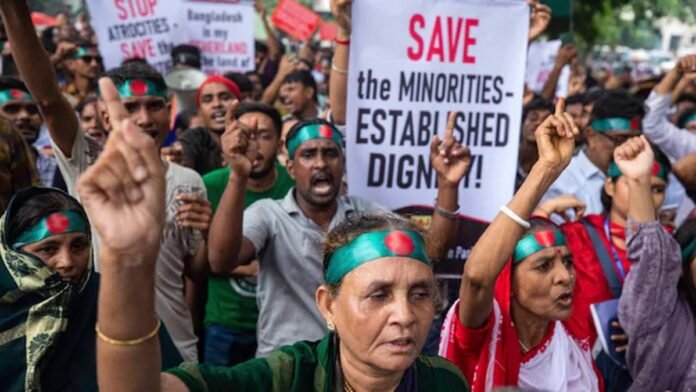
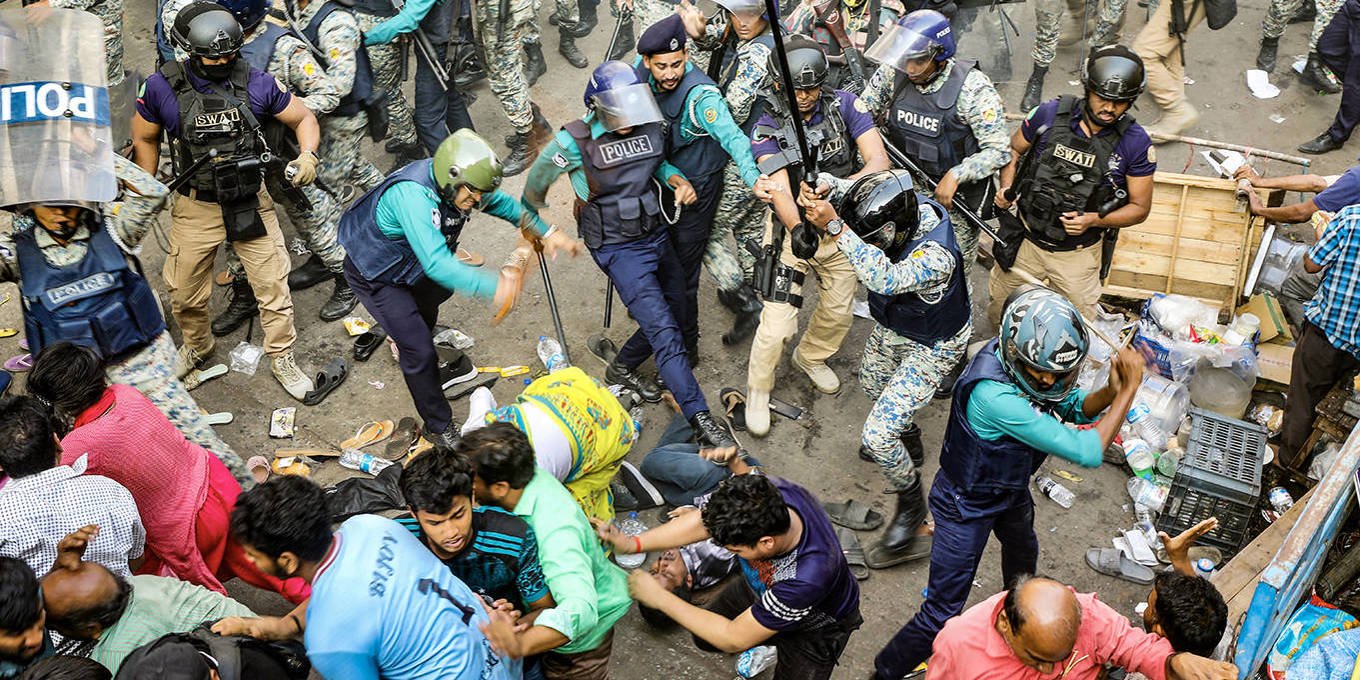
Bangladesh continues to descend into chaos, with killings becoming a routine matter, as under interim government’s Chief Adviser Muhammad Yunus’s watch, law and order has collapsed and there is nothing that will lead to tightening of screw on mob violence, which has taken a toll of several lives, including those of Hindus. All this along anti-India sentiment has taken a sharp rise, turning Bangladesh into a country that risks evolving into yet another Pakistan in the South Asian region.
There is concern that normalcy will not return to Bangladesh even after the February 12 elections, and the country will remain a security threat to India. Behind such arguments lie the ground reality that forthcoming polls in Bangladesh will not be a contest between secular forces.

With the Awami League banned from fighting elections in Bangladesh, contest will be held primarily between the Jamaat-e-Islami, (a radical Islamist group which had supported the Pakistani Army against Bangladeshi nationalists during the liberation war of 1971) and the Bangladesh Nationalist Party (BNP) which has its alliance with the Jamiat Ulema-e-Islami, a fundamentalist outfit which advocates the implementation of Sharia law in the country.
The Muhammad Yunus-led interim government backed National Citizen Party (NCP), the student-led group which was formed in the aftermath of uprising against the Sheikh Hasina government, is trying to have an electoral alliance with the Jamaat-e-Islami. In all, the post-election scenario will be murky and anti-India forces, including Islamists, Pakistanis and Americans who have made a deep entrenchment during the Yunus regime, will never let Bangladesh go out of their tight control.
Will BNP Work Well with India?
The BNP which is eyeing a return to power in the February elections to the parliament, has no history of maintaining good relations with India. During the Khaleda Zia-led government from 1991 to 1996 and again from 2001 to 2006, insurgents such as the United Liberation Front of Assam were not only provided shelter in Bangladesh, they were also given funds and arms to fuel insurgency in India’s North-eastern region.
There is concern that normalcy will not return to Bangladesh even after the February 12 elections, and the country will remain a security threat to India. Behind such arguments lie the ground reality that forthcoming polls in Bangladesh will not be a contest between secular forces
The BNP’s hatred towards India is deep rooted. Working in league with Pakistan and the US, the BNP’s Senior Joint Secretary General Ruhul Kabir Rizvi, who now doubles as the party’s spokesperson had called for the boycott of Indian products in March 2024. BNP’s acting Chairman Tarique Rahman, 60-year-old elder son of ailing Khalida Zia, who has returned from the United Kingdom where he lived in exile since 2008, has made it clear that he will prioritise his country’s interest first.

“Bangladesh comes first. I will prioritise the interests of my country’s people and my nation’s interests first. Whatever I do, I will do so while upholding those interests,” Tarique Rahman said in an interview with BBC Bangla. When he was asked whether he would reset his country’s relations with India, he replied, “If they (India) now choose to shelter a dictator (Sheikh Hasina) and thus earn the resentment of the people of Bangladesh, then there is nothing we can do about it.”
Will India-Bangladesh Relations Improve?
For the Bangladesh experts, who said BNP’s acting Chairman Tarique Rahman, in all likelihood, will try to repair relations with India, this statement shows the harsh reality. On his arrival in Dhaka on December 25, Tarique Rahman said, “We want to build a safe Bangladesh.” However, it should not be forgotten that his own past has not been free from vices.

Tarique faces several criminal cases including attempted murder. At an anti-terrorism rally organised by the Awami League in Dhaka on August 21, 2004, several grenades were lobbed. It led to the killing of 24 people and injury of 500 others, including Awami League Chief Sheikh Hasina. He was given life imprisonment for the attack. But all charges against him were dropped once Muhammad Yunus came to power after Hasina fled the country on August 5, 2024.
He had links with Bangladeshi intelligence agencies which had plotted anti-India activities in the early 2000s. In April 2004, as many as 10 trucks full of arms were seized at Chittagong in Bangladesh. This consignment of weapons was meant for the ULFA and other insurgent groups in India’s North-east region. In this nefarious anti-India activity, the Khalida Zia-led BNP-Jamaat government was involved with Tarique Rahman in the direct loop.
The BNP which is eyeing a return to power in the February elections to the parliament, has no history of maintaining good relations with India. During the Khaleda Zia-led government from 1991 to 1996 and again from 2001 to 2006, insurgents such as the United Liberation Front of Assam were not only provided shelter in Bangladesh, they were also given funds and arms to fuel insurgency in India’s North-eastern region
In this background, to say that expected victory of the BNP under the leadership of Tarique Rahman in the forthcoming parliamentary elections will usher in a phase of corruption-free and violence-free situation in Bangladesh, will be an exaggeration.
In all likelihood, Bangladesh will be in the grip of Islamist forces in the post-election scenario and this is what the just-concluded opinion poll surveys conducted recently suggest. The US-based think tank International Republican Institute (IRI) in its opinion poll said if elections were held today, 33% would cast their vote for the BNP and 29% for the Jamaat.
Since the surveys do not show a major gap between the two groups, likelihood of the emergence of an uncomfortable situation for the BNP cannot be ruled out. Even if it wins elections, it will have to face the Jamaat as its main opponent in the parliament, which will not allow it to navigate towards a centrist position, nor will it wish to have an improved relation with India.
Why Pakistan Will Undermine India-Bangladesh Relations
In stoking Bangladesh’s soured relations with India, Pakistan will leave no stone unturned. Sheikh Hasina was a stumbling block in the way of Pakistan’s closeness with Bangladesh, which was demolished in one hammer by Muhammad Yunus, who looked the other way when unruly and rogue mobs, largely led by the Jamaat leaders, attacked symbols of the 1971 liberation.
In the past 17 months of Yunus-led administration, Pakistan has expanded its network and reach far beyond any Bangladesh watcher’s thinking. In April 2025, Bangladesh and Pakistan resumed foreign secretary-level bilateral consultations, marking a major step to normalise and expand engagement between the two countries.
Tarique faces several criminal cases including attempted murder. At an anti-terrorism rally organised by the Awami League in Dhaka on August 21, 2004, several grenades were lobbed. It led to the killing of 24 people and injury of 500 others, including Awami League Chief Sheikh Hasina. He was given life imprisonment for the attack. But all charges against him were dropped once Muhammad Yunus came to power after Hasina fled the country on August 5, 2024
Pakistan’s Chairman of the Joint Chiefs of Staff Committee, General Sahir Shamshad Mirza visited Bangladesh in October and met Muhammad Yunus in Dhaka. During the meeting the two sides discussed bilateral trade, investment and defence cooperation. General Shamshad Mirza’s visit took place after the August 23-24 visit to Bangladesh by Pakistan’s Foreign Minister and Deputy Prime Minister Ishaq Dar.
Talking about this visit, Ishaq Dar told the media on December 27 that it was a major ice-breaker after years of diplomatic coldness. “There was a very warm feeling throughout the 36 hours (of my visit). Pakistan intends to proactively engage with Bangladesh after its general elections scheduled for February,” he said, indicating the future trajectory of Pakistan-Bangladesh engagement.
If media reports are to be believed, the two countries are moving closer to a planned Mutual Defence Agreement, which would expand military cooperation, intelligence sharing and joint military training. The agreement, if finalised, is expected to be signed after a new government is formed in Bangladesh after the elections. Experts say that the Pakistani military has a history of gaining political leverage, deep strategic and intelligence footholds after the signing of military pact with a nation.
What, however, worries Indians the most is intensification of Bangladeshis’ resentment towards New Delhi. A recent survey by the Centre for Alternatives, a Dhaka-based non-governmental think tank found that more than 75% of Bangladeshis viewed their country’s relations with Beijing positively, compared with just 11% for New Delhi, signalling clearly about a shift in public sentiment in Bangladesh after last year’s uprising
Invariably, New Delhi will be concerned if this military pact is signed between Islamabad and Dhaka. It will contribute to regional instability—an outcome that aligns with Pakistan’s long-standing strategy to unsettle India.
What, however, worries Indians the most is intensification of Bangladeshis’ resentment towards New Delhi. A recent survey by the Centre for Alternatives, a Dhaka-based non-governmental think tank found that more than 75% of Bangladeshis viewed their country’s relations with Beijing positively, compared with just 11% for New Delhi, signalling clearly about a shift in public sentiment in Bangladesh after last year’s uprising.
Amid this are the rising incidents of violence against Hindus in Bangladesh. Over 2,900 incidents of violence against minorities, including cases of killings, arson, land grab have been documented by independent sources during the tenure of the interim government. These incidents cannot be brushed aside as mere media exaggerations or dismissed as political violence.

–The writer is a senior journalist with wide experience in covering international affairs. The views expressed are of the writer and do not necessarily reflect the views of Raksha Anirveda
