


Christchurch: Navies across the Asia-Pacific region are boosting amphibious capabilities in an effort to protect their complex coastlines, as China continues to flex its military muscle in the region.
The Japan Ground Self-Defence Force (JGSDF), for example, is set to receive 10 new landing craft by the end of Fiscal Year 2027. This includes two 3,500-ton Logistics Support Vessels (LSV), four 2,400-ton Landing Craft Utility (LCU) and four smaller Manoeuvre Support Vessels.

Japanese shipbuilder Naikai Zosen launched the first LSV on November 28, and the first LCU on October 29. All these vessels will join a joint Maritime Transport Group being established next March, and will help support the Amphibious Rapid Deployment Brigade, Japan’s equivalent of a marine corps.
Tokyo is alarmed at the vulnerability of its southwest archipelago to Chinese intrusion.
The military said, “In light of the current severe security environment, the JGSDF will steadily build transport vessels to strengthen transport functions to islands.”
Australia is charting the same course as it rapidly overhauls its amphibious capacity with 18 new Landing Craft Medium (LCM) and eight Landing Craft Heavy (LCH). Last year’s Defence Strategic Review mandated greatly improved littoral capabilities.

The LCMs, designed by Birdon Group, carry 90 tons of cargo, while the larger LCHs displace 3,900 tons. On November 22, Canberra announced the LST 100 design from Damen Shipyards had been selected for the LCH. Austal will build all LCMs and LCHs in Western Australia.
Australia’s chief of Army, Lt Gen Simon Stuart, said, “Our plan is to have the first medium in the water by the end of 2026, the first heavy by the end of 2028. That means we’ve got to work with industry and make sensible compromises to get the capability, which will be a step change above anything we’ve currently got.”

The Australian government said the craft “will support a strategy of denial, which includes deploying and sustaining modernised land forces with long-range land and maritime strike capabilities across our region.”
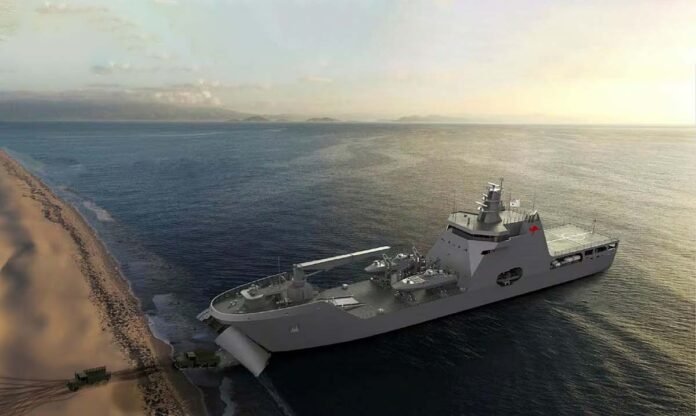
Elsewhere, the Philippines already has two Tarlac-class landing platform dock (LPD) vessels, and PT PAL in Indonesia is building another two following a 2022 contract.
To be delivered to the Philippine navy in 2026, these LPDs are useful for moving units around the Philippine archipelago, including its existing South China Sea bases. Manila is currently facing Chinese pressure in this maritime territory.
Taiwan commissioned the domestically built LPD Yushan in September 2022. This 10,000-ton vessel cannot help counter a full-scale Chinese invasion, but it can support mine countermeasures, resupply offshore islands and support amphibious landings.
India is dragging the chain in terms of improving its limited amphibious sealift. The Indian Navy issued a request for information for four LPDs in 2021, but little more has occurred since.
Navantia of Spain teamed up with Larsen & Toubro to offer the Juan Carlos I platform. However, amphibious vessels are competing for funding against submarines and other surface combatants. Plus, India’s land borders with China and Pakistan are mired in tensions.

Raksha Anirveda's editorial desk team brings in the collective experience of creative professionals - a fine mix of senior copy editors, writers, proofreaders and designers. Working as a team, they continuously create, manage, and curate content to sustain the magazine's profile and reputation in line with market trends and achieve magazine's goal.





