
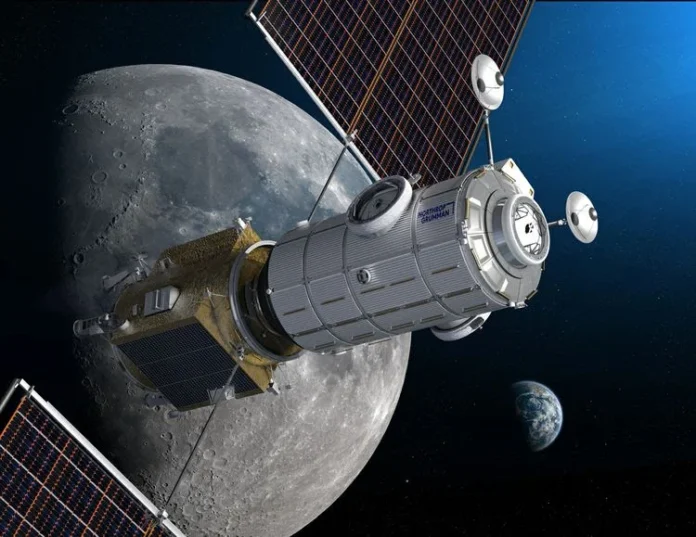
Madrid. Airbus Crisa, an affiliate company of Airbus, has signed a contract for the development of the Power Management and Distribution (PMAD) system for the Habitation and Logistics Outpost (HALO) with Northrop Grumman.
Airbus Crisa is a Spanish company founded in 1985 to design and manufacture electronic equipment and software for space applications, and engineering projects for ground stations. It is fully integrated into Airbus Defence and Space.

The new Lunar Gateway station, scheduled for launch in 2024, will initially have two modules and will be expanded in successive years to five modules. The station is intended to serve as a space laboratory as well as an intermediate logistics post for future trips to the surface of the Moon and on to Mars. The two initial modules are known as PPE and HALO. PPE (Power and Propulsion Element) has solar arrays that power the station and thrusters that allow it to maintain a stable orbit around the Moon. HALO is the Habitation and Logistics Outpost module where the astronauts will live during the estimated 40 days of the first missions.
“This contract worth more than $50 million reflects our ability to deliver highly specialised space equipment to global manufacturers and is our first contribution to the Moon-orbiting Gateway, which is part of NASA’s Artemis programme to return to the Moon,” said Fernando Gómez-Carpintero, CEO of Airbus Crisa. “This is an exciting step as Airbus Crisa is designing the PMAD to become the standard modular power management system for all future space stations and human vehicles. We have provided a disruptive solution, with an architectural concept never before seen in the sector. This lays the foundations for a new international standard, placing the company at the forefront of the sector.”
The PMAD has four power units and will manage the electricity from the solar panels of the Power and Propulsion Element (PPE). It will distribute the power to onboard equipment and the rest of the station as required, always ensuring the safety of the crew on board. The PMAD will power the life support system, the interior lighting, the communications systems and the scientific experiments. It will ensure that HALO’s battery remains at optimal levels and is ready for use when the panels do not receive sufficient sunlight. PMAD must also provide power to visiting vehicles when they dock.
Airbus Crisa is a key international player in the fields of power conversion digital control and energy management and distribution for satellite and launcher applications thanks to the experience gained in the challenging ESA exploration missions. This contract demonstrates its great potential to provide reliable flight products to US manufacturers.