


New Delhi: On a crisp October morning, as smog and dust swirled over a semi-urban location in North India, a quiet drama was unfolding—one that may redefine how India fights its future wars. For the first time, the Indian Army unleashed a fully operational electronic-warfare (EW) “kill zone” to push domestic drones to their limits.
The objective was simple yet daunting: identify UAVs capable of surviving when every satellite link, every navigation cue, and every communication channel is deliberately ripped away.

This wasn’t a limited demonstration on the familiar ranges of Babina, Pokhran, or Mahajan, which featured minimal jammers and counter drone measures. It was a battlefield in miniature—dense with multi-layered jammers, GNSS spoofers, and spectrum-flooding systems all working in sync to create the kind of electromagnetic chaos India encountered during Operation Sindoor. It was in that operation that the Army saw firsthand how vulnerable drones become when pitted against sophisticated EW systems.
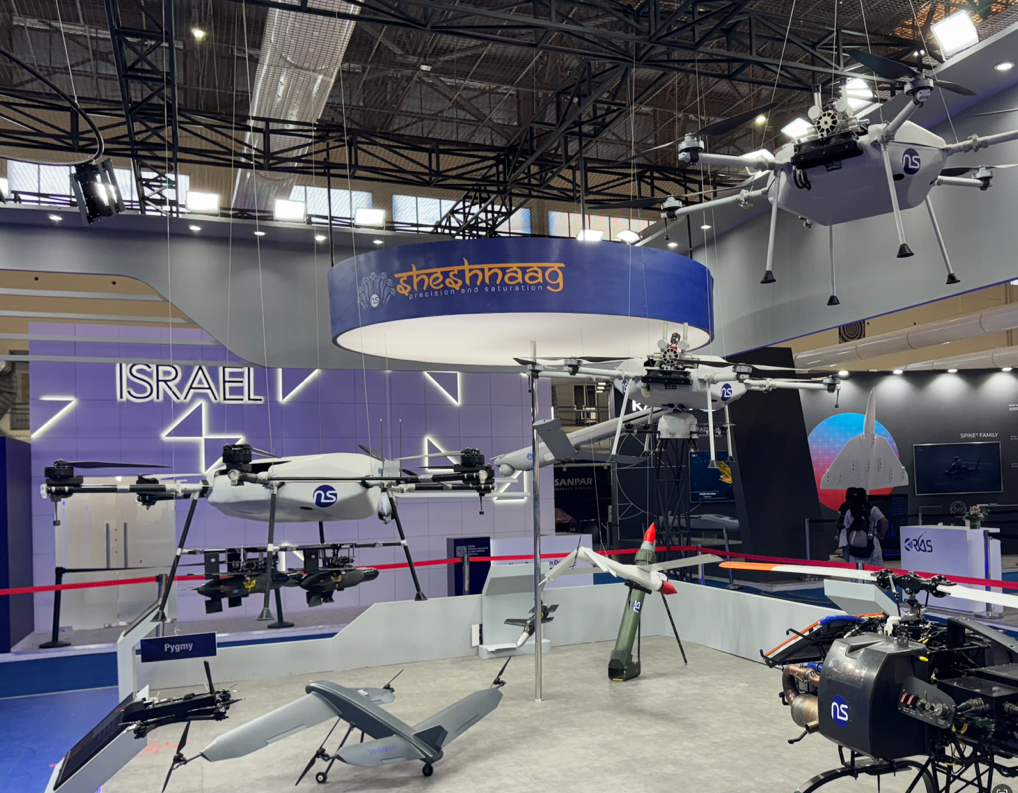
What unfolded in this October trials was closer to a combat audition than a routine evaluation. Only a handful of companies like Raphe mPhibr, NewSpace Research & Technologies, SMPP and Munitions India Limited (MIL) could operate ‘repeatedly’ in this maze of multi-spectrum jammers and spoofers which critically focused on terminal phases of operations. Many others simply fell off the map, unable to meet the unforgiving standards.
In the coming days, the successful few companies from this trial, as well as other Indian companies participating in similar efforts happening at other locations – will likely receive Emergency Procurement contracts from various Army directorates. This reinforces an unmistakable message – the Indian Army is done settling for drones that work only in ideal conditions.
Operation Sindoor Changed Everything
To understand the Army’s urgency, rewind to the months post Operation Sindoor, where the Indian Army was attempting to urgently scale its drone arsenal. The operation, executed under emergency procurement powers, forced India to rapidly replenish drones, munitions, and precision weapons.

With ₹9,000 crore earmarked under EP-6, the Army scrambled to restock what had been consumed and procure more items for a sustained fight. But a sobering revelation followed: in late September 2025, during an earlier round of EW testing near Dehradun, all 46 participating indigenous drone manufacturers failed to operate in GPS-denied conditions designed to mimic the electromagnetic mayhem of Sindoor. Blanket jamming. Falsified GNSS signals. Communication blackouts. None of the drones made it through the counter drone means.
The Army recognises that in the drone–counter-drone race, wins and losses are inevitable, and no system can fully dominate or defend every part of the spectrum. Yet instead of lowering standards or loosening requirements, the Army leadership dug in. At the insistence of the Army Chief, who has repeatedly emphasised readiness for next-generation, multi-domain battlefields, the follow on October trials were redesigned to be even more realistic and potent in context.

This time, the Army employed its full counter-UAV arsenal including Multi-spectrum GNSS jammers, Communication disruptors, Spoofers capable of injecting false satellite signals and Layered spectrum attacks mimicking enemy tactics.
The message was unmistakable:
If a drone cannot operate in a denied environment, it has no place in the Army’s future arsenal. This rigor dovetails with the country’s push for indigenous defence production under Make in India and its preparations for contested airspace scenarios along the borders with Pakistan and China.
Reshaping the Force: Ashni Platoons and Bhairav Battalions
These trials are not isolated experiments—they feed directly into a larger reimagining of the Indian Army’s combat units supported by drones and other robotic platforms. After Operation Sindoor, the Army initiated structural reforms driven by two powerful new formations:
Ashni Drone Platoons: Small, nimble units embedded within traditional infantry battalions. Their job?
- Provide real-time ISR feeds
- Deliver precision strikes
- Offer continuous situational awareness
- Operate swarms in coordination with ground units
Bhairav Battalions: Ultra-light, highly mobile commando-style formations created for:
- Deep-area penetration
- Rapid deployment
- High-tempo reconnaissance
- Tech-driven precision missions
These aren’t just paper concepts. Indian Army Exercises like ‘Drone Kavach’ in Arunachal Pradesh and ‘Sentinel Strike’ in the deserts of Rajasthan have already showcased large-scale drone coordination, multi-tiered surveillance, and integrated strike missions—essential precursors to making Ashni and Bhairav operational realities.
The Road Ahead: India’s Bid for Drone Supremacy
The aggressive format of the October EW event represents a turning point for the Army. For the first time, Indian made drones have been forced to fight ‘sustained’ and ‘blind,’ manoeuvre through the fog of electronic war, and prove that they can still navigate, communicate, and strike even when the sky turns hostile and the spectrum turns deadly.
Those that succeeded will not only earn future EP contracts—they will also earn a role in shaping India’s aerial doctrine for the wars to come.
In a world where drones no longer just support the battle but define it, the Indian Army’s insistence on EW survivability isn’t just technological ambition—it’s a strategic necessity.
And the message is not lost on Indian drone companies, who have to massively upgrade their ability to operate in denied zones – to do or die!

