

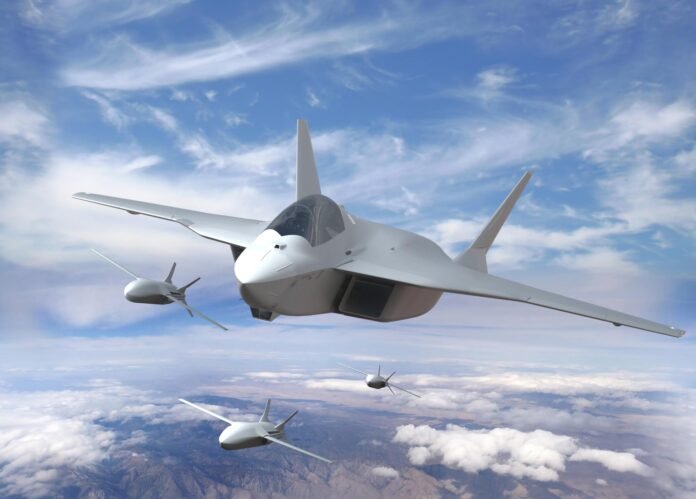
Major powers are competing to develop next-generation aerial combat systems, as the global competition to develop sixth-generation fighter aircraft is entering a critical phase. The United States, China, the United Kingdom, France, Germany, and Japan are already making major investments in advanced fighter programmes that have the potential to revolutionise aviation warfare for decades. India is meticulously positioning itself to enter the race through prospective collaboration with Europe’s Future Combat Air System (FCAS) in this evolving strategic environment.
According to reports, the Indian Air Force (IAF) is currently investigating the feasibility of participating in the FCAS programme with the ultimate objective of introducing a sixth-generation combat aircraft by 2040. In light of China’s ongoing development of next-generation fighter concepts and Pakistan’s ongoing modernisation of its air fleet with Chinese assistance, such an action could significantly alter the technological equilibrium in Asia.

Understanding Sixth-Generation Fighter Technology
The sixth-generation fighters represent the next major development in combat aviation, following the F-35, J-20, and Su-57, which are now classified as stealth aircraft. These future aircraft will not merely be enhanced fighter aircraft; rather, they will be components of a much more extensive networked combat ecosystem.
The concept of a “system of systems” is the distinguishing characteristic of sixth-generation systems. The fighter functions as a command node that coordinates drones, satellites, sensors, electronic warfare platforms, and other aircraft in real time, rather than operating independently. Artificial intelligence will be instrumental in managing battlefield data and supporting pilots in their decision-making.
It is expected that core features will include advanced stealth designs, adaptive engines with enhanced fuel efficiency, long-range sensors, and electronic warfare capabilities. Furthermore, sixth-generation fighters are being developed to operate in conjunction with autonomous “loyal wingman” drones that augment their combat capabilities and survivability.
The sixth-generation fighters represent the next major development in combat aviation, following the F-35, J-20, and Su-57, which are now classified as stealth aircraft. The future aircraft will not merely be enhanced fighter aircraft; rather, they will be components of a much more extensive networked combat ecosystem
India’s Increasing Interest in the FCAS Programme
The possible participation of India in the FCAS programme has become a subject of increasing discussion in defence circles. FCAS is a European initiative primarily led by France, with Germany and Spain as major partners. The programme’s objective is to establish a digital combat infrastructure, a network of autonomous systems, and a new generation of fighter aircraft.

According to reports, India initiated a study into the potential for joint participation in the programme with France. According to reports, the main subjects of discussion have been long-term operational integration, industrial participation, and technology collaboration.
India and France already maintain a strong defence partnership. The Indian Air Force operates the Rafale fighter aircraft, and the two nations have maintained a close partnership in the development of advanced military technology. Given this existing partnership, France could serve as an ideal entry point for India to engage with the FCAS.

India has the potential to make an important contribution to the FCAS ecosystem by participating in the initiative, which could include avionics, software systems, materials engineering, or drone technologies.
AMCA: India’s First Step Towards the Future
India is not participating in the sixth-generation competition without its own domestic initiatives. The Advanced Medium Combat Aircraft (AMCA), a fifth-generation, indigenous stealth fighter, is currently under development.
Stealth shaping, internal weapons compartments, advanced radar systems, and next-generation electronic warfare capabilities are projected to be included in the AMCA. It is expected that the aircraft will be operational in the 2030s.
Nevertheless, Indian defence planners acknowledge that many nations will have already initiated the development of sixth-generation combat systems by the time AMCA becomes operational. India has been motivated to implement a dual-track strategy as a result of this realisation.
India is discussing long-term operational integration, industrial participation, and technology collaboration. India has the potential to make an important contribution to the FCAS ecosystem by participating in the initiative, which could include avionics, software systems, materials engineering, or drone technologies
Although AMCA enhances India’s domestic aerospace capabilities, collaboration on FCAS could provide India with early exposure to sixth-generation technologies without incurring the full development costs.
Research organisations in India are currently studying technologies that may underpin future combat aircraft. These involve experimental research on quantum-based avionics concepts, advanced sensors, network-centric warfare architecture, and artificial intelligence-driven mission systems.
China’s Rapid Progress in Advanced Fighter Development
China remains the primary strategic competitor driving India’s modernisation efforts. Over the past decade, Beijing has rapidly enhanced its airpower capabilities.
The J-20 stealth fighter, widely regarded as China’s premier fifth-generation aircraft, is currently in service with the Chinese People’s Liberation Army Air Force. Additional stealth fighters, including the J-35, are currently under development and may be operational in the near future.
In addition to these platforms, China is believed to be researching sixth-generation fighter concepts. Analysts have reported sightings and discussions of new aircraft designs that boast enhanced networking capabilities and tailless stealth configurations.
Advanced sensors and unmanned wingmen are anticipated to enable these aircraft to control contested airspace.
India is also pursuing its own domestic initiatives. The AMCA, a fifth-generation stealth fighter, is under development. Stealth shaping, internal weapons compartments, advanced radar systems, and next-generation electronic warfare capabilities are projected to be included in the AMCA. It is expected that the aircraft will be operational in the 2030s
According to certain analysts, China could establish a significant technological advantage if other nations fail to develop operational sixth-generation fighters by the mid-2030s.
Pakistan’s Position in the Regional Airpower Balance
Pakistan’s air force is also undergoing rapid modernisation, primarily through collaboration with China. The Pakistan Air Force has inducted the advanced Chinese-built J-10C and operates the JF-17 fighter, which was jointly developed with China.
Furthermore, there have been indications that Pakistan may eventually acquire China’s J-35 stealth fighter. Pakistan could acquire fifth-generation combat capabilities much sooner than had been expected if such acquisitions are realised.
Although Pakistan is unlikely to develop a sixth-generation fighter independently, its close strategic partnership with China suggests it could benefit from Chinese technological advancements in the future.
This dynamic underscores the necessity for India to preserve its technological edge.
Strategic Advantages for India
Joining the FCAS programme could confer many long-term benefits on India. Access to state-of-the-art aerospace technologies that would otherwise require decades to develop domestically would be the clearest advantage.
Engaging local businesses in high-technology manufacturing and research would also fortify India’s expanding aerospace industry.
Cost sharing is an additional big advantage. The development of sixth-generation fighter programs is exceedingly costly, frequently costing tens or even hundreds of billions of dollars. India could distribute the financial burden across multiple countries through collaboration with European partners.
The J-20 stealth fighter, widely regarded as China’s premier fifth-generation aircraft, is currently in service with the Chinese People’s Liberation Army Air Force. Additional stealth fighters, including the J-35, are under development and may be operational in the near future
Additionally, this collaboration would strengthen India’s strategic alliances with Europe amid intensifying geopolitical competition in the Indo-Pacific.
Potential Obstacles and Political Factors
Despite its potential benefits, India’s participation in FCAS would not be without challenges. The programme has encountered internal disputes among European partners regarding technology exchange and industrial leadership.
In negotiations, technology transfer is expected to be a major problem. European partners may be hesitant to share confidential intellectual property, whereas India has historically sought meaningful access to advanced technologies in defence partnerships.
Additionally, India must reconcile its domestic aerospace objectives with international collaboration. Strategic considerations must be taken into account.
India will probably seek to guarantee that its indigenous AMCA programme is not undermined by its participation in FCAS.
The Pakistan Air Force has inducted the advanced Chinese-built J-10C and operates the JF-17 fighter, which was jointly developed with China. There have been indications that Pakistan may acquire China’s J-35 stealth fighter. Pakistan could acquire fifth-generation combat capabilities much sooner than had been expected if such acquisitions are realised
The IAF’s Strategic Prospects
In the coming decades, the Indian Air Force will face significant modernisation challenges. As new technologies arise, multiple aircraft in its fleet are ageing and will require replacement.
Simultaneously, India must prepare for a future in which autonomous platforms, artificial intelligence, and networked systems increasingly dominate aerial combat.
India is pursuing a balanced long-term strategy by investigating participation in FCAS while simultaneously continuing to develop AMCA.
The country can maintain technological independence while still benefiting from international collaboration through this approach.
Positioning for the 2040 Battlefield
India’s interest in the FCAS programme indicates that the country is considering issues beyond the imminent challenges of air force modernisation. Rather, New Delhi is preparing for the technological realities of warfare in the 2040s and beyond.
India has the potential to become one of the few nations capable of deploying sixth-generation combat systems if it successfully integrates its indigenous aerospace programmes with international collaboration.
In a region where China is making rapid progress and Pakistan is upgrading its airpower with Chinese assistance, these capabilities could be instrumental in preserving strategic equilibrium.
India’s prospective entry into FCAS suggests that competition for air dominance in Asia will intensify in the decades ahead, even as the sixth-generation fighter race continues to unfold.

The writer is the Publisher of Frontier India and the author of the book Foxtrot to Arihant: The Story of Indian Navy’s Submarine Arm.
