
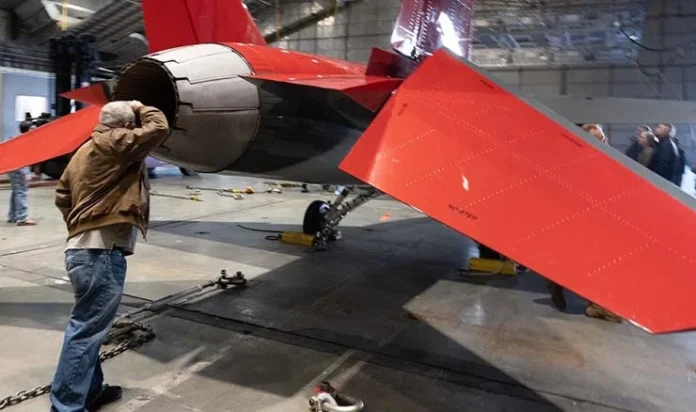
Washington: Within the McKinley Climatic Laboratory at Eglin US Air Force Base in Florida, the Air Force subjects aircraft and other systems to the most extreme weather conditions the planet can dish out.
Antarctic temperatures. Blistering desert heat. Simulated winds battering planes with sand, dust, freezing rain, salt spray and snow, all to make sure they won’t fail when conditions get rough. And on December 15, one of the Air Force’s newest jet trainers arrived at the McKinley lab to be put to the test.

The T-7A Red Hawk is the next jet the Air Force plans to use to train new pilots how to fly advanced fighters and bombers, and it is designed to emulate fifth-generation jets such as the F-22 Raptor and F-35.
The service plans to buy a fleet of 351 Boeing-made T-7s to replace its older 504 T-38 Talon trainers, which will be retired. The Air Force’s first T-7 in November flew to Edwards Air Force Base in California for further flight testing.
The service said December 20 it plans to subject this T-7 now at the McKinley lab, which bears a different tail number than the one that flew to Edwards, to sustained temperatures ranging from -25 degrees to 110 degrees Fahrenheit. Those tests are called cold soaking and solar loading, and testers will then see how well the T-7′s propulsion, hydraulic, fuel, electrical, secondary power, environmental control and other systems hold up under the punishing conditions.
“The Red Hawk must withstand a range of environments from sitting on the ground in the Texas heat to flying at altitude,” Troy Hoeger, the T-7′s chief developmental tester at the Air Force Life Cycle Management Centre, said in the statement. “The climatic lab helps us do this in a deliberate and methodical way and will give us confidence that our new aircraft meets requirements.”

The Air Force and Boeing said earlier this year the climate testing would likely last about six weeks.
The military began running tests at the McKinley lab in 1947 to make sure its vehicles and equipment could survive anywhere on the globe. It has been upgraded and expanded several times over the decades, and now has five chambers and other systems. Aircraft, weapons and equipment tested there have included the World War II-era B-29 Superfortress, P-51 Mustang, and P-47 Thunderbolt, as well as tanks, missile launchers, shelters, jet engines, vehicles and tires.

Its main chamber — the largest environmental chamber in the world — is an insulated, 70-foot-high hangar big enough to test entire aircraft, weapons, and other support systems, according to an Air Force fact sheet. The main chamber is even big enough to test a massive C-5M Super Galaxy, although a 2007 release on a C-5 test showed it was a tight fit. That chamber’s two air makeup unit systems — essentially some of the most intense HVAC systems in the world — produce temperatures from -65 degrees to 165 degrees. The South Pole often records temperatures of -76 degrees in wintertime, according to the United States Antarctic Program. And it can produce multiple humidity conditions, and simulate the pounding of solar radiation an aircraft might absorb while parked long periods of time under the Texas sun.
Other chambers at McKinley can create salt fog to quickly simulate the highly corrosive conditions aircraft might encounter over years of exposure in coastal areas, or bombard an aircraft with wind, rain, or simulated sand and dust storms like they might encounter in the Middle East. Yet another chamber can create a variety of pressures an aircraft might face at up to 80,000 feet, and test how an aircraft might handle rapid decompression.