

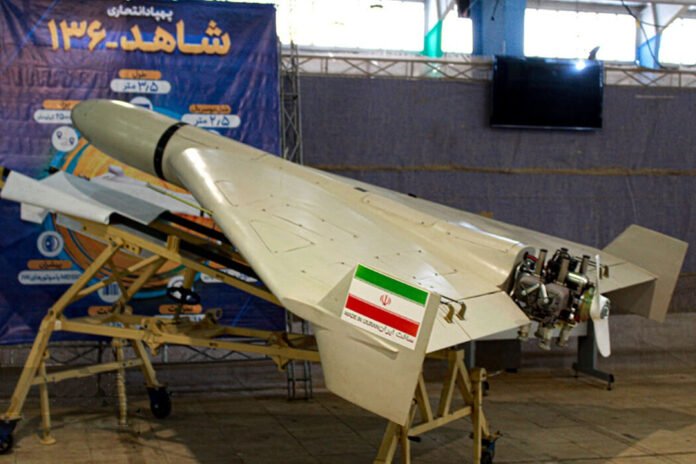
Iran’s approach to unmanned warfare has become the focal point of the global discourse regarding one-way assault drones. Iranian systems, particularly the Shahed-131 and Shahed-136, have illustrated the potential of inexpensive, mass-produced drones to impact contemporary battlefields over the past decade. These drones are similar to loitering munitions, as they travel great distances before descending on their targets with explosive payloads.
For example, the Shahed-136 is intended to be a long-range expendable drone that can deliver heavy explosive ordnance and travel over a thousand kilometers, dependent upon the mission configuration. With its unique delta-wing design, it is possible to maintain a relatively low manufacturing cost while maintaining a long endurance.

Iran’s drone strategy stands out by its emphasis on scalability and simplicity. Iran prioritised the development of drones that could be mass-produced at a low cost, as opposed to the development of complicated unmanned aircraft. Air-defence systems are compelled to intercept several targets simultaneously as a result of the ability of these drones to be launched in waves.
The conventional air force of Iran is relatively outdated (and probably now obliterated), which is one of the reasons for the adoption of its approach. Tehran pursued an asymmetric strategy that focused on missiles and drones, rather than investing heavily in advanced fighter jets. This strategy has been highly influential over time, influencing the approach of other nations to long-range unmanned strike systems.
Although their technological priorities and approaches differ substantially, both India and China are currently studying and adapting aspects of this Iranian drone doctrine.
Iran’s drone strategy stands out by its emphasis on scalability and simplicity. Iran prioritised the development of drones that could be mass-produced at low cost. Air-defence systems are compelled to intercept several targets simultaneously as a result of the ability of these drones to be launched in waves
China’s Rapid Adaptation of the Iranian Model
China has established one of the most sophisticated drone industries in the world, and its approach to loitering munitions is a reflection of both indigenous innovation and the adaptation of foreign operational concepts.

In recent years, analysts have identified Chinese drones, including the ZT-180 drone, as systems that bear similarities to Iranian long-range loitering drones in terms of both appearance and mission profile. It is suspected that these drones are intended for deep-strike missions and could be deployed in large quantities to overpower adversary air defenses.
Additionally, China has created a wide variety of smaller loitering munitions that are intended for battlefield deployment. The ASN-301 loitering munition is a prime example of this. It is capable of being launched from vehicles and is intended to target hostile radar systems. These drones function as disposable weapons that can autonomously locate and eliminate air-defence assets.

It seems that Chinese military strategists regard loitering munitions as a component of a more comprehensive unmanned warfare ecosystem. In this concept, reconnaissance drones are used to identify targets, electronic warfare systems are used to disrupt adversary communications, and loitering munitions are used to make the final strike.
China has also demonstrated swarm drone technologies, which enable the simultaneous discharge of dozens of loitering munitions from a single vehicle. These swarm tactics are indicative of a comprehensive comprehension of the operational advantages that Iranian drone attacks have exhibited in recent conflicts.
China’s substantial industrial foundation provides it with a significant competitive advantage in this field. Chinese companies are capable of swiftly developing and mass-producing drone systems at scale due to their extensive aerospace production facilities and robust electronics manufacturing capabilities.
The Emerging Drone Ecosystem of India
In response to the increasing significance of unmanned strike systems in modern warfare, India began the process of expediting the development of indigenous loitering munitions.
The Nagastra-1 loitering munition, a tactical loitering munition that is specifically designed for precision attacks on the battlefield, is one of the most prominent indigenous programmes. The system is designed to equip infantry units with a portable weapon that is capable of accurately identifying and eradicating targets.
Nagastra-1, a tactical loitering munition specifically designed for precision attacks on the battlefield, is one of India’s most prominent indigenous programmes. The system is designed to equip infantry units with a portable weapon that is capable of accurately identifying and eradicating targets
India is at present looking into the development of longer-range strike drones that are capable of engaging high-value targets located deeper within hostile territory, in addition to tactical systems. radar installations, ammunition depots, command centers, or air-defense systems could potentially be targeted by these drones.
The drone industry in India has also experienced a substantial increase in private sector participation. Advanced autonomous assault drones that integrate artificial intelligence for target identification and navigation are currently being developed by defense technology companies and startups.
Nevertheless, India’s strategy differs greatly from the Iranian model. India is seeking to integrate precision targeting capabilities with sophisticated electronics and affordability, whereas Iran prioritised simplicity and mass production.
This involves the integration of sophisticated sensors, secure communication links, and satellite navigation systems. Although these features enhance accuracy and survivability, they also lengthen development timelines and complicate the system.
Testing Infrastructure: India’s Key Limitation
The absence of an adequate testing infrastructure is one of the major challenges that India’s long-range one-way drone programmes must overcome.
Large instrumented test ranges are necessary for the development of long-range strike drones, which can fly for hundreds or even thousands of kilometers during trials. Each trial is a sizable logistical operation because these drones are expendable weapons that self-destruct during testing.
China’s substantial industrial foundation provides it with a significant advantage in this field. Chinese companies are capable of swiftly developing and mass-producing drone systems at scale due to their extensive aerospace production facilities and robust electronics manufacturing capabilities
India’s current facilities, including the Chitradurga Aeronautical Test Range, offer major abilities for the development of unmanned aerial vehicles (UAVs). However, they may not be adequate for the testing of ultra-long-range loitering drones at maximum operational distances.
The pace of development can be slowed, and it can be challenging to rapidly validate new designs due to the limited access to large test ranges. This infrastructure challenge has the potential to become a significant impediment as India endeavors to expand its drone programs.
China is not subject to the same restrictions. Its extensive geographic territory encompasses remote regions and huge deserts, enabling the conduct of extensive flight tests without operational constraints.
Iran, intriguingly, circumvented comparable constraints by emphasising drone designs that necessitated less intricate testing procedures. This enabled Iran to rapidly establish operational systems in spite of its limited resources.
The Strategic Lesson from Iran
Iran’s drone programme illustrated a powerful strategic lesson: drones are not necessarily required to be technologically advanced in order to be effective.
The Shahed-136’s success demonstrates that drones can effectively target critical infrastructure, including air bases, logistics centres, and radar installations, at a low cost. These drones have the potential to overpower even the most advanced air-defence systems when deployed in large quantities.
This introduces an imbalance in the cost of modern warfare. The defence against drone attacks often requires the deployment of costly interceptor missiles, radar coverage, and air-defence networks. Conversely, the drones may be priced at a fraction of the cost of the systems employed to prevent them.
India’s current facilities, including the Chitradurga Aeronautical Test Range, offer major abilities for the development of unmanned aerial vehicles (UAVs). However, they may not be adequate for the testing of ultra-long-range loitering drones at maximum operational distances
China seems to be assimilating this lesson by creating systems that are capable of mass deployment, such as long-range loitering strike drones and truck-launched drone swarms.
Nevertheless, India is still in the process of determining how to reconcile the advantages of mass deployment with the benefits of precision and advanced technology.
India’s Strategic Path Forward
The development of long-range one-way strike drones is a critical strategic capability for India. These systems have the potential to strike targets that are located far behind hostile lines without putting manned aircraft at risk.
These drones have the potential to be an invaluable resource in high-altitude conflicts where conventional aviation operations are challenging. Logistics routes, radar installations, or missile launch sites in remote mountainous regions could be the targets of long-range loitering munitions.
Nevertheless, in order to contend with China in this sector, India will need to overcome numerous structural obstacles. These encompass the development of indigenous drone components, the reinforcement of domestic manufacturing capacity, and the expansion of testing infrastructure.
India needs to overcome numerous structural obstacles. These encompass the development of indigenous drone components, the reinforcement of domestic manufacturing capacity, and the expansion of testing infrastructure
Simultaneously, Indian planners may intensify the examination of the operational lessons from Iran’s drone strategy, with a particular emphasis on the advantages of low-cost, mass-deployable unmanned strike systems.
In conclusion, Iran’s success with the Shahed series of loitering munitions has significantly influenced the rapid evolution of one-way attack drones. These drones illustrated the significant influence that relatively straightforward and economical systems can have on contemporary warfare.
Leveraging its sizable industrial base, China has promptly implemented comparable concepts into its drone programmes, resulting in the development of a diverse array of swarm drone technologies and loitering munitions.
In contrast, India is currently in the process of establishing its own drone ecosystem. Although it has made substantial strides with systems like Nagastra and other experimental assault drones, there are still substantial challenges in terms of testing infrastructure and manufacturing scale.
The future of this emergent drone race will be contingent upon strategic decisions regarding infrastructure development, operational doctrine, and production scale, in addition to technological innovation. Iran’s lessons may ultimately influence the design of the next iteration of one-way attack drones by both India and China.

The writer is the Publisher of Frontier India and the author of the book Foxtrot to Arihant: The Story of Indian Navy’s Submarine Arm.
