

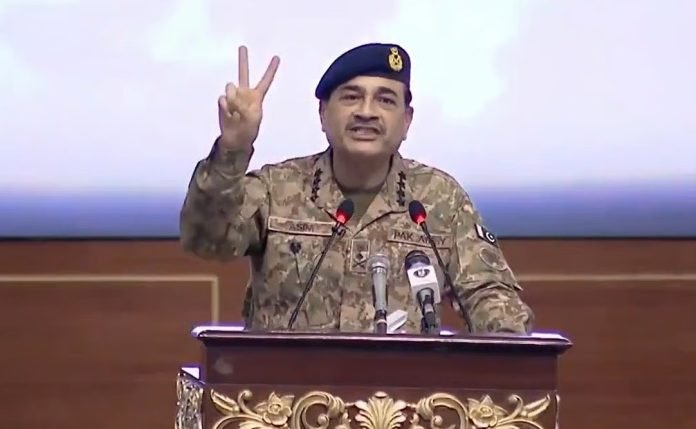
Asim Munir: The General Who Refuses to Fall: There is an old proverb that says a cat has nine lives. But there is a catch – it doesn’t say that cats are immortal or destined for an indefinite lease of life. In Pakistan, more than anyone else, this applies to Field Marshal Syed Asim Munir.
The year 2025 was nothing short of a roller coaster ride. Month after month, Pakistan lurched from one crisis to another—political instability, economic turbulence, and diplomatic challenges. Yet each time Islamabad shivered, Munir not only survived but consolidated power, emerging stronger, more visible, and more empowered—both within Pakistan and abroad.

From civil–military tensions to regional geopolitics, Munir had the last word. He weathered storms that might have consumed lesser figures, reinforcing the perception that Pakistan’s military remains the ultimate arbiter of national stability. Internationally, his profile sharpened as he positioned himself as both negotiator and power broker in South Asia’s shifting landscape.
Operation Sindoor: Pakistan’s Loss = Munir’s Gain
The story began with a terror attack in Pahalgam that killed 26 civilians. India retaliated with Operation Sindoor, a series of pre‑emptive missile strikes on terrorist infrastructure in Pakistan and Pakistan‑occupied Kashmir. The campaign drained Pakistan’s resources and morale, becoming one of its most humiliating defeats since 1971.
Munir faced intense criticism, with some analysts predicting his dismissal. Yet paradoxically, this humiliation became the turning point. By controlling the narrative, he reframed defeat as sacrifice, projecting the army as the nation’s shield against external aggression. What could have ended his career instead magnified his authority.
Every crisis—economic, political, or diplomatic—enhanced Munir’s stature. Domestically, he positioned himself as a steadying figure, camouflaging the military as guardian of resilience. Despite recurring clashes with civilian leaders, he ensured the army retained primacy in decision‑making.

Pakistan’s loss was Munir’s gain. Paradoxically every— economic, political, or diplomatic — crisis that knocked on Pakistan’s door in 2025 enhanced Munir’s stature both at home and on the international stage and presented a fresh opportunity for him to position himself as shock-proof, Teflon-coated Mr Invincible
Internationally, Munir secured financial bailouts from Gulf allies and streamlined ties with China. His role in counterterrorism dialogues elevated his profile and presented him as the country’s most credible face abroad. Each setback became a rebirth, reinforcing the idea that Pakistan’s survival rested on his shoulders.
Elevation to the Rank of Field Marshal
Munir achieved a rare distinction: elevation to Field Marshal, only the second in Pakistan’s history. The promotion consolidated his authority and symbolised survival after Sindoor. Even Imran Khan, his bitter critic, publicly congratulated the military, briefly diluting animosity between PTI and the army. This moment of forced unity gave Munir his second “life” in 2025.

Lunch at the White House
In June, Munir achieved what few Pakistani army chiefs could dream of: a one‑on‑one meeting with US President Donald Trump, followed by lunch at the White House. Trump credited him as “extremely influential” in halting escalation with India and averting nuclear war.
The optics mattered. Munir became the first Pakistani army chief hosted for lunch by a sitting US president. The thaw in US–Pakistan ties unlocked trade discussions, counterterrorism cooperation, and reportedly secured $2 billion in aid. For Munir, the lunch was more than symbolism—it was validation, cementing his place as both commander and statesman.
Nuclear Threat to India
Two months later, Munir provoked controversy during a second US visit. At a dinner in Tampa, he reportedly warned: “We are a nuclear nation. If we think we are going down, we’ll take half the world down with us.”
Washington did not endorse the remarks, but his high‑level access sparked criticism in India. At home, however, the episode reinforced his image as custodian of Pakistan’s nuclear shield. What seemed reckless abroad consolidated his authority domestically, projecting him as guardian of sovereignty and survival.
Global Outreach: Pakistan’s De Facto Foreign Minister
With inflation soaring and IMF negotiations eroding trust, Munir turned outward and travelled to Riyadh and Abu Dhabi, securing defence assurances and economic pledges. These visits stabilised reserves and positioned him as Pakistan’s de facto foreign minister, overshadowing civilian diplomats.
The very next month he travelled to Beijing to repair Pakistan’s strained image after Sindoor. China needed reassurance about the China‑Pakistan Economic Corridor. Munir’s visit showcased solidarity and security cooperation. Later, he also met President Xi Jinping, presenting himself as architect of Pakistan’s external strategy. For a man shadowed by defeat, Beijing offered redemption.
On the domestic front Munir positioned himself as a steadying figure and managed to camouflage the military as the guardian of national resilience. Internationally too, by projecting himself as indispensable in foreign policy, Munir reinforced the idea that Pakistan’s army was not merely a domestic arbiter but also the country’s most credible face to the world
His outreach extended further: hosting Crown Prince Mohammed bin Salman in Islamabad, signing defence exercises and a $4 billion wastewater deal, and receiving Saudi Arabia’s King Abdulaziz Medal. He also visited Türkiye, Iran, Azerbaijan, and Libya, widening Pakistan’s orbit. These milestones reinforced the perception that Munir had become Pakistan’s most visible diplomat.
Indispensable for Pakistan’s Survival
Munir was no longer merely surviving crises—he was shaping the security narrative. Military exercises became highly publicised demonstrations of strength, projecting him as commander‑in‑chief who could inspire confidence.
Ceremonial events emphasised unity and sacrifice, consolidating his image as guardian of Pakistan’s constitutional promise. By rewarding loyalists and elevating trusted commanders, he bound the military closer to his leadership.
He launched an anti‑corruption drive within the armed forces; sidelining officers accused of graft. Critics saw the campaign as selective, but it strengthened his control and projected him as incorruptible. Awarding himself the Nishan‑i‑Imtiaz symbolically elevated his stature as an indispensable protector.
Amid unrest and economic despair, Munir delivered a high‑profile address framing the army as ultimate guarantor of sovereignty. Civilian leadership was portrayed as incapable of navigating crises. The paradox crystallised: Pakistan’s weakness was Munir’s strength.
Western Engagements
Munir’s diplomatic calendar expanded to include high‑profile meetings with Western leaders. He spoke not only of defence but of trade, investment, and regional stability. The optics were unmistakable: Munir as Pakistan’s chief diplomat, overshadowing the foreign ministry.
For elites and foreign observers, these meetings crystallised a new reality: Munir was not only guardian of sovereignty at home but also architect of Pakistan’s international posture. His ability to command attention abroad reinforced his indispensability.
Symbolic Recognition in Washington
November brought symbolic recognition. Appearing alongside Prime Minister Shehbaz Sharif in the Oval Office, official photos showed Trump meeting both men. Yet Munir had already met Trump independently, underscoring his direct channel to Washington.
His profile rose further at a private dinner with Trump. The optics presented him as Pakistan’s most credible representative abroad. While civilian leaders struggled for recognition, Munir’s presence symbolised Washington’s acknowledgment of his centrality.
Command Over All Defence Forces
The final—and most consequential—life was institutional. In November, parliament passed the 27th Amendment, abolishing the Joint Chiefs of Staff Committee and creating the post of Chief of Defence Forces (CDF). The role placed the Navy, Air Force, and nuclear command under Munir’s authority. Critics warned of democratic erosion, while PTI lawmakers protested.
By December, the legal architecture became reality. President Asif Ali Zardari approved Munir’s appointment as Pakistan’s first CDF. Officially described as coordination, it was widely seen as sweeping power consolidation. Munir now stood above the service chiefs, as supreme commander of Pakistan’s military establishment.
Postscript: Nothing Succeeds Like Success
December crowned Munir’s ascent. On the 9th, he was named the world’s most influential military leader, ranked ahead of counterparts in the US, China, and Russia. On the 22nd, Saudi Arabia awarded him the King Abdulaziz Medal of Excellent Class. Days later, his daughter Mahnoor’s marriage in Rawalpindi drew Pakistan’s political and military elite, symbolising his centrality in power circles.
India’s swift reaction in the form of Operation Sindoor was one of Pakistan’s most humiliating military moments in 2025. Analysts predicted Munir’s downfall but paradoxically, it became the turning point that strengthened Asim Munir’s grip on power. He not only survived but also managed to transform the moment of weakness into a narrative of endurance
By year’s end, Munir held multiple titles simultaneously: Chief of Defence Forces, Field Marshal, de facto Army Chief, Foreign Minister, and No1 trouble shooter. In other words, Pakistan’s fragility became his platform for consolidation and the nation’s loss became his personal gain.
Conclusion
Each crisis was a potential downfall. Yet Munir’s ability to adapt, consolidate, and emerge stronger mirrored the proverbial cat with nine lives. By year’s end, Pakistan’s losses had paradoxically become Munir’s gains, leaving him more entrenched than ever as the ultimate arbiter of national destiny.
His journey in 2025 exemplifies resilience. Each setback became a rebirth, each crisis a new life. Like a phoenix, he rose from ashes; like a cat, he lived nine lives. Yet the metaphor carries a warning: cats may have nine lives, but they are not immortal. Munir’s survival underscores his dominance, but it also highlights Pakistan’s fragility.
As Pakistan enters 2026, the question lingers: how many lives does Munir have left—and at what cost to the country he commands?

–The writer is a seasoned media professional with over three decades of experience in print, electronic, and web media. He is presently Editor of Taazakhabar News. The views expressed are of the writer and do not necessarily reflect the views of Raksha Anirveda
