

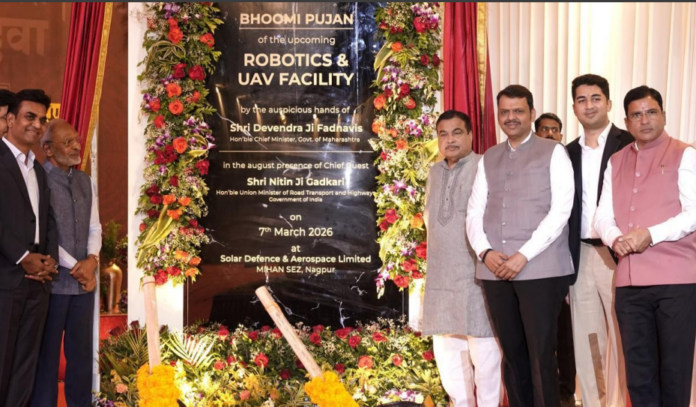
New Delhi: Solar Defence and Aerospace Limited, a wholly owned subsidiary of Solar Industries India Limited, has unveiled plans to invest approximately ₹128 billion in a state-of-the-art robotics and unmanned aerial vehicle (UAV) manufacturing facility.
This ambitious project signals a pivotal shift in India’s defence sector, underscoring the rising prominence of private enterprises in bolstering indigenous capabilities and curtailing import dependence.

The initiative kicked off with a traditional Bhoomi Pujan ceremony on March 7, 2026 at the MIHAN Special Economic Zone (SEZ) in Nagpur. Attended by senior government officials, the event highlighted robust policy backing for ‘Make in India’ and Aatmanirbhar Bharat initiatives, which prioritise self-reliance in defence production.
Nagpur’s MIHAN SEZ was chosen for its superior infrastructure, seamless connectivity via road, rail, and air, and burgeoning industrial ecosystem. This location positions the facility as a cornerstone for export-led growth, transforming central India into a defence manufacturing powerhouse akin to hubs in Bengaluru and Hyderabad.
At its core, the facility will specialise in advanced unmanned systems, encompassing UAVs for surveillance, strike, and logistics roles, alongside robotics platforms for ground operations. It will also venture into long-range missile technologies, integrating artificial intelligence (AI) and automation—essentials in modern warfare doctrines emphasising precision and minimal human risk.
Solar Defence anticipates a development timeline of three to four years before full operations commence. Upon completion, the plant aims to manufacture 10,000 drones and 1,000 robotic systems annually, with the first robot prototype slated for unveiling within the next year, demonstrating an aggressive innovation pace.

This expansion marks a strategic pivot for Solar Industries, long renowned for explosives and ammunition. By entering deep-tech domains like autonomous systems, the company aligns with global trends where robotics and UAVs dominate battlefields, from Ukraine’s drone swarms to Indo-Pacific maritime patrols.
The investment promises substantial economic ripple effects. It will generate thousands of high-skill jobs in robotics, AI, aerospace engineering, and related fields, nurturing talent in Maharashtra and beyond. Local supply chains will flourish, empowering small and medium enterprises (SMEs) with opportunities in components, sensors, and software.

Export potential looms large, fuelled by surging worldwide demand for affordable, reliable drones amid conflicts and border tensions. India’s competitive edge—bolstered by cost efficiencies and proven systems like the DRDO-developed Nagastra—could capture markets in Southeast Asia, Africa, and the Middle East.
This move dovetails with India’s defence modernisation agenda. Recent procurements, including indigenous UAVs under the Army’s drone programme and Navy’s sea drone initiatives, underscore the urgency. Solar’s facility will complement public-sector giants like Hindustan Aeronautics Limited (HAL) and Bharat Electronics Limited (BEL), fostering a hybrid ecosystem.
Technologically, the plant will harness AI for swarm intelligence, enabling coordinated UAV operations over vast theatres. Robotics will feature modular designs for explosive ordnance disposal, reconnaissance, and counter-insurgency, addressing threats from loitering munitions and hypersonic adversaries.
Challenges persist, however. Scaling production demands skilled labour, supply chain resilience against global disruptions, and cybersecurity safeguards for AI-driven platforms. Regulatory hurdles in export controls and technology transfer will require deft navigation.
Yet, government incentives—such as 74% FDI in defence and SEZ tax benefits—mitigate these. Solar’s lineage in munitions provides a solid foundation, with synergies in propulsion and warheads enhancing UAV lethality.
Strategically, this bolsters India’s deterrence posture along contested frontiers. UAVs and robotics will augment capabilities against asymmetric threats from neighbours, while deep-tech exports strengthen diplomatic ties via defence diplomacy.
In the broader canvas, Solar’s bet reflects private sector dynamism. Firms like Tata Advanced Systems and Adani Defence are similarly investing in UAVs, driving a projected ₹5 lakh crore defence production target by 2029.
The facility’s success could catalyse cluster development in Nagpur, mirroring aerospace corridors elsewhere. It will spur R&D collaborations with institutions like IITs and DRDO, accelerating innovations in quantum sensors and electric propulsion.
Environmentally conscious designs, including sustainable manufacturing, align with global norms, appealing to eco-aware export markets. Workforce upskilling via partnerships with vocational institutes will ensure a future-ready talent pool.
Ultimately, this ₹128 billion infusion cements Solar Defence’s role in India’s ascent as a defence tech exporter. It not only fortifies national security but also fuels economic vitality, paving the way for a self-reliant, innovative defence-industrial base.

