
India faces increasingly complex maritime security challenges in the Indian Ocean Region (IOR), stemming from geopolitical competition, strategic rivalries, and the growing importance of the region as a corridor for global trade and the transportation of critical energy supplies. It has also become a contested space with increasing naval activities by regional and extra-regional powers, notably China and Pakistan, among others.
By expanding its naval footprint, including the establishment of a military base in Djibouti, adopting an aggressive anti-piracy operation, and the development of the ‘String of Pearls’ – a network of ports and infrastructure encircling India — China is threatening to undermine India’s strategic interests and traditional predominance in the IOR.

Concurrently, Pakistan’s naval modernisation, closely linked with China’s strategic partnership, adds further layers of complication to India’s maritime security landscape. These developments call for enhanced vigilance to counter geopolitical rivalry, territorial disputes, and maritime domain awareness.
This region also encompasses some of the world’s most critical sea lanes, including the Malacca Strait, the Strait of Hormuz, and the Bab el-Mandeb, which are vital for global energy supplies and maritime trade. Hence, India must safeguard these sea lanes against threats of piracy, terrorism, and potential blockades that could disrupt energy imports and economic lifelines.
Moreover, conflicting claims and territorial disputes, especially with Pakistan and China coming together for a broader maritime domain, also demand vigilant diplomatic and military engagement. Protecting this global trade artery, therefore, is critical for India’s economic prosperity – a region that is rich in fisheries, hydrocarbons, and potential seabed minerals and national and energy security.
Maritime Challenges
Unfortunately, the country is facing challenges in maintaining technological parity with competitors’ naval capabilities, including undersea warfare, long-range surveillance, and network-centric warfare. Hence, building a modern navy with advanced platforms and indigenous technological expertise is critical for strengthening surveillance, showing its naval capabilities, including its submarine power and maritime diplomacy.

Submarines provide India with leverage in regional geopolitics, influencing power equations and cooperation within frameworks like the Quadrilateral Security Dialogue (Quad), an informal strategic forum consisting of four nations: the United States, India, Japan, and Australia.
The Project 75(I) submarines, designed by TKMS, will substantially bolster India’s conventional maritime power, safeguarding coastal security, exclusive economic zones, and critical underwater infrastructure, protect vital sea lanes, deter adversaries, and safeguard national interests, including vital underwater communications cables
Given this evolving threat environment and changing geopolitical situation, India needs to rapidly upgrade and expand its submarine fleet to deter adversaries and maintain its strongholds in the region. The Indian Navy’s submarine fleet currently faces several challenges, which underline the urgent need for modern platforms like the P-75I German submarines.

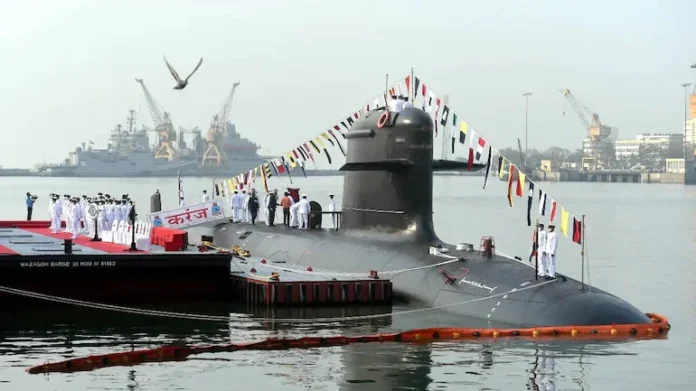
India presently operates around 17 diesel-electric attack submarines, six of which are of the Kalvari class, based on the French Scorpene design. These submarines, while newly commissioned, will soon face obsolescence challenges in the face of rapidly evolving maritime threats. The Indian Navy also operates two nuclear-powered ballistic missile submarines, with more such submarines planned. However, their primary role is strategic nuclear deterrence.
More importantly, India’s submarine capabilities have faced delays and procurement hurdles over the years, affecting operational readiness against rapidly advancing regional competitors. Investing in contemporary submarine capability, streamlining procurement processes, and boosting indigenous construction are imperative to close the undersea capability gap.
Due to delays and the existing ageing fleet, the Indian Navy faces a shortfall in undersea warfare capability. The P-75I project aims to address this shortfall by indigenously building six state-of-the-art conventional submarines based on advanced German technology provided by the TKMS. The German design ensures access to cutting-edge stealth technology, sensors, and combat systems, thus improving their detection ranges, engagement, stealth and survivability.
These new conventional submarines, with advanced German technology, will also incorporate high indigenous content, as mandated by the Ministry of Defence. Their weapon package will include heavyweight torpedoes and tube-launched land attack missiles, advanced sonars, and they will be fitted with air-independent propulsion (AIP) and Lithium-ion batteries, which will significantly extend their underwater endurance.
The Navy is also focused on the future with next-generation indigenous designs like Project 76 and Project 77 nuclear attack submarines, but these are longer-term efforts.
The Project 75(I) submarines, designed by TKMS, will substantially bolster India’s conventional maritime power, safeguarding coastal security, exclusive economic zones, and critical underwater infrastructure, protect vital sea lanes, deter adversaries, and safeguard national interests, including vital underwater communications cables.
Why Diesel-Electric and AIP Submarines Matter to India
While nuclear-powered submarines offer unmatched endurance and speed, there are technical and financial constraints on the numbers that can be added to the Indian fleet. Hence, diesel-electric submarines equipped with the latest fuel cell-based AIP technology are a cost-effective alternative, which significantly extends the time of underwater operations without sacrificing stealth and operational reach.
One of the standout features of the TKMS design is the incorporation of fuel cell-based AIP technology. It enables the submarine to operate and remain submerged for weeks without surfacing or snorkelling to recharge batteries, providing a crucial tactical advantage in the Indian Ocean, where there is a high presence of surveillance, detection, and monitoring systems
These advanced submarines are based on an existing Type 214 design, and are being modified to include the latest state-of-the-art technologies and specific Indian requirements. Adapted to India’s operational requirements. They feature a modular hull design optimised for acoustic discretion in challenging environments. They are designed to remain submerged for a longer period, thus reducing the risk of detection and optimising their mission effectiveness. Operating quietly with low acoustic signatures – the submarine is designed to make as little noise as possible while moving underwater – is crucial in the congested and shallow littoral waters of the IOR, where Indian naval operations are concentrated.
The project’s commitment to indigenisation through partnership with the public sector Mazagon Dock Shipbuilders Limited (MDL) will help India to build a modern, self-reliant submarine fleet adaptable to emerging maritime threats through the rapid transfer of technology. It also stands as a flagship initiative representing India’s strategic leap in undersea warfare technology by emphasising its state-of-the-art technology, operational adaptability to Indian maritime conditions, and alignment with India’s self-reliance and modernisation goals.
Cutting-Edge Air-Independent Propulsion (AIP)
One of the standout features of the TKMS design is the incorporation of fuel cell-based AIP technology. It enables the submarine to operate and remain submerged for weeks without surfacing or snorkelling to recharge batteries. It is a crucial tactical advantage in the constrained and sensor-rich waters of the Indian Ocean because there is a high presence of surveillance, detection, and monitoring systems. These include underwater sonar arrays, radar systems on ships and aircraft, satellites, and other electronic equipment used to gather data about movements and activities in the region.
The proton exchange membrane fuel cells (PEMFC), present in the AIP, work like tiny power plants, converting hydrogen and oxygen into electricity. Inside the fuel cell, hydrogen gas splits into tiny parts called protons and electrons, with the electrons creating an electric current that powers the submarine quietly and efficiently. Simultaneously, the oxygen reacts with the protons and electrons to create water, the only byproduct, with no harmful emissions or noise. Since there are no moving parts inside the fuel cell, unlike a traditional engine, it operates almost silently, which is crucial for submarines to stay hidden underwater.
Other types of AIP systems also work on similar principles. Engines use stored oxygen to burn fuel in a closed system, or Stirling engines that use liquid oxygen for combustion. All these systems aim to generate electricity underwater without needing to surface for air, allowing submarines to stay submerged longer and be stealthier during their missions. It drastically reduces the acoustic and thermal signatures – the unique sounds and noises produced by a submarine, ship, or any vessel underwater- that could reveal the submarine’s location.
An AIP system on board will enable these submarines to conduct long-duration patrols and covert operations without compromising on surprise and survivability. For instance, as a generic estimate, submarines with AIP can operate submerged for 14 days or so at low speeds, compared to just 2-3 days for non-AIP conventional submarines. This allows them to maintain stealthy ‘waiting’ positions and reduces their vulnerability to detection.
Advanced Stealth and Acoustic Signature Reduction
Moreover, TKMS submarines employ angular hull design and integrated noise-dampening systems to prevent detection by sonar and other anti-submarine warfare (ASW) sensors. This stealth capability is vital in Indian waters, which are teeming with rival anti-submarine assets and maritime traffic, and therefore, present significant detection risks. Having acoustic superiority means that these new conventional submarines can quietly track surface ships and rival submarines, enforce maritime boundaries, and safeguard India’s critical sea lanes.
Collaboration with Mazagon Dock Shipbuilders Limited will enable local integration, creating a sustainable submarine industrial ecosystem critical in India. TKMS ensured adaptability to Indian Naval operational needs by developing and tailoring advanced submarine designs and working closely with MDL to meet India’s strategic, technological, and industrial requirements
These submarines are designed for stealth using special sound-absorbent materials. The design of the submarine is such that it allows it to move smoothly through water undetected, with machines and engines built and mounted to reduce vibration and noise, thus minimising its self-noise. A combination of lithium-ion batteries and the AIP system also increases the high-speed endurance, thus enhancing lethality.
Loaded with layers of defence and stealth capabilities, these submarines promise advanced countermeasures like water ram expulsion torpedo launchers, underwater effector jammers, and minimised magnetic signatures. The water ram expulsion torpedo launcher, for instance, fires torpedoes using high-pressure water instead of noisy air or explosives, making the launch quieter and harder to detect by enemies.
Similarly, underwater effector jammers confuse or block enemy sonar and guided weapons, helping protect the submarine from incoming attacks by ‘jamming’ or hiding its exact location. Built on the principle of minimised magnetic signatures, these submarines avoid creating strong magnetic fields, thereby going undetected by active sonar, torpedoes, and magnetic anomaly detectors – special devices used in military operations to find submarines underwater by detecting small changes or disturbances in the earth’s magnetic field caused by the metal hull of the submarine. These are critical for covert operations and survivability in contested waters.
Additional stealth is achieved through operational tactics like ‘bottoming’, where the submarine rests quietly on the seabed with minimal systems running, aided by passive sonar for target detection. By running the submarine at low speeds on low power, the submarine can stay underwater for a longer time on a single mission without making much noise that could reveal its position.
Their communication and surveillance equipment has also been designed to avoid detection, making the submarine even stealthier during its operations.
Superior Combat Capabilities and Armament
The P-75I submarines also come equipped with powerful torpedo tubes – six 533mm torpedo tubes – that can launch modern heavyweight torpedoes, designed for anti-ship and anti-submarine warfare. Besides torpedoes, these submarines are also capable of firing long-range cruise missiles, attacking both ships and land targets. This significantly boosts their ability to strike and defend against threats above and below the surface. Land-attack missile capability will enhance their combat capabilities beyond traditional underwater warfare.
Moreover, the submarine will also be designed to deliver cutting-edge weapons like anti-aircraft missiles and hard-kill anti-torpedo systems, which are under development.
In addition, the submarine will be designed to carry up to 24 naval mines for laying in strategic areas, thus increasing its defensive and offensive options in shallow-water operations.
By committing to extensive technology transfer, TKMS promises to help Indian engineers, designers, and technicians master critical submarine technologies. It will enhance India’s long-term maintenance, upgrade, and future indigenous design capabilities, increasing operational independence
Sensors and Combat Systems
German submarines have highly advanced sonar systems that can actively and passively scan the surrounding waters to find and track targets with great accuracy, to detect and respond to threats. Instead of traditional periscopes, they use special optical periscopes equipped with infrared cameras that allow the crew to scan the surface without exposing the submarine.
The state-of-the-art ORCCA combat system will add more firepower to these submarines, help evaluate threats faster, and improve weapon control. With these state-of-the-art technologies, these submarines will be amongst the most advanced non-nuclear submarines in the world.
Adaptability to Indian Naval Operational Needs
Most importantly, TKMS has customised the submarine design to meet India’s specific naval warfare doctrines, regional maritime geography, and security challenges. The modular design supports future upgrades and can incorporate Indian-origin systems. Such a system allows blending of global best practices with domestic technological expertise, and it is also in sync with India’s broader Make-in-India mission, fostering indigenous manufacturing capabilities while incorporating advanced foreign technology.
Collaboration with Mazagon Dock Shipbuilders Limited (MDL) will enable local integration, thereby creating a sustainable submarine industrial ecosystem critical for India’s long-term maritime power projection. Thus, TKMS has ensured adaptability to Indian Naval operational needs by developing and tailoring advanced submarine designs and working closely with MDL to meet India’s strategic, technological, and industrial requirements.
This partnership is focusing on local construction and indigenous content, and will endeavour to meet and exceed the MoD-mandated percentages. This will support India’s strategic goal of building domestic naval manufacturing capabilities and technical know-how. By integrating the Indian industry in design adaptation, assembly, and supply chain, TKMS will be promoting technology transfer and local skill development and fostering a sustainable submarine industry.
By committing to extensive technology transfer, TKMS promises to facilitate Indian engineers, designers, and technicians in mastering critical submarine technologies, including the complex AIP systems and combat management systems. It will enhance India’s long-term maintenance, upgrade, and future indigenous design capabilities, significantly increasing operational independence.
TKMS is actively engaging with the Indian defence establishment and industry to deliver India-specific solutions such as multi-mission capabilities, including anti-submarine warfare (ASW), anti-surface warfare (ASuW), intelligence gathering, and extended endurance for Indian Ocean surveillance.
Enhanced Endurance and Operational Depth
These submarines will be able to operate below the effective range of many existing detection technologies and anti-submarine weapons. Coupled with the extended submerged endurance through AIP, this capability will allow sustained covert operations, vital for intelligence gathering, sea denial, and deterrence missions.
TKMS-designed submarines are being successfully deployed by several navies worldwide, including Germany, Greece, South Korea, Singapore, Egypt, Israel, Turkey and many other navies, demonstrating operational reliability and effectiveness in varied maritime conditions. This proven pedigree reinforces confidence in the design’s suitability for the Indian maritime environment and operational challenges.
TKMS-designed submarines are being successfully deployed by several navies worldwide, including Germany, Greece, South Korea, Singapore, Egypt, Israel, and Turkey, demonstrating operational reliability and effectiveness in varied maritime conditions. This proven pedigree reinforces confidence in the design’s suitability for India’s operational challenges
Conclusion
TKMS’s P-75(I) submarine design offers the Indian Navy a harmonious blend of stealth, endurance, firepower, and technological sophistication, tailor made for Indian waters and Indian conditions. The incorporation of proven AIP fuel cell technology ensures extended submerged operations — a critical tactical edge. Advanced noise reduction and customised armaments reinforce operational superiority in complex threat environments.
More importantly, the project’s commitment to indigenisation through partnership with MDL empowers India to build a modern, self-reliant submarine fleet adaptable to emerging maritime threats. In an era where undersea dominance shapes national security, the TKMS P-75(I) design stands out as an ideal foundation for India’s underwater future.

-TKMS –officially branded as ThyssenKrupp Marine Systems until June 2025– is a group and holding company of providers of naval vessels, surface ships and submarines
