

India today stands at the epicentre of a rapidly evolving maritime landscape. The Indian Ocean, viewed largely as the country’s commercial lifeline, has become a geopolitical hotspot, often invisible borders—where even low-signature actors can generate disproportionate impact through advanced technologies. The outcome of future conflicts in this region will be shaped less by the size of fleets and more by the ability to deploy smarter, smaller autonomous platforms that exploit every crevice of the maritime battlespace through unmanned systems.
India’s stability, prosperity, and geopolitical influence are inseparable from the Indian Ocean. Nearly 95% of the country’s trade, energy flows, and data connectivity depend on these sea lanes. Yet this vast expanse has also become a domain where threats are multiplying faster. In such a battlespace, visibility is everything: every nautical mile demands unblinking vigilance, every second counts, and continuous presence is the ultimate deterrent. To keep pace, India needs surveillance that never sleeps, patrols that never tire, and response systems that can outthink, outmanoeuvre, and outlast adversaries.

Sagar Defence: India’s Indigenous Catalyst for Unmanned Maritime Power
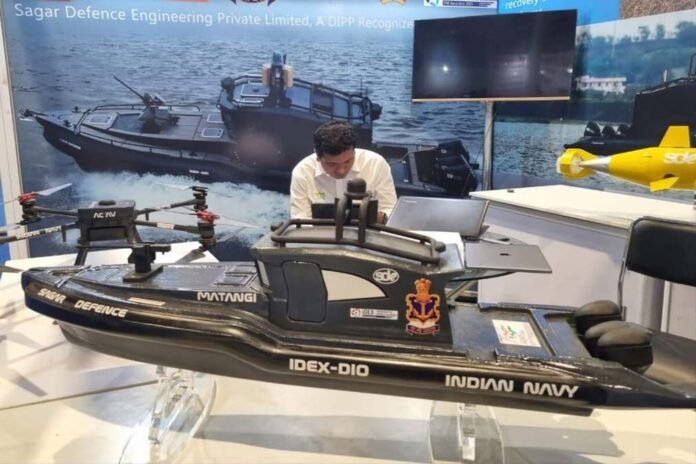
Against this backdrop, Sagar Defence Engineering (SDE), a company that began with a simple but ambitious conviction: to design and build such systems for national security. In a relatively short span, SDE has developed and indigenised Unmanned Surface Vehicles (USVs), Unmanned Aerial Vehicles and Underwater Systems that have attracted serious interest from the Indian Armed Forces, port authorities, and international partners.
What differentiates SDE is that it does not treat autonomy as an add-on—it builds it into the core of each platform. Every vessel integrates navigation algorithms, obstacle-avoidance AI, multi-sensor fusion, autonomous mission planning, and secure, encrypted communications with the use of the platform-agnostic technology known as GENISYS (Boat in a Box). The result is a family of maritime robots that can think, adapt, and execute complex missions with minimal human intervention.
Equally important, these systems are built for Indian realities. They are engineered to withstand monsoon sea states, high salinity, tropical corrosion, crowded harbours, and dense littoral traffic. This is not technology transplanted from another geography; it is designed from the keel up for the subcontinent’s operational environment.
Founded in 2015, Sagar Defence Engineering Private Limited (SDEPL) has developed and indigenised a robust portfolio of Unmanned Surface Vehicles (USVs) and AI-enabled maritime robotics that have attracted serious interest from the Indian Armed Forces, port authorities, and international partners
SDE’s platforms are already being deployed for autonomous patrolling, harbour security, persistent surveillance, and unmanned logistics—all critical building blocks of a future-ready maritime posture.

The Vanguard Role: Transforming Surveillance and Littoral Security
Surveillance is the area where Sagar Defence’s platforms have produced the most visible operational shift. Traditional harbour and coastal patrols require crewed boats, rotating teams, fuel, and constant human supervision. An autonomous USV, by contrast, can patrol a designated harbour perimeter day and night without fatigue or distraction. It can track suspicious movements using electro-optical and infrared sensors, classify unknown contacts, relay live feeds to coastal command centres, and independently alter course to investigate anomalies.
This way, it aims to enhance the Indian Navy’s maritime domain awareness without a corresponding expansion of manpower. Along India’s coastline, where critical naval bases, industrial ports, strategic islands, and offshore installations sit alongside dense civilian traffic, such an unmanned presence may become an operational necessity.

What emerges is the foundation of a new doctrine: let machines patrol persistently; let humans intervene decisively.
Autonomous Logistics: A Silent Revolution in Readiness
Traditionally, small, manned boats shuttle between shore and ship to keep this logistical chain running. Sagar Defence has upended this model with India’s first indigenous autonomous logistics boats. These unmanned platforms move supplies from shore to ship or between ships without crew, reducing risk during heightened tensions and freeing sailors for more critical duties.
In contested environments where mines, small-boat attacks, or UAV strikes are plausible, sending manned craft for routine logistics becomes increasingly risky. Unmanned logistics vessels offer a safer, more resilient alternative. In peacetime, they lower operating costs and turnaround times; in crisis or conflict, they help ensure that critical platforms are never left waiting for the basics that keep them operational.
Logistics may appear mundane compared to high-speed interceptors or strike USVs, but its transformation is one of the most profound shifts in naval readiness. SDE’s innovations contribute towards directly strengthening this backbone.
Preparing for Swarm Warfare and the Distributed Battlespace
The next era of naval conflict will likely see the rise of swarms—dozens or even hundreds of small unmanned platforms acting in concert. Working together, such systems can saturate enemy sensors, map minefields, conduct deception operations, or threaten high-value targets without exposing crewed assets to first contact.
Sagar Defence is already building towards this reality. Its USVs are designed to operate collaboratively, share data in real time, and execute distributed missions under a common command architecture.
AI, Autonomy, and the Smart Sea
At the heart of SDE’s capability lies GENISYS – a platform-agnostic AI Command and Control Module that provides any vessel three levels of autonomy: Semi-Autonomous, Fully Autonomous or Remotely Operated. This allows USVs to continue operating even when communications are degraded or contested, a likely feature of any future conflict involving cyber interference, jamming, or spoofing.
SDE’s platforms are designed to integrate into the wider naval information architecture: coastal radar chains, the Information Management and Analysis Centre (IMAC), and tactical communication networks. Each unmanned vessel becomes a node in an AI-enabled maritime mesh, feeding and drawing information in real time. This significantly sharpens the Navy’s observe–orient–decide–act loop
For naval planners, this offers something invaluable: they can continue to execute mission objectives, adapt routes, and maintain safety without constant human oversight.
Moreover, SDE’s platforms are designed to integrate into the wider naval information architecture: coastal radar chains, the Information Management and Analysis Centre (IMAC), and tactical communication networks. Each unmanned vessel becomes a node in an AI-enabled maritime mesh, feeding and drawing information in real time. This significantly sharpens the Navy’s observe–orient–decide–act loop.
The Indigenous Edge: Aatmanirbhar, Agile, and Secure
Perhaps the most strategically significant aspect of Sagar Defence’s rise is its contribution to India’s technological sovereignty. As global export controls tighten around dual-use and high-end maritime technologies, reliance on foreign suppliers becomes a growing vulnerability. SDE’s model addresses this head-on.
- Platforms are designed and engineered in India
- Autonomy software is conceived and coded domestically
- Sensors and key components are increasingly sourced from local manufacturers
- Operational data is processed on sovereign systems
- Upgrades, mission customisation, and lifecycle support are handled within the country
This reduces exposure to external restrictions, ensures greater security over sensitive data, and allows India to scale unmanned capabilities at its own pace and on its own terms.
India’s Autonomous Navy Begins Here
By 2035, the Indian Navy will be defined by the invisible networks of intelligent autonomous systems that surround, support, and extend them. As the world enters the age of autonomous warfare, one reality stands out clearly: nations that master unmanned power will shape maritime power.

