

New Delhi: Modern warfare’s paradigm is shifting away from sheer numbers to a blend of affordable technology and innovation. As stated by Army Chief Gen Upendra Dwivedi, India’s self-reliance, rooted in a triad of military, industry, and academia collaboration, is transforming cost-efficiency into combat advantage on the battlefield.
Gen Dwivedi emphasised that low-cost, high-tech indigenous systems can help smaller forces counter more powerful adversaries through rapid innovation and constant capability upgrades, illustrated by the drive to extend missile ranges from 100 km to 300 km swiftly.

India’s defence modernisation budget is set to reach ₹3 lakh crore annually over the next decade, with approx. 10% yearly growth, signalling strong financial commitment to indigenisation. Prime Minister Modi’s spotlight on “Made in India” hardware in Operation Sindoor reflects the strategic shift towards indigenous defence tech becoming operationally indispensable, not symbolic.
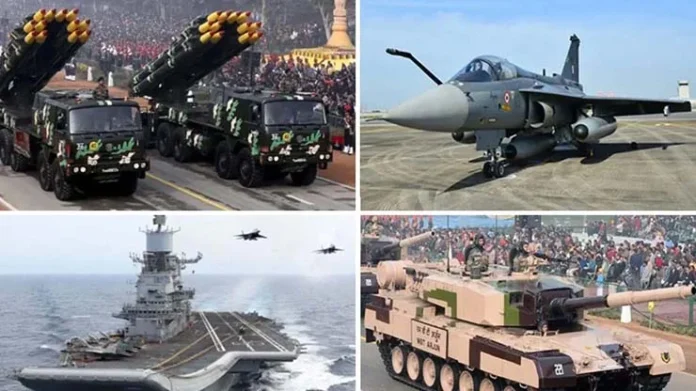
The Indian Air Force (IAF) illustrates challenges and opportunities of indigenisation. With the MiG-21 fleet retired, the IAF strength is lowest in 60 years. The indigenous Tejas MK-1A, produced by HAL with increasing private sector support, is critical to fill this gap, offering a more affordable alternative to imported fighters like Rafale.
Tejas MK-1A jets average $74–78 million per unit, less than a third of imported fighter prices like the Rafale-M at $280 million. Similarly, indigenous missile systems like Akash cost around $500,000 per missile, far cheaper than Western counterparts like the Patriot or S-400. This cost-effectiveness extends to artillery and naval domains. The Pinaka multi-barrel rocket launcher costs about $270,000 per unit versus $4.9 million for the US HIMARS. India’s first indigenous aircraft carrier INS Vikrant, commissioned in 2022 for approximately $3.1 billion, exemplifies cost-aligned capability suited to national needs with future carriers aiming to integrate advanced tech selectively.
Operation Sindoor demonstrated the combat maturity of India’s indigenous arsenal. Systems like the Akash missile family, BRAHMOS supersonic cruise missile, D4 anti-drone system, and locally produced loitering munitions showcased their operational effectiveness under combat conditions against Pakistani targets.

Supporting technologies such as DRDO-developed secure communications (SAMBHAV), electronic warfare suites, and radar systems were crucial for operational success, enabling precise, coordinated strikes while minimising collateral damage. The indigenous anti-drone D4 system effectively neutralised hostile drones during the operation, underscoring innovation in emergent warfare domains.
India’s defence production hit a record ₹1.5 lakh crore in FY 2024-25, an 18% annual increase and nearly double since 2019-20. Public-sector units contributed 77% of output, while private sector share rose to 23%, reflecting growing industrial ecosystem participation.

Defence exports surged to a historic high of ₹23,622 crore (+12% year-on-year) in FY 2024-25, demonstrating India’s expanding global footprint. DPSUs boosted exports by 43%, and private players maintained significant contributions, facilitated by streamlined policies and increased export authorisation.
India’s strategic aim is to grow indigenous defence manufacturing to ₹3 lakh crore in three years and double exports to ₹50,000 crore by 2029, relying on continued innovation, component standardisation, semiconductor investments, and an aggressive export push. India is not just producing low-cost weapons but is pioneering a model where cost efficiency and rapid tech advancement empower smaller forces to compete effectively.
Operation Sindoor showed that indigenous weapons are battle-tested, and production plus export growth indicates defence manufacturing is a significant growth sector for India’s economy and strategic autonomy. This quiet revolution marks India’s bet on self-reliance as a strategic force multiplier, blending economics, technology, and operational readiness into a modern defence doctrine.

