


The Transformation Chronicle: From Barracks to Quantum Battlefields: In January 1949, Field Marshal K.M. Cariappa made history by becoming the first Indian Commander-in-Chief of the Indian Army, succeeding British General Sir Roy Bucher. This watershed moment marked India’s true military autonomy and set the foundation for what would become one of the world’s most formidable armed forces.
Seventy-seven years later, as the nation observes the 77th Army Day under the theme “Samarth Bharat, Saksham Sena” (Capable India, Empowered Army) and Networking and Data Centricity, the Indian Army stands at another equally transformative moment – one where quantum physics meets military strategy, optical fibres carry unbreakable encryption, and indigenous technology replaces foreign dependence.

This transformation didn’t happen overnight. It represents decades of deliberate policy shifts, technological absorption, and an unwavering commitment to strategic autonomy. At the intersection of this journey stands a critical yet invisible force: quantum-safe cybersecurity, pioneered by Indian innovators and battle-tested across India’s most sensitive critical sectors, including military networks and globally.
Two Decades of Strategic Awakening: The Journey from Procurement to Production
The turn of the millennium marked India as the world’s largest arms importer, haemorrhaging precious foreign exchange while remaining vulnerable to supply chain disruptions and technology denials. The wake-up call came in multiple form the Kargil conflict exposed critical gaps in defence preparedness, the 2008 Mumbai attacks revealed cybersecurity vulnerabilities, and the 2020 Galwan crisis catalysed unprecedented urgency for indigenous defence capabilities.
Seventy-seven years later, as the nation observes the 77th Army Day under the theme “Samarth Bharat, Saksham Sena” (Capable India, Empowered Army) and Networking and Data Centricity, the Indian Army stands at another equally transformative moment – one where quantum physics meets military strategy, optical fibres carry unbreakable encryption, and indigenous technology replaces foreign dependence
The transformation blueprint emerged through systematic policy interventions. In the mid-2000s, the Defence Procurement Procedure began prioritising indigenous content.
By 2014-2015, India’s domestic defence production stood at ₹46,429 crore – a figure that would explode to ₹1.54 lakh crore by 2024-2025, representing a staggering 231% growth.

The Aatmanirbhar Bharat initiative, launched in 2020, crystallised this vision into actionable policy. Defence Minister Rajnath Singh’s compendium of 20 defence reforms fundamentally restructured acquisition procedures, corporatised Ordnance Factory Boards, and raised FDI limits to 74% under the automatic route. The Defence Acquisition Procedure 2020 introduced the Buy Indian-IDDM (Indigenously Designed, Developed, and Manufactured) category as the top priority, ensuring indigenous capabilities lead every procurement decision.
The results speak volumes – “India’s defence exports surged from ₹686 crore in 2013-14 to ₹21,083 crore in 2023-24 – a 30-fold increase. India now exports to over 100 nations, with the USA, France, and Armenia as top destinations.” By 2029, India targets ₹50,000 crore in defence exports, cementing its position as a reliable global defence partner.

The Decade of Transformation: Networking and Data-Centricity as Force Multipliers
Chief of Army Staff General Upendra Dwivedi’s vision articulates the roadmap clearly: “The Indian Army is undergoing a decade of transformation, where jointness, self-reliance, and innovation are the core pillars of our strategic power. Through the effective use of indigenous technologies, new ideas, and continuous improvements, we are making the Army more capable and future-ready. Networking and data-centricity are providing new impetus to this transformation.”
This isn’t mere rhetoric. The Army declared:
- 2023 as the Year of Transformation
- 2024-2025 as the Years of Technology Absorption, and
- 2026 as the Year of Networking and Data Centricity
All nested within the Decade of Transformation (2023-2032) framework.
The Ministry of Defence has designated 2025 as the Year of Reforms, with integrated theatre commands, tri-service synergy, and indigenous capabilities as core focus areas.
QNu Labs, incubated at IIT Madras Research Park in 2016, emerged as India’s answer to quantum-era cyber threats. Recognised by Research and Markets as positioning itself as a global leader in quantum-safe security, QNu Labs exemplifies the Aatmanirbharta vision—indigenous innovation serving both national security and global markets. The company’s journey mirrors India’s defence transformation
General Dwivedi emphasised during the Forces First Conclave that Operation Sindoor demonstrated this transformation in action: “What we achieved through Operation Sindoor was by deliberate design driven by foresight, preparation and organisational transformation and the tri-service synergy which became the strong point.”
The modernisation encompasses advanced weaponry (K-9 Vajra howitzers, T-90 tanks, BMP-2 Sarath vehicles), cutting-edge surveillance systems (Swathi Weapon Locating Radar), battlefield robotics (Robotic Mules for reconnaissance), and most critically, quantum-safe communication infrastructure securing command, control, and intelligence networks.
Quantum Suraksha Kavach: India’s Indigenous Answer to Next-Generation Threats
While tanks and artillery dominate parades, the invisible infrastructure securing military communications represents the real force multiplier. Every command transmission, every intelligence brief, every strategic coordination depends on unbreakable encryption. This is where quantum technology transforms from laboratory curiosity to battlefield necessity.
QNu Labs, incubated at IIT Madras Research Park in 2016, emerged as India’s answer to quantum-era cyber threats. Recognised by Research and Markets as positioning itself as a global leader in quantum-safe security, QNu Labs exemplifies the Aatmanirbharta vision—indigenous innovation serving both national security and global markets.
The company’s journey mirrors India’s defence transformation. In 2018, QNu launched India’s first Quantum Key Distribution (QKD) system, placing India on the global quantum map. By 2022, QNu won the prestigious iDEX Open Challenge 2.0, successfully developing a 150-kilometre QKD system with trusted nodes—breaking distance barriers that had constrained quantum communication networks.
QNu’s global footprint extends beyond India. The company has deployed quantum security solutions in the Middle East, partnered with VIAVI Solutions for international markets, and secured contracts across USA, Australia, and APAC regions
Defence Secretary Dr Ajay Kumar lauded this achievement: “Great way to usher Azadi Ka Amrit Kaal! Breakthrough in quantum computing puts India in global leadership in this new-age technology.”
Battlefield-Proven: Securing Sky, Soil, Border, and Sea
QNu’s quantum security solutions aren’t conference room concepts—they’re battle-tested across India’s most sensitive installations:
Military College of Telecommunication Engineering (MCTE) and Military College of Electrical & Mechanical Engineering (MCEME): In 2023-24, QNu deployed Quantum-safe VPN solutions using Tropos QRNG (Quantum Random Number Generator) and NIST-compliant Post-Quantum Cryptography algorithms, securing wireless networks at these critical training establishments.
India developed 500+ Kilometre Intercity QKD Network: Under the National Quantum Mission and National Security Council Secretariat grant, QNu built India’s Hub-and-Spoke QKD network, securing wireline communications using existing optical fibre infrastructure. This network will now extend to 1000s of kilometres, creating an unbreakable communication backbone for strategic operations.
Indian Navy Deployment: In 2024, QNu delivered 25 Armos QKD systems to the Indian Navy, marking the largest quantum security deployment in Indian maritime forces, securing critical naval communications and command centers.
Cross-Border Applications: Today QNu has solutions for secure border surveillance systems, drone communications (India’s first quantum-safe drone platform), and satellite links creating a comprehensive quantum suraksha kavach (quantum protection shield) across all operational domains.
Recognition and Validation: From Startup to Strategic Partner
QNu’s contributions have earned recognition across globally and India’s defence ecosystem:
- iDEX Winner (2019, 2022): Dual victories in Innovations for Defence Excellence challenges; also awards from DSCI, Best Cybersecurity Start-up, Digital Innovator in Quantum Cybersecurity and more.
- Ministry of Defence Contracts: First private startup to receive RFP from Armed Forces on a nomination basis (2022)
- National Quantum Mission Selection: Chosen QNu Labs to build the world’s first end-to-end quantum-safe heterogeneous network. Recognised by Prime Minister Narendra Modi, Union Minister Jitendra Singh, DST Delegates and NQM Delegates for their innovative 500Km + intercity quantum safe network established in India and also coming up with QRNG Chip (QRNG SiP)
- TEC Certification: QNu’s QKD certified by Telecom Engineering Centre
- DRDO Partnership: Delivering QRNG systems for critical defence applications
- Global Recognition: Featured by Breaking Defence (USA) as representing India’s “disruptive impact” in military quantum technology
- QNU also partners with many others – Some worth mentioning names will be NASSCOM Deeptech Club, Thales, AWS, BSNL, STL, Viavi, Cisco Launch Pad, Likha Wireless, Dhruva Space, NetApp Accelerator,
The company has trained over 400 defence officers, and filed 11+ patents (with 15 plus pending) across its QKD and QRNG technologies.
In this fractured order, data sovereignty equals national sovereignty. QNu’s comprehensive quantum security stack ensures that India’s military communications remain secure not just today, but against tomorrow’s quantum-powered cyber threats
Global Leader with Indian Heart: Exporting Quantum Sovereignty
QNu’s global footprint extends beyond India. The company has deployed quantum security solutions in the Middle East, partnered with VIAVI Solutions for international markets, and secured contracts across USA, Australia, and APAC regions. Research and Markets’ vendor profile recognises QNu Labs as “positioning itself as a global leader” in quantum security, with projected revenue reaching ₹200 crore by FY2026.
This export success mirrors India’s broader defence transformation—from being the world’s largest arms importer to becoming a credible defence exporter, with products bearing the “Made in India” stamp serving global security needs.
Integrating with India’s Defence Ecosystem
QNu’s quantum security stack integrates seamlessly across India’s military modernisation initiatives:
- QShield Platform: Unified quantum security platform with four services—quantum-safe file sharing, secure messaging, encrypted collaboration, and quantum key management
- Tropos QRNG: Root of Trust for all cryptographic operations, generating true randomness from quantum physics
- Armos QKD: Point-to-point quantum-secure communication for distances up to 150+ kilometres
- QVerse: India’s first quantum-safe messaging platform for secure military collaboration
- QConnect: Quantum-safe VPN protecting tactical networks and field communications
- Drone Security: Lightweight, NIST-compliant quantum-safe drone communication platform
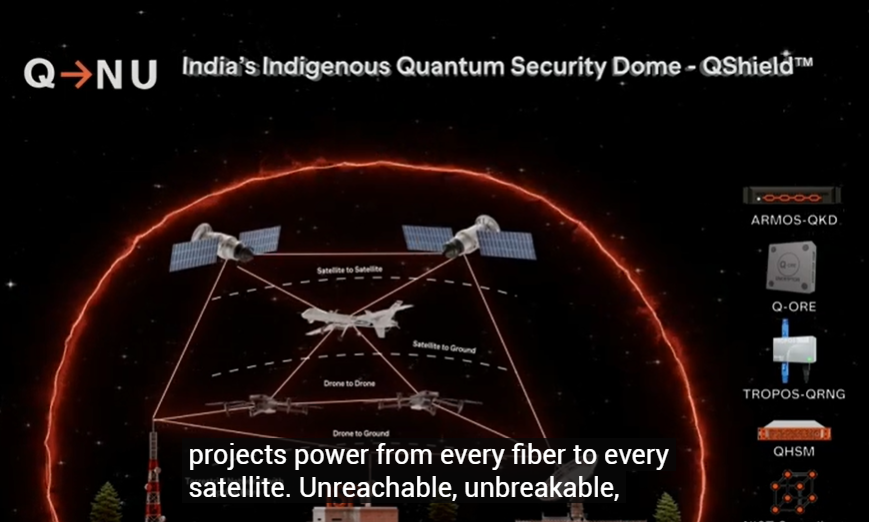
Securing Today’s and Tomorrow’s Battles Today, Being Quantum-First and Nation-First
As highlighted in Raksha Anirveda our quantum technology isn’t about replacing conventional systems—it’s about making them quantum-resilient. The convergence of AI-powered cyber-attacks and quantum computing capabilities creates threats that classical encryption cannot counter.
General Dwivedi articulated this urgency during the Chanakya Defence Dialogue: “We are living in an increasingly multipolar world, where major powers are continuously jostling and competing. The world has moved from the Cold War’s bipolarity through a brief unipolar moment, into an uncertain and fractured order.”
In this fractured order, data sovereignty equals national sovereignty. QNu’s comprehensive quantum security stack ensures that India’s military communications remain secure not just today, but against tomorrow’s quantum-powered cyber threats.
As India marches toward its Viksit Bharat (Developed India) 2047 vision, the Army’s transformation from tradition to technology leadership will remain critical. The integration of quantum security, artificial intelligence, hypersonic weapons, and space-based assets represents Phase Three of General Dwivedi’s transformation roadmap—graduating to an “integrated future-ready force design”
The Road Ahead: Viksit Bharat 2047
As India marches toward its Viksit Bharat (Developed India) 2047 vision, the Army’s transformation from tradition to technology leadership will remain critical. The integration of quantum security, artificial intelligence, hypersonic weapons, and space-based assets represents Phase Three of General Dwivedi’s transformation roadmap—graduating to an “integrated future-ready force design.”
QNu Labs continues expanding this vision. Selected under the National Quantum Mission, the company is building the world’s first end-to-end quantum-safe heterogeneous network integrating QKD over optical fibre, data centres, free-space QKD for cross borders (beyond optical fibre), indigenous Single Photon Detectors, Quantum Hardware Security Modules, and software-defined QKD controllers. Plus, showcasing India’s leadership in cutting-edge quantum communication technologies by innovating quantum safe secure communication over VPN, drone, satellite ensuing seven (7) layers of end-to-end security.

The writer is Chief Marketing Officer at QNu Labs, India’s pioneering quantum cybersecurity company incubated at IIT Madras. An IIM-Calcutta alumnus with 22+ years of global marketing leadership, she has led quantum security thought leadership initiatives positioning India’s “Made in India, Made for the World” quantum capabilities across defence, government, and enterprise sectors globally
