


If you have stood on the deck of a ship at sunrise, watching the first light soften the horizon, you know that the sea rarely reveals everything at once. What appears calm can shift without warning; what looks empty may hold activity just beyond sight. For the men and women of the Indian Navy and the Indian Coast Guard, this quiet uncertainty is part of every mission. As India celebrates Navy Day, I find myself thinking not only of history and heroism, but of these subtle, everyday moments at sea when clarity matters most — long before a crisis unfolds.
Over the past several years, India’s maritime forces have been preparing for exactly this kind of clarity. The shift toward unmanned aviation has been steady, deliberate and deeply practical. At Schiebel India, we have witnessed this transformation first-hand as the CAMCOPTER® S-100 and its larger successor, the S-300, become essential tools for extending awareness at sea without increasing risk to those on board. For the Navy, the Coast Guard and coastal enforcement agencies, these aircraft are not about replacing existing capabilities, but about filling the crucial gap between what the naked eye can see and what the mission demands.

The maritime domain surrounding India is vast, diverse and constantly in motion. Navy ships patrol blue waters far from shore, escort merchant traffic and support partners across the Indian Ocean Region. Coast Guard vessels defend the Exclusive Economic Zone, respond to distress calls, conduct anti-smuggling patrols and manage search-and-rescue operations, often in unpredictable conditions. Coastal police units work every day in crowded harbours, where threats or emergencies can emerge in seconds. Across this spectrum, one truth remains constant: the sea rarely gives advance notice. The ability to understand what lies ahead – early, accurately and safely – has become a defining operational requirement.
The maritime domain surrounding India is vast, diverse and constantly in motion. Navy ships patrol blue waters far from shore, escort merchant traffic and support partners across the Indian Ocean Region. Coast Guard vessels defend the Exclusive Economic Zone, respond to distress calls, conduct anti-smuggling patrols and manage search-and-rescue operations, often in unpredictable conditions
This is where unmanned helicopters have changed the picture. Unlike fixed-wing systems that require runways or catapults, rotary-VTOL platforms such as the S-100 and S-300 lift off from the moving deck of a frigate, from a Coast Guard OPV, from a small patrol vessel or even from a pier during harbour security operations. They need no special launch infrastructure. They are built to withstand salt spray, strong winds and the unpredictable motion of the ship beneath them. Once airborne, they give the commander something invaluable: an elevated perspective that does not tire, does not take risks and does not miss details.
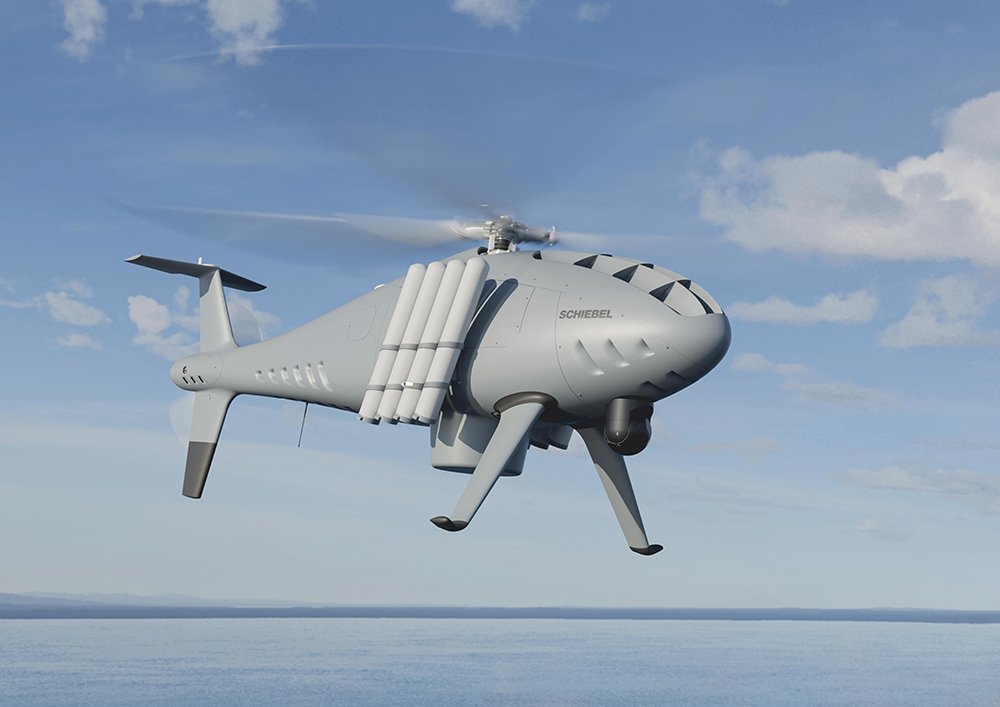
The CAMCOPTER® S-100, in particular, has reshaped how close-in, precise maritime surveillance is conducted. With endurance of up to six hours and the ability to hover or fly slow at low altitude, it can identify suspicious vessels, track small craft approaching convoys, provide overwatch during boarding operations, monitor piracy-prone waters or quietly observe fishing activity without alerting targets. Hovering allows the aircraft to focus on the smallest changes on deck – something fixed-wing VTOL UAVs simply cannot match. And because the S-100 can cover a sensor-effective search area three times larger in six hours than some platforms do in ten, its operational value is far greater than the raw flight time suggests.

The CAMCOPTER® S-100, in particular, has reshaped how close-in, precise maritime surveillance is conducted. With endurance of up to six hours and the ability to hover or fly slow at low altitude, it can identify suspicious vessels, track small craft approaching convoys, provide overwatch during boarding operations, monitor piracy-prone waters or quietly observe fishing activity without alerting targets
The CAMCOPTER® S-300 builds on this with a different kind of strength: persistence, reach and payload. With endurance beyond 24 hours and the ability to carry multiple sensors at once – EO/IR, radar, AIS, SIGINT – the S-300 is designed for wide-area maritime surveillance and long-range convoy escort, supporting missions that require continuous coverage far beyond the ship’s visual range. In a future naval task group, the CAMCOPTER® S-100 and CAMCOPTER® S-300 will operate together as complementary systems: one offering agility and precise observation, the other offering endurance and multi-sensor reach.
To understand the impact of these capabilities, consider a realistic morning in the Andaman Sea. A Coast Guard patrol vessel detects an intermittent radar contact but cannot classify it. Visibility is poor. Launching a boat team would take time and expose the crew to unnecessary risk. Instead, the commander deploys the S-100. Within minutes, the unmanned helicopter climbs above the sea clutter and reveals the truth: a small vessel drifting with engine trouble, two crew waving for help. What began as uncertainty becomes clarity – without placing a single human in harm’s way. Hours later, during a routine escort, a second S-100 launch quietly monitors a fast craft shadowing a merchant ship. From altitude, it records the vessel’s behaviour, allowing the ship to determine intent calmly and confidently.

For missions farther offshore or requiring all-day endurance, the S-300 offers the next layer of situational awareness. While the S-100 returns to the deck for refuelling, the S-300 remains on station, maintaining wide-area coverage and feeding the operations room with continuous multi-sensor data. Together, they transform uncertainty into understanding – and understanding into informed action.
In a future naval task group, the CAMCOPTER® S-100 and CAMCOPTER® S-300 will operate together as complementary systems: one offering agility and precise observation, the other offering endurance and multi-sensor reach
As unmanned operations expand, localisation within India becomes essential. Systems designed to safeguard national waters must be supported, sustained and customised on Indian soil. Building technical expertise, training operators, ensuring maintenance readiness and enabling Indian industry involvement are all key to long-term success. For maritime forces relying on continuous operational availability, support infrastructure must be as robust as the aircraft themselves.
Looking ahead, the direction is unmistakable. India’s maritime forces are moving toward an operational model where unmanned systems are not auxiliary platforms but central elements of fleet architecture. Rotary-UAVs will sit alongside manned helicopters on naval and Coast Guard decks. Maritime domain awareness networks will integrate unmanned feeds as a matter of routine. Task groups will employ layered unmanned surveillance, pairing the responsiveness of the S-100 with the persistence of the S-300. Doctrine will evolve, training will expand and unmanned operations will become embedded in the everyday rhythm of India’s maritime work.
India’s maritime forces are moving toward an operational model where unmanned systems are not auxiliary platforms but central elements of fleet architecture. Rotary-UAVs will sit alongside manned helicopters on naval and Coast Guard decks. Maritime domain awareness networks will integrate unmanned feeds as a matter of routine
On this Navy Day, as we honour the Indian Navy’s service, leadership and professionalism, I also recognise the Coast Guard crews, maritime enforcement agencies and countless individuals who work tirelessly to keep India’s waters secure. If technologies like the CAMCOPTER® S-100 and CAMCOPTER® S-300 can help them anticipate challenges, reduce risk and deepen understanding of the environment they operate in, then our work at Schiebel India carries real purpose.
The sea will always surprise us. But with the right tools – precise, persistent, autonomous and supported within India – our forces can meet those surprises with confidence and calm.
Jai Hind!
The writer is a Chief Executive Officer, Schiebel System India Pvt Ltd
