

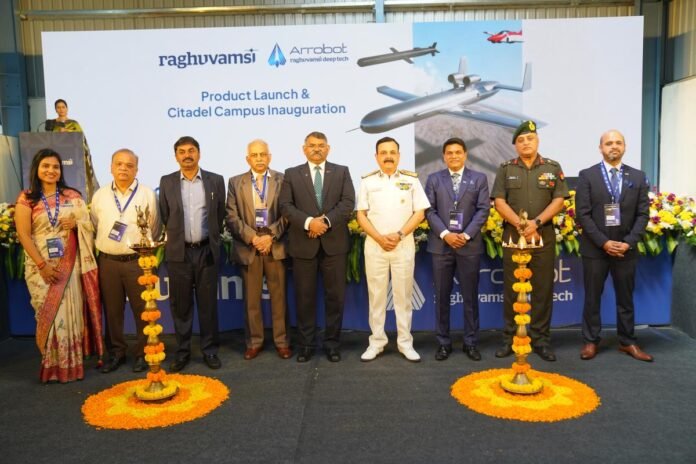
Raghu Vamsi Aerospace Group, with 10 manufacturing locations across three countries and more than 1,000 employees, has been supplying aero engines and missile subsystems for global OEMs and Indian DPSUs recently inaugurated its Citadel Campus at Hardware Park, near Hyderabad International Airport. The new facility strengthens the group’s ability to support Indian strategic programmes and global customers with faster turnaround times and scalable production.
Branded under its DeepTech vertical Arrobot, the initiative marks a significant step in India’s push towards Aatmanirbharta or self-reliance, next-generation defence technologies, supported by an investment exceeding ₹100 crore in infrastructure and innovation. The group has commissioned a new advanced design, production, and systems integration campus, alongside the rollout of six fully indigenous unmanned and autonomous defence platforms.

The newly unveiled Citadel Campus, adds large-scale facilities for design engineering, system integration, assembly, and testing. Building on Raghu Vamsi’s existing manufacturing footprint, the campus enhances the Group’s ability to deliver faster development cycles, scalable production, and mission-critical support for Indian defence programmes as well as global customers.
With operations spanning over 10 manufacturing sites across India, the US, and the UK, and a workforce of over 1,000 professionals, Raghu Vamsi Aerospace Group has long supplied aero-engine and missile subsystems to global OEMs and Indian defence public sector undertakings. The new campus significantly deepens its role in strategic defence manufacturing.
Alongside the infrastructure expansion, the Group unveiled six advanced defence platforms that reflect India’s growing expertise in autonomous and unmanned systems. The portfolio includes jet-powered loitering munitions, decoy and target drones, tethered surveillance platforms, air-launched missile systems, micro turbojet engines, long-endurance kamikaze UAVs, unmanned ground vehicles (UGVs), autonomous combat systems, and robotic aircraft maintenance solutions.
Designed for surveillance, deep-strike missions, logistics, and battlefield support, these platforms offer operational ranges exceeding 300 km and speeds of up to 650 kmph. Products such as RV Astra, RV Maya, RV Lakshya, RV Rudra, RV Indra, RV Yodha, and RV Drishti, underlining India’s transition from dependence on imported UAV and propulsion technologies to in-country design and large-scale manufacturing of advanced unmanned systems.

To accelerate indigenous development and defence exports, Raghu Vamsi has signed four key Memorandums of Understanding. These include a strategic collaboration with the 515 Army Base Workshop of the Indian Army for co-design, testing, and validation of advanced drone platforms, with Arrobot supporting the establishment of dedicated drone manufacturing capabilities at the Workshop.
Another MoU with Bharat Dynamics Limited (BDL) focuses on the joint development and supply of fully indigenous 200 kgf thrust-class engines for next-generation autonomous fighter platforms. A third partnership with IIIT Hyderabad targets AI-driven autonomy, swarm intelligence, and intelligent mission systems, while a fourth collaboration with ARCI aims to advance aero-engine technologies through laser cladding, additive manufacturing, and thermal barrier coatings. Together, these alliances strengthen India’s technology readiness and production depth in unmanned defence systems.

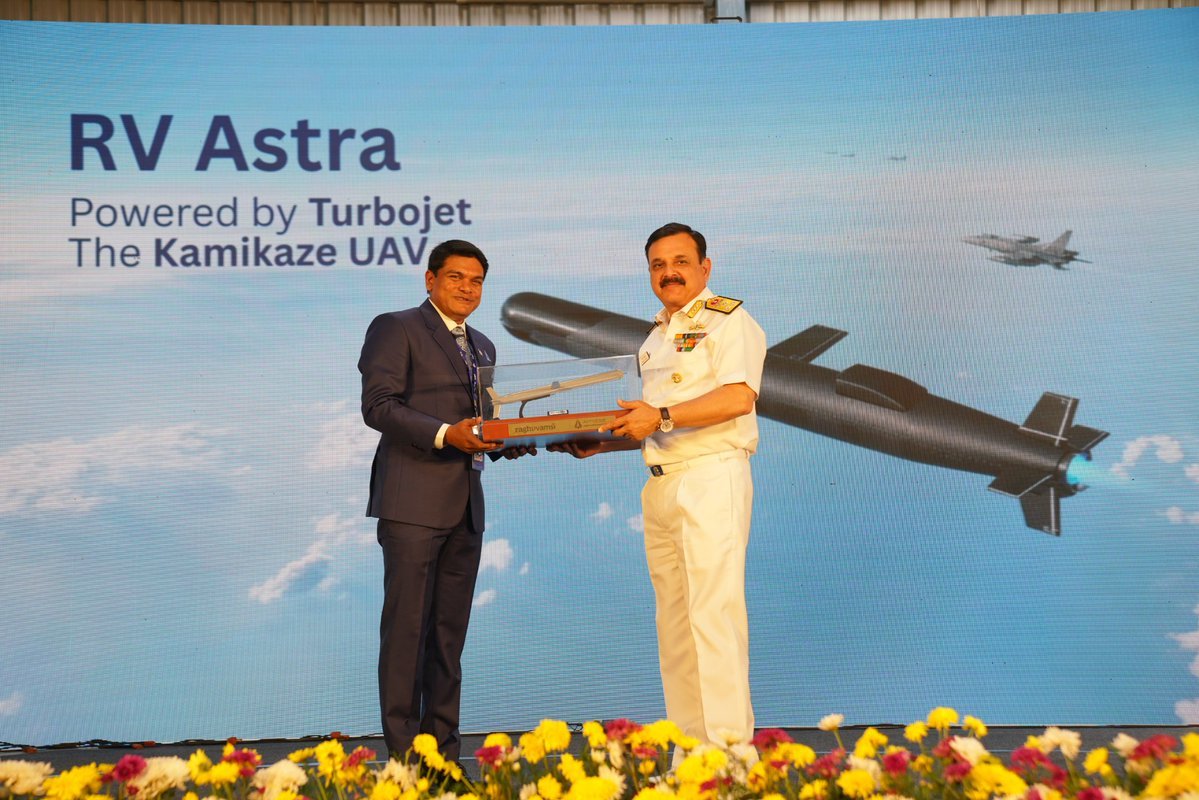
Commenting on the development, Vamsi Vikas, Founder and Managing Director of Raghu Vamsi Aerospace Group, said the expansion reflects India’s growing confidence in building advanced aerospace and defence technologies domestically. He noted that the focus goes beyond capacity creation to developing globally competitive systems engineered for future warfare, powered by Indian talent. He further said that India is now well positioned not only to meet domestic defence requirements but also to emerge as a trusted global supplier of high-technology aerospace solutions.
Founded in 2002, Raghu Vamsi Group has built a strong global presence over the past two decades by delivering high-precision engineering components and sub-assemblies to leading international corporations. As of now, the Group operates as an AS9100D and NADCAP-certified consortium with annual revenues exceeding ₹500 crore, serving sectors ranging from aerospace and defence to space, medical, energy, and industrial manufacturing. Its capabilities span design and engineering, CNC machining, composites, electronics, surface treatments, and full system integration, with exports to global OEMs such as Boeing, GE Aviation, Honeywell, Rolls-Royce, Safran, and Collins Aerospace, while also acting as a Tier-1 supplier to Indian organisations including DRDO, HAL, ISRO, BDL, and ADA.
In addition to the Citadel Campus, Raghu Vamsi Group is developing a large manufacturing complex with an investment of ₹300 crore at Telangana’s Hardware Park. Spread across eight acres with three buildings covering 2.5 lakh square feet, the facility is scheduled for inauguration by November 2026 and is expected to generate employment for over 2,000 people within three years, further reinforcing India’s position as a rapidly advancing global defence manufacturing hub.

