
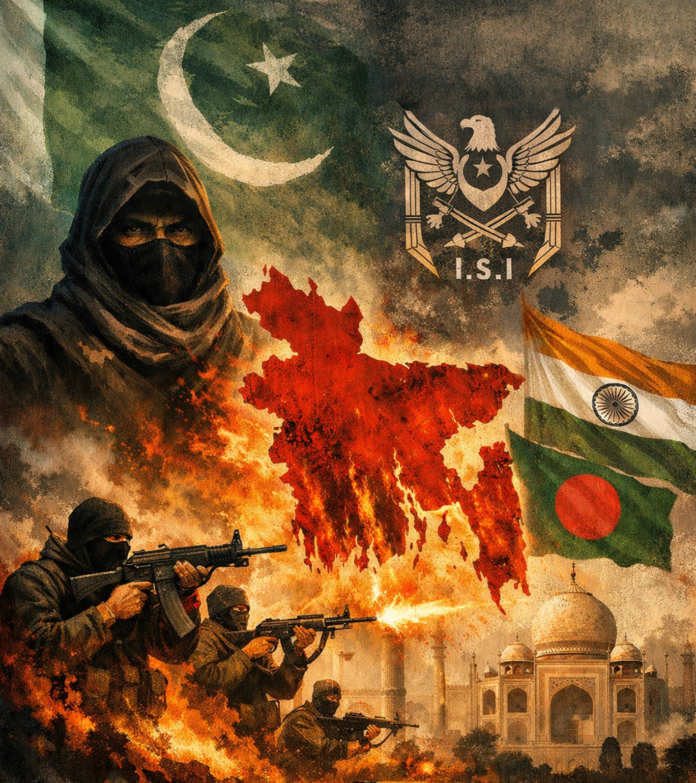
Bangladesh faces its worst turbulence in recent times. Street violence surges through its core, spilling past quota fights into something rawer, more directed. In quiet briefings and guarded conversations, Indian security officials increasingly trace this turbulence to a single, chilling construct: a covert ISI-directed ‘Dhaka Cell’ embedded inside Pakistan’s High Commission in Dhaka. What appears on the surface as political unrest and quota agitations is, in this reading, the visible edge of a deeper, long-prepared campaign to reshape Bangladesh’s internal balance in ways that reopen pressure on India’s eastern flank.
At the heart of this assessment lies intent, infrastructure and timing. The Dhaka Cell is believed to have been established only months ago, following a high-level visit by Pakistan’s senior military leadership to Dhaka, and staffed not by routine diplomatic personnel but by serving officers from the army, air force, and navy, including senior and mid-level serving officers. This is classic ISI tradecraft: embed operational cadres inside protected premises, fuse diplomatic cover with covert mandate, and then plug into local networks of radical preachers, student fronts and political intermediaries.

The playbook is old, but it works when conditions are right. Tap into religious networks already primed for mobilisation. Recruit student groups simmering with frustration. Social media serves as the accelerant, converting local grievance into national rupture. In this model, dialogue serves as a cover for disruption, and diplomacy becomes a staging ground for disorder.
The Dhaka Cell is believed to have been established only months ago, following a high-level visit by Pakistan’s senior military leadership to Dhaka, and staffed not by routine diplomatic personnel but by serving officers from the army, air force, and navy, including senior and mid-level serving officers
The assassination of student leader Sharif Osman Hadi has become the defining inflexion point in this emerging theatre. The killing, which triggered a surge of anti-government and anti-India sentiment on the streets, is increasingly viewed by Indian agencies as the carefully chosen ‘spark’ for an operation that had been under preparation since at least October. The killing altered the emotional temperature of the streets, creating both fear and a rallying symbol that organisers could rapidly exploit.
According to this view, unrest was not a spontaneous overflow but a pre-scripted mobilisation: propaganda primed in advance, crowds prepared, narratives aligned, and digital amplifiers ready to convert a violent incident into a political rupture. Timing matters. Sheikh Hasina’s departure removed a leader who had aligned Bangladesh’s internal security firmly against extremist spillovers. Under her tenure, counter-terror pipelines were constricted, and security cooperation with India became routine.
The stains of 1971 are being diluted by the present chaos. Religious mobilisation is being sold as reform. Electoral ambition is dressed up as a moral revival. External actors, always alert to opportunity, are pushing from the shadows. For Pakistan’s security establishment, Bangladesh remains unfinished business. The trauma of losing its eastern wing in 1971 was never reconciled; it was displaced outward, blamed on India, and preserved as institutional grievance. Destabilising Dhaka now is less about Bangladesh itself and more about settling an old strategic score.

The objectives extend beyond the turmoil of one country. A fractured Bangladesh weakens India’s eastern flank. A compromised election or none at all creates prolonged instability. That instability can then bleed outward. West Bengal’s electoral cycles and the Northeast’s dormant fault lines remain vulnerable to calibrated provocation. Reactivation does not require mass infiltration, only targeted funding, limited arms movement, and sustained narrative pressure. India’s Northeast, though quieter than in decades past, still contains dormant fault lines. Reactivating them does not require mass infiltration; just enough arms, money and messaging to restart momentum.
The killing of student leader Sharif Osman Hadi became the defining inflexion point. Indian agencies view the killing, which triggered a surge of anti-government and anti-India sentiment on the streets, as the carefully chosen ‘spark’ for an operation that had been under preparation since at least October
Patterns repeat with grim predictability. ISI operatives embedded in the High Commissions funnel funds to extremists to stoke anti-India sentiment. Dhaka reflects the same pattern, but in a far more combustible setting. Bangladesh’s demography, economic stress and proximity make it a far more combustible arena. The cell’s pre-October groundwork betrayed long gestation. Recruitment drives built networks and safe houses multiplied. Digital propaganda surged. Hadi’s killing aligned with election calculus. Delay the vote, and Yunus clings to power; rig it, and Jamaat surges. Either path erodes India’s influence. The ousted PM Sheikh Hasina had cemented goodwill through trade, water-sharing pacts, and counter-terror cooperation. This irked Pakistan, which saw an opportunity in the present window to re-enter via the back door of Islamist ideology.

The strategic cost for India is real. The eastern corridor had stabilised after years of patient engagement. Insurgent sanctuaries dried up. Connectivity projects reshaped regional trade. Trust replaced suspicion. That equilibrium is now under threat. A permissive Bangladesh risks reopening routes for arms, ideology and organised crime. Meanwhile, China watches closely. Its investments in ports, power plants and logistics infrastructure already translate into political and economic leverage. A weakened India–Bangladesh relationship would only deepen Dhaka’s dependency, allowing China to tighten its arc of influence across the Bay of Bengal without firing a shot.
New Delhi’s choices are constrained. Heavy-handed pressure on the caretaker government risks validating narratives of Indian interference. Public accusations against Pakistan, without publicly admissible proof, will be dismissed as paranoia. Silence, however, allows hostile networks to entrench themselves.
China watches closely. Its investments in ports, power plants and logistics infrastructure translate into political and economic leverage. A weakened India-Bangladesh relationship would only deepen Dhaka’s dependency, allowing China to tighten its arc of influence across the Bay of Bengal without firing a shot
The viable path lies in calibrated pressure and quiet clarity.
First, dismantle the operational spine of the Dhaka Cell, mapping personnel, funding routes and local collaborators. Intelligence exposure, even without public theatrics, disrupts confidence and limits reach.
Second, work discreetly with Bangladeshi institutions that still value sovereignty over subversion, reinforcing the costs of becoming a proxy battleground.
Third, communicate a clear line: India supports democratic stability, not regime engineering, and any actor inviting external manipulation will bear long-term consequences.
Simultaneously, India must secure its own flank. Borders require sustained vigilance backed by an integrated, real-time intelligence grid. Cyber spaces require active defence against narrative warfare. Information warfare may prove decisive in reviving public memory of 1971 and exposing the cost of Pakistani control. The generation that lived it understands what Pakistani control looked like and undercuts Jamaat’s attempt to recast itself as a force of liberation. Economic integration, people-to-people ties and visible benefits of cooperation with India must be foregrounded. Stability has dividends; chaos only creates patrons.
India’s choices are constrained. Pressure on Dhaka risks validating narratives of Indian interference. India’s role is neither saviour nor bully, but a firm neighbour that knows the stakes. The eastern horizon is turbulent. Meeting it requires steadiness and the resolve to prevent history from being weaponised again
None of this denies Bangladesh’s genuine internal failures. Youth unemployment is real. Governance gaps exist. Political exclusion fuels anger. Local actors committed violence. Those truths matter. But patterns also matter. Financial trails converge oddly. Mobilisation timelines align too neatly. External fingerprints match past operations elsewhere. Ignoring that convergence would be wilful blindness.
At its core, this confrontation is not about one election or one intelligence cell. It is about whether South Asia remains trapped in proxy conflicts and inherited resentments, or whether it finally breaks free. Pakistan’s security establishment has never fully accepted the verdict of 1971. Instead, it has sought redemption through disruption. India’s interest and Bangladesh’s are to ensure that history is not relitigated through chaos.
Dhaka now faces a choice. Anchor itself in the sovereignty earned at immense cost, or drift back into the shadow of those who once denied it. India’s role is neither saviour nor bully, but a firm, clear-eyed neighbour that understands the stakes. The eastern horizon is turbulent. Meeting it requires steadiness, not slogans, and the resolve to prevent history from being weaponised again.

The author, a PVSM, AVSM, VSM has had an illustrious career spanning nearly four decades. A distinguished Armoured Corps officer, he has served in various prestigious staff and command appointments including Commander Independent Armoured Brigade, ADG PP, GOC Armoured Division and GOC Strike 1. The officer retired as DG Mechanised Forces in December 2017 during which he was the architect to initiate process for reintroduction of Light Tank and Chairman on the study on C5ISR for Indian Army. Subsequently he was Consultant MoD/OFB from 2018 to 2020. He is also a reputed defence analyst, a motivational speaker and prolific writer on matters of military, defence technology and national security. The views expressed are personal and do not necessarily carry the views of Raksha Anirveda
