

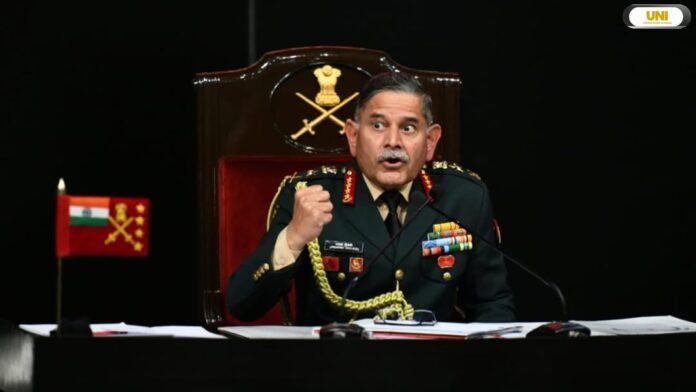
Reminding Islamabad that “Operation Sindoor is still ongoing, Indian Army Chief General Upendra Dwivedi on Tuesday (January 13) warned that “any misadventure by the adversary will be dealt with effectively.” The Chief of Army Staff (COAS) also stated that Operation Sindoor is the best example of tri-service synergy under a clear-cut political directive and full freedom to act or respond.
Addressing the annual press conference ahead of the Army Day, General Dwivedi spoke extensively about Operation Sindoor carried out against terrorists and terror hubs in Pakistan and Pakistan-occupied Kashmir. The Operation was launched in May 2025 by India to avenge the killings of 26 tourists in Pahalgam terror attack. The attack was carried out by The Resistance Front, a proxy of Pakistan-based terror group Lashkar-e-Taiba (LeT) on April 22, 2025.

Stating that the Indian Army had mobilised its troops and was ready for ground offensives, the COAS said that Operation Sindoor was conceptualised and executed with precision.
“Through 22 minutes of initiation on May 7 and an orchestration that lasted 88 hours up to May 10, the operation reset strategic assumptions by striking deep, dismantling terror infrastructure, and puncturing the longstanding nuclear rhetoric,” he said.
“This time, the action we took, especially the kind of firing that took place in Jammu and Kashmir, and the way we addressed it, and how we eliminated approximately 100 of their people, all that action was taken because we expanded the conventional space. In those 88 hours, you saw that the army’s mobilisation to expand the conventional space was such that if Pakistan made any mistake, we were fully prepared to launch ground operations,” he added further.
Speaking about the turning point of the Operation which finally forced Pakistan to approach India for a ceasefire, the army chief said that it was after they were able to “connect some dots” during the course of action.

“On the morning of May 10, certain orders regarding what needed to be done if the fight escalated were issued to all three-armed forces. The message of what would happen if the fighting continued was understood by whoever needed to understand it,” he said, while adding that complete details of the “orders” can’t be made public.
“The intent behind those orders was clearly conveyed through ground realities. Pakistan, had access to satellite imagery that showed the movement of Indian naval assets, strike corps and aircraft. When they connected the dots, they realised that it was the right time to stop the fight,” he said further.

The COAS said that around 9.30 am on May 10, Pakistan contacted the then Director General of Military Operations (DGMO) Lt Gen Rajiv Ghai to seek a ceasefire.
He also said that the successful precision strikes carried out on the nine terror camps in Pakistan and Pakistan-occupied Kashmir (PoK) also shook the “decision-making cycle on the other side.”
“They were shaken and took time to understand what had happened. Since they could not comprehend it immediately, they resorted to throwing stones and firing drones and missiles, whatever they had at their disposal,” he said adding that the actions demonstrated high level of chaos, panic and mismanagement within the Pakistani establishment.
“They could not understand what was happening. There was complete confusion. We gave a measured response. We did not want to push the fighting forward. We achieved the politico-military aim of the operation,” he said.

