

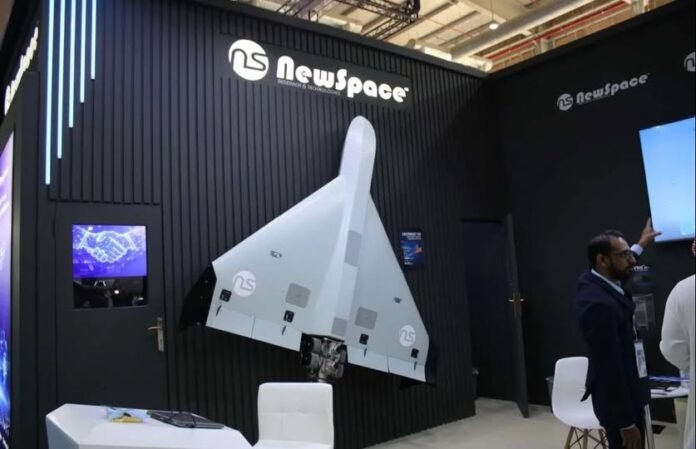
New Delhi: At the World Defense Show (WDS) 2026 in Riyadh, NewSpace Research and Technologies showcased its Sheshnaag 150 long-range collaborative loitering munition with 1,000+ km range, endurance of around five hours and 25 to 40 kg payload class. The system offers a lower-cost deep-strike alternative to cruise missiles.
Presenting its Sheshnaag-150 collaborative attack concept in front of an international audience at the World Defense Show in Riyadh, NewSpace Research and Technologies displayed a full-scale airframe and product material aimed at the long-range loitering munition market. According to the company, Sheshnaag-150 has already flown as part of ongoing work to mature the autonomy stack designed for massed and saturation employment. Designed for 1000+ km deep-strike missions with a 25-40 kg warhead class, Sheshnaag-150 enables networked swarm attacks that can overwhelm air defenses while also supporting ISR and electronic warfare roles through coordinated multi-vehicle tactics.

With a compact, low-aspect delta wing with a central dorsal fin and a rear propulsion section configuration, Sheshnaag-150 layout is optimised for simple manufacture, internal fuel volume, and stable long-range cruise. Emphasising on autonomy and collaborative behaviours as the core deliverable, NewSpace highlights work on intelligent cyber-physical uncrewed systems, including self-healing swarms, dynamic retasking, and advanced mesh networking, all of which align with a concept of launching multiple vehicles that cooperate rather than merely fly the same route. The system during early flight activity, reportedly demonstrated target engagement with an indicated CEP of 5 m.
Sheshnaag-150 positions itself to be most valuable for pre-emptive and follow-on strikes against air defense nodes, command posts, fuel and ammunition points, airfield infrastructure, and fixed high-value assets where a single hit creates cascading disruption. Its loitering attribute adds a tactical edge: launched on a permissive route, the munition can wait for time-sensitive cues, refine aim points through onboard sensors, and strike when the target pattern confirms, reducing wasted salvos compared with purely pre-planned one-way drones.
The “collaborative attack” focus by the company points to a specific method of employment: forcing defenders into an economic and tactical dilemma by presenting many simultaneous problems. This allows a commander to shape an air defense picture, provoke radar emissions, map engagement zones, and then drive a saturation wave through a seam. The same architecture also supports maritime coercion, with loitering munitions used to hold chokepoints and coastal approaches at risk, or to complicate naval air defenses through multi-axis arrivals.
In concept and competitive landscape, Sheshnaag-150 appears closest to Israel’s Harop class of loitering munitions, which has long-range reach and a warhead designed for high-value target sets. What differentiates Sheshnaag-150 is its heavier payload bracket and a stronger focus on multi-vehicle swarm behaviors as a primary design goal. Similarly, when compared with Iran’s Shahed-136 family, Sheshnaag-150 is a more actively coordinated, mission-adaptable system with ISR and electronic warfare growth paths. Sheshnaag-150 is a theater-level strike tool in comparison to tactical competitors like AeroVironment’s Switchblade 600, which is optimised for frontline units with tens of kilometres of range.

The robust performance of Sheshnag-150 under jamming, intermittent connectivity, and contested air defense conditions, will mark the arrival of relatively low-cost deep strike and saturation options.

