

Bitra — often hailed as the ‘Jewel of Lakshadweep’ — is a glistening speck in the vast Arabian Sea, rich in ecological charm and marine wealth. With just 0.105 sq km of land, Bitra is the smallest inhabited island in the Union Territory of Lakshadweep, yet it cradles a sprawling lagoon of over 45 sq km and boasts the highest percentage of live coral cover in the archipelago.
An oval-shaped stretch of white sands and turquoise shallows, the island is part of the Aminidivi group and home to fewer than 300 people. Despite its modest size, Bitra’s environmental significance is monumental — a natural sanctuary of coral atolls, reefs, and rich marine biodiversity.

Surrounded by scheduled wildlife areas, it forms part of the subcontinent’s only coral atoll reef system, and contributes to the 79,000 sq km of ecologically sensitive marine landscape that defines Lakshadweep.
Yet, this serene island — accessible by boat from the Amini jetty — now finds itself at the centre of a controversy.
The Lakshadweep Administration is fast pacing moves towards a takeover of Bitra, citing national security concerns, raising alarms among environmentalists and islanders alike. However, Vice Admiral Samir Saxena says that the fragility of the Lakshadweep ecosystem has been factored in by the Indian Navy and the expansion activities will take place in a measured way. “We don’t want to upset the ecosystem,” he added while speaking to journalists at the Annual Navy presser in New Delhi on December 2.
The new naval detachment on Bitra island is more or less completed and the Navy already has manpower positioned there, Rear Admiral Upal Kundu, Chief of Staff, SNC, said. “By next year, it will be fully functional,” he said.

Bitra’s Strategic Significance
Increased shipping traffic in the sea-lanes, Chinese interest in the Indian Ocean Region and the threat of Arabian Sea piracy increases the strategic significance of the Lakshadweep Islands from a security perspective. According to Vice Admiral Saxena, in the last one year alone, the Navy deployed more than 35 ships and conducted more than 1,000 boarding operations in response to shipping attacks and incidence of piracy in the western Arabian Sea. “The swift action by the Navy has saved the lives of more than 520 people from various nations,” he said.
“The Chinese operations are quite opaque with regard to their intentions. But we have our eyes on them and we are confident that our national maritime interests are never jeopardised,” he further said.

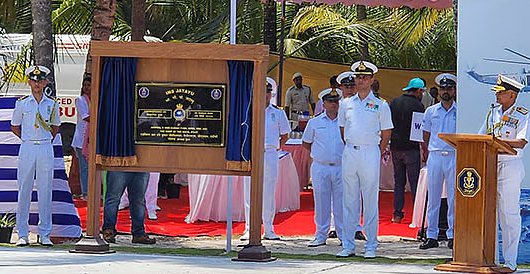
On Minicoy, the Navy already has the INS Jatayu naval base and the INS Dweeprakshak base on Kavaratti. On the Air Force plans for Lakshadweep, Vice Admiral Saxena pointed out that in future, “all assets are joint,” referring to increasing synergy among the forces.
In the emerging Indian Ocean scenario, the Air Force views the Lakshadweep Islands, as well as the Andaman and Nicobar Islands in the east, as good “stepping stones” for military and surveillance operations.
Air Marshal Narmdeshwar Tiwari, Vice Chief of the Air Staff, who was in Thiruvananthapuram in October earlier, had described the Lakshadweep Islands as “our frontier posts,” stating that their continued development assumes relevance in the current geopolitical climate. The Air Force is expanding the existing air field to accommodate bigger aircraft in Agatti and a new air base on Minicoy.
In the coming years, the Air Force also hopes to have long-range cargo drones capable of carrying heavy payloads play a vital role in its expansion plans in Lakshadweep.
The development of defence infrastructure in Lakshadweep islands comes at the time of heightened maritime security threats. As per the Navy, they had deployed more than 35 ships and conducted 1000-plus boarding operations in the last one year to deal with piracy and attacks on ships.
Meanwhile, the Indian Navy has rescheduled its Maritime Capability Perspective Plan (MCPP) to a 2032 deadline, as it was unable to achieve the goals due to various constraints, Saxena said.
The (MCPP) is the Indian Navy’s long-term blueprint for building and modernising its force structure to meet future operational and strategic requirements.
“Now that aspiration has to be built by several stakeholders, and shipbuilding per se is not easy, though they have now become much more efficient and rapid. That is why we are churning out a ship in 40 days. This is more of a recent development, the thrust on Aatmanirbharta, the support to the shipbuilding industry, MSMEs that support the ship builders and the shipyards,” Saxena said.
“It is an aspirational plan, perhaps in that MCPP, the numbers we intended could not be reached. We have a budgetary constraint across the nation, with so many compelling demands for finances in our great country,” he added.
He further said that the timeline of the MCPP has been extended to 2032.

