

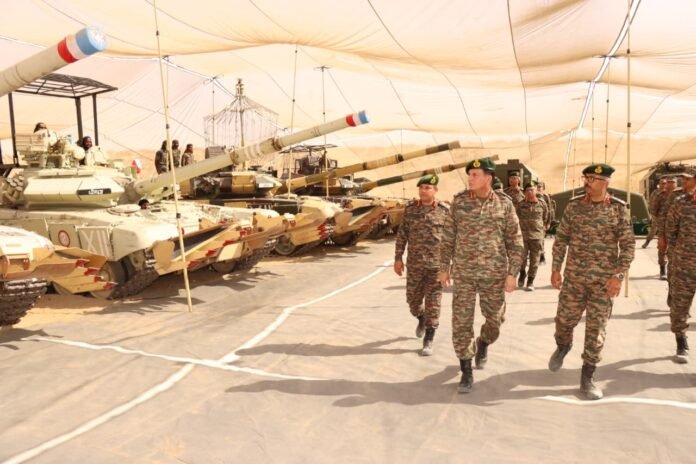
Cold Start Doctrine: The ‘Cold Start’ doctrine was developed to mitigate slow and time-consuming mobilisation of strike formations owing to the geographic locations. It was designed to achieve a preliminary battlefield strike against Pakistan’s defences, calibrated to achieve a deeper strike by Strike Corps to inflict damage well before international pressure could mount. The entire operation was in the conventional domain where the doctrine was a military strategy designed for rapid, limited conventional attacks into Pakistani territory, using conventional superiority to achieve political goals without infringing Pakistan’s nuclear threshold.
The doctrine was a construct to project India’s punitive deterrence, which could transcend the escalation matrix, ranging from location-specific trans-border strikes to a limited localised conventional attack, and finally culminating in a full-blown traditional war. The sequence was by default aimed to deplete Pakistan’s war-waging potential, thus forcing it to stop supporting cross-border terrorism, besides using the captured territory as a bargaining chip.

The key elements of the Cold Start doctrine were rapid mobilisation for limited offensive operations by integrated battle groups against shallow objectives designed as swift incursions to seize and hold a narrow slice of Pakistani territory while remaining below the nuclear threshold. All this was aimed at providing the requisite political leverage to force Pakistan to abrogate its support for cross-border terrorism. However, if it did not yield the requisite results, the Army’s strike corps has been designed to strike deep at politically sensitive objectives in depth, as part of a full-blown conventional war to bring about a favourable war termination.
‘Cold Strike’ emphasises the application of instant force at points of decision for instant punitive destruction. Lethality has been enhanced manyfold in the ‘Cold Strike’ doctrine by the integration of modern technologies (drones, cyber/ EW) and joint operations across land, air, and sea
Need for Doctrinal Shift
On the contrary, in the domain of proxy war, Pakistan’s continued support for cross-border terrorist actions has only increased with impunity despite India’s cross-border surgical strikes at Balakot, which was a departure from the past restraint of transboundary violations. This required a strategic rethink on the methodology of inflicting punitive damages to achieve the political objectives against terrorism in particular, while remaining in the non-escalatory domain. Thus, Op Sindhor was the next level on the escalation ladder, conceived to punish perpetrators and planners of terror and destroy terror infrastructure deep inside Pakistan territory, irrespective of its location. It was a principle-driven military response underpinned by strategic restraint and measured non-escalatory intent using strategic weapons despite striking deep into Pakistan’s territory.
These strikes were deliberately confined to the neutralisation of systems that had facilitated the Pakistani assault and were executed under the guiding principle of “equal intensity in the same domain.” By targeting only those installations directly involved in the aggression, India balanced the imperative of deterrence with its overarching commitment to de-escalation. The response was non-escalatory, precise and targeted terrorist training camps at nine different locations within Pakistan and the Pakistan-Occupied Kashmir. No military targets were engaged. Thus, India’s strategic calculus in Operation Sindoor was based on an unwavering objective to uphold national sovereignty and protect civilian lives without precipitating a broader military conflagration. Therefore, at the doctrinal level, the need was to develop capabilities that could provide the requisite punitive punch across the spectrum to complement the larger deep strike matrix when required.
The key elements of the Cold Start doctrine were rapid mobilisation for limited offensive operations by integrated battle groups against shallow objectives designed as swift incursions to seize and hold a narrow slice of Pakistani territory while remaining below the nuclear threshold
The Cold Strike Doctrine
The Cold Strike Doctrine is an evolution of India’s Cold Start Doctrine, a military strategy for rapid, decisive, multi-domain offensive actions against Pakistan, triggered by large-scale terror attacks, to neutralise perpetrators of terror. It is aimed at achieving limited political objectives operating below Pakistan’s nuclear threshold before de-escalation. It shifts from seizing territory (a prerequisite for Cold Start) to paralysing enemy response mechanisms through swift cyber, air, land, sea and electronic warfare strikes, focusing on time and disruption rather than territorial conquest, using pre-deployed Integrated Battle Groups (IBGs) in concert with air and sea components for immediate destructive response.

The raising of the Rudra All-Arms Brigade is a fallout of this doctrinal shift from the ‘Cold Start’ to a more aggressive ‘Cold Strike’ doctrine. It is the raising of a technologically integrated formation of highly autonomous units designed for rapid, multi-domain ‘sensor-to-shooter’ action. It pairs light commando elements with advanced unmanned systems and hybrid loitering-munition / RPAS batteries to enable near-real-time target acquisition and engagement. The formation symbolises a shift in doctrine precept — signalling India’s capability for swifter and precise operations across multiple domains. In organisational terms, the Rudra Brigade merges infantry, armour, engineering and air-defence artillery under unified command with an emphasis on rapid mobilisation and multi-domain coordination — land, air, sea and cyber.
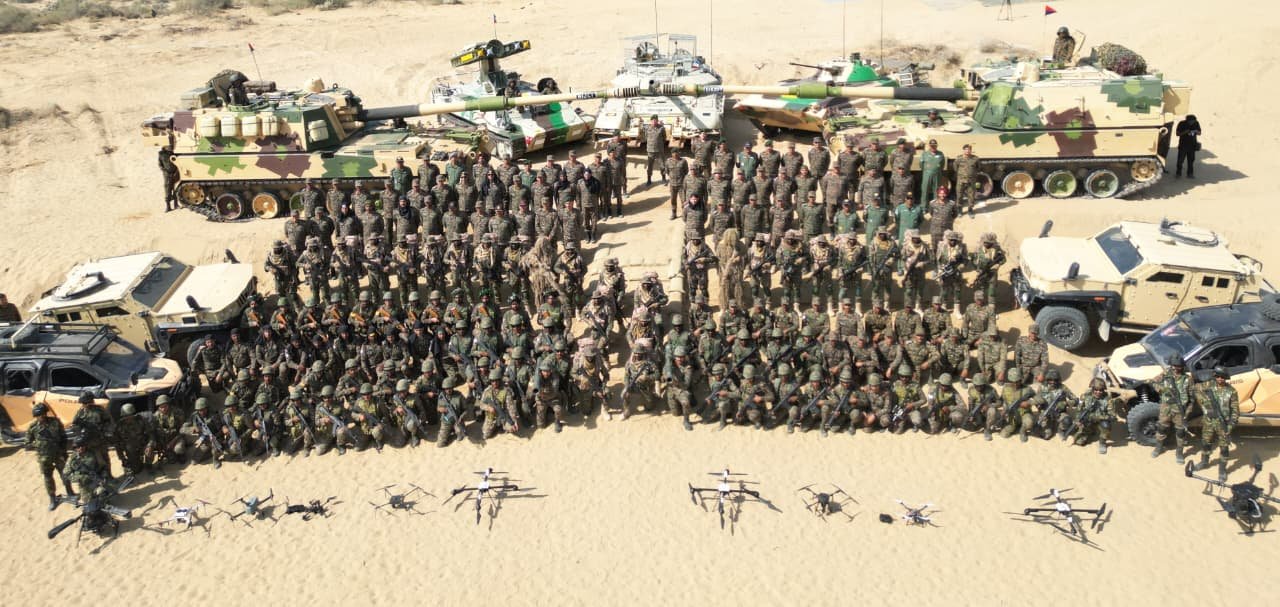

The key components of the Rudra brigade include the Bhairav commando battalion, the UAS-driven Shaktibaan artillery regiments (air-artillery), and Divyastra batteries, mixing loitering munitions with dual-role RPAS — a configuration intended to reduce dependence on external ISR and speed up decision-to-strike cycles. These moves mark the first phase of a broader transition towards Integrated Battle Groups (IBGs) — smaller, agile, self-sufficient combined arms formations optimised for rapid offensive operations and high-tempo multi-domain fights. Officials and analysts cited at recent exercises framed the Rudra/IBG pathway as central to the Army’s future operational posture.
The Cold Strike Doctrine is an evolution of the Cold Start Doctrine. It shifts from seizing territory to paralysing enemy response mechanisms through swift cyber, air, land, sea and electronic warfare strikes, using pre-deployed Integrated Battle Groups in concert with air and sea components
The Concept
As a concept, ‘Cold Strike’ emphasises the application of instant force at points of decision, aiming for near-immediate readiness and instant punitive destruction. Hence, its lethality has been enhanced manyfold by the integration of modern technologies (drones, cyber/ EW) and joint operations across land, air, and sea, signalling a lethal joint force application that implies rapid and deeper strikes with precision across multiple domains. In effect, it signals an era of ‘instant-operational’ readiness designed to reduce Pakistan’s political, military and diplomatic response time, while retaining the key to ‘Escalation-risk dynamics’. It is designed to demonstrate India’s punitive strike capability across the entire spectrum of the battlefield. For Pakistan, it is aimed at reducing reaction time, increasing uncertainty and intensifying the decision/deterrence dilemma, where speed, precision and multi-domain application of forces matter more than sheer mass.

–The writer is a former GOC of the Indian Army and presently serves as a Strategic Consultant and Principal Advisor. The views expressed are of the writer and do not necessarily reflect the views of Raksha Anirveda
