

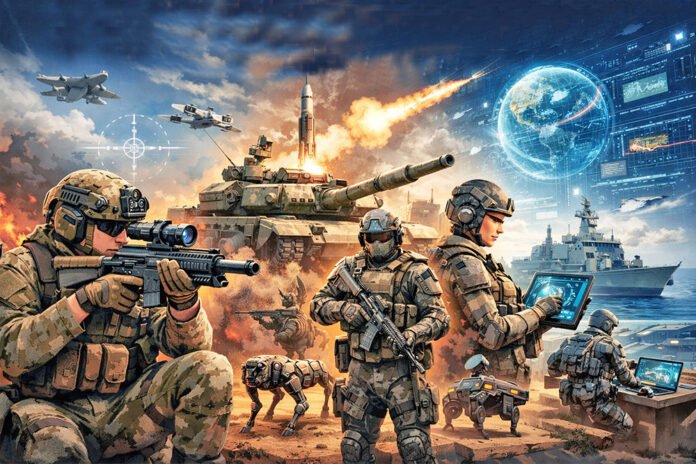
For decades, India’s military posture along both active borders relied on manpower, grit, and the comfort of legacy doctrines. The Army lived in a world defined by defensive culture, siloed compartments and reactive mindsets. China’s rise was acknowledged but not fully absorbed. Pakistan’s proxy strategy was countered but rarely transformed. The battlefield has transformed into a battlespace and the defence landscape has outgrown old warfighting grammar, yet India lived a generation of warfare behind, struggling to adapt to be future-ready.
This has now changed. Today, the Indian military is transforming where intent and urgency converge. The numbers speak for themselves: expanding participation of the private sector, record contracts, rising exports and indigenous character of military equipment. However, the vision, velocity and vocabulary for deterrence and a future-ready force are sluggish in a strategic environment that punishes hesitation. What counts now is a defence ecosystem that spots disruption early and absorbs shocks without losing tempo.

A Year of Scale, But Not to Scale
A review of 2025 reveals the Ministry of Defence signing a record 193 contracts worth over ₹2 lakh crore, with nearly 80% routed to domestic players. A chunk of this sprint came straight out of Operation Sindoor’s warning shot on ammunition and drone shortages, triggering emergency procurements close to ₹40,000 crore. Production crossed ₹1.54 lakh crore and exports reached ₹23,622 crore, a 12% year-on-year rise. Reforms like digital export authorisation and Open General Export Licences fuelled this, turning India into a supplier to over 100 countries.
Positive Indigenisation lists expanded, with thousands of items shifted off the import books. Yet the transformation from indigenisation to indigenous solutions remained sluggish. The technology indexing and indigenous content mapping remained in the grey zone, concealing more than reality.
Positive Indigenisation lists expanded, with thousands of items shifted off the import books. Yet the transformation from indigenisation to indigenous solutions remained sluggish. India’s dependence on foreign engines, electronics, subsystems, sensors and chips stayed stubborn
Behind the headline numbers, India’s dependence on foreign engines, electronics, subsystems, sensors and chips stayed stubborn. As the Russia–Ukraine war disrupted global components and the Middle East crisis distorted shipping cycles, India felt the fragility of its modernisation from beyond the borders.
Operation Sindoor: India’s Wake-Up Call
Operation Sindoor became the defining military event of 2025. The campaign showed how far the Army and Air Force had come in fusing sensors, shooters and decision tools at altitude, with C5ISR networks, loitering munitions, swarms and hardened links finally working as a single chain instead of scattered pieces. Indigenous kit held up, fusion cells moved information without choking, and the overall precision cycle looked sharper than anything seen in 2020.

Yet the cracks were just as clear: ammunition stocks were tight, cyber and electronic resilience wobbled, air defence and drone warfare needed a proper doctrinal construct, and too many frontline systems leaned on imported components with fragile supply lines. Digital readiness across formations was uneven, and legacy manpower-heavy habits still dragged down sectors where tech should’ve carried more weight. Most telling was the mismatch between what was inducted and how it was actually employed; doctrine and training simply hadn’t kept pace.
Sindoor did not break deterrence, but it made one thing obvious: the next crisis will not allow the luxury of emergency procurement as the mainstay. The force must enter a confrontation already stocked, networked, trained and integrated in a doctrine, for a compressed battlespace. It also sent a clear message that no two wars will ever be the same.

Where India Gained Strategic Ground
Despite structural issues, 2025 did deliver a strategic pathway:
- C5ISR Expansion: India’s surveillance footprint, be it space, air, ground, and electronic, grew deeper and more resilient.
- Precision Strike: New BRAHMOS regiments, tactical loitering munitions, drones/ swarms and expanding missile programmes strengthened deterrence.
- Air Defence: Akashteer and MRSAM deployments created layered defence grids in sensitive sectors.
- Naval Deterrence: Progress on submarines, destroyers, ASW platforms and maritime patrol assets took shape, countering the PLA Navy’s increasing Indian Ocean presence.
- Export Credibility: BRAHMOS orders, Akash deliveries, Tejas interests, and radar exports improved India’s diplomatic leverage.
Operation Sindoor made one thing obvious: the next crisis will not allow the luxury of emergency procurement as the mainstay. The force must enter a confrontation already stocked, networked, trained and integrated in a doctrine, for a compressed battlespace. It also sent a clear message that no two wars will ever be the same
A Doctrinal Gap that Technology Alone Cannot Fix
Modernisation in India has historically been procurement-led, not doctrine-led. Further, it’s always chasing the goose with the procurement philosophy being ‘Threat cum Capability’ rather than ‘Capability cum Opportunity’. As the Army, Navy, and Air Force inducted high-tech systems, their doctrinal alignment lagged. Multi-domain operations remained more aspiration than operational design. Jointness moved forward, but theatre commands still lacked full operational, financial, and conceptual clarity. Cyber, space, and electronic warfare units existed but were not yet fused into everyday operations at a scale commensurate with adversaries.
India’s services fought with determination, but too often in parallel lanes. In an era where adversaries deploy AI-driven targeting, cognitive warfare, cross-border information ops, drones at scale, and bandwidth-denial tactics, stovepipes are more dangerous than scarcity.
The Triple Whammy that Must be Overcome
India’s push for defence self-reliance keeps running into the same three roadblocks that feed off each other.
First, immediate operational needs take precedence. The frontline demand for equipment is immediate, but the tech and procurement cycles are totally misaligned.
Second, the private sector’s economic logic leans heavily towards assembly and licensed production over real design work, locking itself into predictable margins but shallow innovation. Add to it, the process is slow, tangled, and driven by fantasy-grade GSQRs that chase what isn’t on the shelf, so foreign buys keep winning by default.
Third, the public sector’s legacy of Transfer of Technology (ToT) continues to deliver diminishing returns. Decades of ToT deals have made India a competent assembler but not the author of its own systems, leaving true autonomy just out of reach.
India’s services fought with determination, but too often in parallel lanes. In an era where adversaries deploy AI-driven targeting, cognitive warfare, cross-border information ops, drones at scale, and bandwidth-denial tactics, stovepipes are more dangerous than scarcity
2026: The Opportunity India Cannot Afford to Waste
The coming year demands a shift from speed to acceleration. Without doctrinal clarity, budget discipline, cultural jointness, and technology ownership, 2025’s gains will plateau. Four foundational pillars:
- A National Security Strategy. Modernisation strategy is foundational on a clear National Security Strategy that integrates ends, ways and means. Devoid of that anchor, reforms drift with budgets, turf battles and shifting politics, leaving the entire effort scattered and reactive rather than purpose-driven.
- A Deep-Tech Defence Industrial Base. India needs propulsion lines, sensor foundries, materials labs, and electronics clusters that match military requirements, not civilian assembly lines repackaged as the defence industry. They need to invest in new domains such as Cyber, Space, Cognition and emerging technologies like C5ISR, Artificial Intelligence, Quantum, Machine Learning, Hypersonic and Robotics.
- Real Jointness Built on Multi-Domain Operations. Theatre commands must be preceded by battlespace assets integration and designed around effects, not turf; the services must train and fight as a single organism, not as discrete formations.
- Reforming the Acquisition-to-Deployment Pipeline. Modern war moves in months; technology cycle moves weeks; India’s procurement cycles move in years. Without structural reform, India will buy yesterday’s technology at tomorrow’s prices to fight future wars with yesterday’s tools.
What Must Come Next
India’s military modernisation now hinges on four truths.
First, war is entering the age of cheap mass and expensive precision. The Army must dominate both. That means industrial-scale production of sensors and expendables, alongside a selective rise in precision weapons that punch above their cost.
The private sector’s economic logic leans heavily towards assembly and licensed production over real design work, locking itself into predictable margins but shallow innovation. Also, the process is slow and driven by fantasy-grade GSQRs that chase what isn’t on the shelf, so foreign buys keep winning by default
Second, modernisation cannot remain procurement-led. It has to be doctrine-led. A force that buys technology without redesigning its fight will always underperform the platform. Further procurement cycle and technology cycle must be two sides of the same coin. Disruptive and emerging technology procurements must follow a different process.
Thirdly, the Army needs to handle data as it treats ammunition. It will prevail on the side that perceives patterns, anomalies and the digital pulse of the enemy.
Fourth, the technology development in India cannot be based on a foreign ecosystem. Gaps can be filled by imports, yet a decisive edge is acquired by indigenous systems, which adapt to the operational environment and address the challenges of the subcontinent threats.
The modernisation strategy is foundational on a clear National Security Strategy that integrates ends, ways and means. Devoid of that anchor, reforms drift with budgets, turf battles and shifting politics, leaving the entire effort scattered and reactive rather than purpose-driven
The Bottom Line
India shed its legacy cloak in 2025, but now needs a new overall to deter, deny and dominate future threats. The industrial potential, human capital and strategic intent that the country possesses must develop a force that can deter its technologically superior neighbours as well as the politically unpredictable ones. However, the actual change will only be realised when India no longer regards modernisation as a checklist but as a national mission with clear inviolable time lines, clear ownership and clear deliverables. The year 2026, to that extent, will be a defining year for ‘Aiming, Arming, and Adapting’ a Future Ready Military.

The author, a PVSM, AVSM, VSM has had an illustrious career spanning nearly four decades. A distinguished Armoured Corps officer, he has served in various prestigious staff and command appointments including Commander Independent Armoured Brigade, ADG PP, GOC Armoured Division and GOC Strike 1. The officer retired as DG Mechanised Forces in December 2017 during which he was the architect to initiate process for reintroduction of Light Tank and Chairman on the study on C5ISR for Indian Army. Subsequently he was Consultant MoD/OFB from 2018 to 2020. He is also a reputed defence analyst, a motivational speaker and prolific writer on matters of military, defence technology and national security. The views expressed are personal and do not necessarily carry the views of Raksha Anirveda
