

As India celebrates Navy Day on December 4, 2025, the nation honours not just the historic success of Operation Trident in 1971, but also the transformative journey toward becoming a self-reliant maritime superpower. This year’s theme, “Strength and Power through Innovation and Indigenisation,” perfectly captures the Indian Navy’s strategic pivot toward technological sovereignty and quantum-resilient security infrastructure.
The stakes are enormous: approximately 95 per cent of India’s trade by volume and about two-thirds by value moves by sea, making a strong navy absolutely central to India’s goal of becoming a Viksit Bharat – a developed India by 2047. With over 67,000 personnel and approximately 150 ships and submarines, the Indian Navy stands as the guardian of India’s 7,517-kilometre coastline and these vital maritime trade routes that fuel economic prosperity.

But beyond the impressive fleet numbers lies a more profound transformation: the Navy’s aggressive push toward indigenous technology, multi-domain networked operations, and next-generation quantum security solutions that will define India’s maritime dominance in the 21st century.
What Top Indian Navy Leaders Are Saying
Admiral Dinesh K Tripathi, the 26th Chief of Naval Staff, released the strategic document “CNS Course to Steer-2024” (CTS-2024) in August 2024, outlining his vision for the Navy’s role in achieving Viksit Bharat. This comprehensive roadmap emphasises creating a “combat-ready, credible, cohesive and future-ready navy” aligned with India’s broader national development goals by 2047.
Upon assuming command in April 2024, Admiral Tripathi declared his commitment to strengthening the Navy’s efforts toward Aatmanirbhar Bharat, emphasising new technologies as critical pillars for national development. The vision is to build a well-balanced, multi-domain, networked force operating seamlessly across space, air, surface, subsurface and cyber, with indigenous capabilities and niche technologies to handle emerging threats.
His predecessor, Admiral R Hari Kumar, had set an ambitious target: achieving complete aatmanirbharta (self-reliance) in capabilities, capacities, and concepts by 2047, coinciding with India’s centenary of independence. In January 2024, Admiral Hari Kumar stated, “The government has given us clear guidelines on Aatmanirbhar Bharat. We have given assurances that the Indian Navy will become Aatmanirbhar by 2047.”

Senior leadership consistently links Aatmanirbhar Bharat with strategic autonomy, viewing indigenous capabilities not just as military needs but as drivers of economic growth, high-tech jobs, and national resilience.
From Buyer’s Navy to Builder’s Navy
The transformation Admiral Hari Kumar described—from a “buyer’s navy to a builder’s navy”—is now a reality. India commissions a new warship approximately every 40 days, with over 54 ships under construction as of September 2025, valued at approximately ₹99,500 crore ($12 billion).

Speaking at the commissioning of INS Sandhayak in February 2024, Admiral Hari Kumar emphasised the Navy’s dedication to crafting a balanced “Aatmanirbhar Force” in service of an ascended India. The numbers speak volumes: 43 of 45 ships and submarines currently on order are being constructed in Indian public and private shipyards, with all new vessels fitted with indigenous weapons and sensors.
Key Indigenous Achievements
INS Vikrant (2022): India’s first indigenous aircraft carrier, designed by the Warship Design Bureau and built by Cochin Shipyard Limited, represents 76 per cent indigenous content. This 262-meter floating fortress can house over 1,500 personnel and operate independently for 45 days, showcasing India’s warship-grade steel manufacturing and complex shipbuilding infrastructure.
Arihant-Class Submarines: India became the first country outside the UN Security Council’s permanent members to build ballistic missile submarines. INS Arihant and INS Arighaat are currently on deep sea patrols, completing India’s nuclear triad with 75 per cent indigenous content in the latest vessels.
Project 75(I) Submarines: This ambitious conventional submarine programme is designed to establish national competence in complex platform design and construction, with progressively higher indigenous content including weapons, communication and command systems—further reducing external dependencies.
Indigenous Systems Progress
The Navy’s Centre for Indigenisation & Self Reliance (CISR) reports achieving 90 per cent indigenisation in hull components (“Float”), 60 per cent in propulsion systems (“Move”), and 50 per cent in sensor suites and weapon systems (“Fight”) as of October 2024.
Admiral Hari Kumar’s Naval Innovation and Indigenisation Organisation (NIIO) filtered over 300 proposals from more than 1,100 submissions from MSMEs, signing 518 contracts for game-changing indigenous technologies that provide strategic autonomy during conflicts.
Cyber, Data and Maritime Security
As naval platforms, ports, logistics and command systems become hyper-connected, the Indian Navy recognises cyber threats as a major risk to mission assurance and national security. As one analysis notes, a developed maritime power is defined not just by the size of its fleet but by the resilience of its digital backbone—data, networks and cryptography—which now sit at the heart of deterrence, war-fighting and peacetime presence operations.
The Mounting Cyber Threat
The cyber threat landscape facing India—and particularly its defence forces—has reached critical proportions.
- CERT-In data indicates that between 2021 and mid-2025, India recorded more than 2.2 million cybersecurity incidents, averaging over 3,000 attacks per day across sectors.
- Cyber intrusions can disable critical communication lines, disrupt fleet movements, compromise surveillance systems, and undermine operational readiness. Naval fleets increasingly rely on networked systems for communication, navigation, and mission-critical operations, making them particularly susceptible to cyberattacks.
The Indian Navy has become a pioneer in quantum-secure communication, deploying 25 indigenous QKD systems in a landmark partnership. This strategic collaboration with QNu Labs provides an unbreakable shield for mission-critical naval communications against future threats
The government’s response reflects the severity of this threat. The Union Budget 2025 earmarked over ₹1,900 crore specifically for national-level cybersecurity initiatives, signalling a material increase in direct cyber allocations.
Why Quantum Security Matters for Naval Operations
Traditional encryption methods face an existential threat from quantum computers, which could decrypt sensitive military communications in minutes. For the Navy—handling classified submarine patrol routes, strategic weapon deployment plans, satellite communications, and real-time maritime intelligence—data security isn’t just important; it’s mission-critical to national survival.
The quantum threat is already present: hackers could steal encrypted information today, store it, and decrypt it in 10-15 years using a future quantum computer—a strategy known as “harvest now, decrypt later”. For long-term sensitive naval data, this poses an unacceptable risk.
India’s Quantum Security Infrastructure
India is investing heavily in quantum technologies for secure maritime communications. The National Quantum Mission provides the overarching framework, and the Navy has moved decisively to become an early adopter.
In a landmark move in May 2023, the Indian Navy became India’s first large-scale procurer of quantum-based encryption systems through a partnership with Bengaluru-based QNu Labs. The procurement order for 25 Quantum Key Distribution (QKD) systems in a hub-and-spoke configuration across multiple locations marked a watershed moment in India’s quantum-secure communication infrastructure.
This deployment demonstrated the Navy’s determination to stay at the forefront of emerging security technologies and positioned it as a pioneer in quantum-secure communication within India. The partnership represents a perfect synergy between the Navy’s strategic needs and the capabilities of India’s growing deep-tech ecosystem.
QNu Labs: Building India’s Quantum Shield
QNu Labs, India’s first commercial quantum cybersecurity company, has emerged as a key player in this strategic domain. Founded in 2016 and based out of IIT Madras Research Park, the company specialises in comprehensive quantum security solutions.
The company’s recognition and growth trajectory underscore its strategic importance:
- Selected under the National Quantum Mission (NQM) by the Department of Science & Technology (DST)
- Showcased its Quantum Random Number Generator System-in-Package (QRNG SIP)—the nation’s first quantum random number generator in compact chip format—to the Prime Minister at ESTIC 2025
- Unveiled India’s inaugural 500-kilometer QKD network over pre-existing optical fibre using completely indigenous technology
- Won iDEX Open Challenge 2.0, developing a 150-km QKD system with trusted nodes
- Projected ₹200 crore revenue by FY2026, with over 50 per cent from the private sector
QNu Labs, India’s first commercial quantum cybersecurity company, showcased a pioneering 500-kilometer QKD network built with completely indigenous technology. This milestone underscores a viable commercial ecosystem for deep-tech and the Navy’s commitment to sovereign security solutions
Comprehensive Quantum Security Solutions
The technological solutions deployed for naval applications represent cutting-edge innovation:
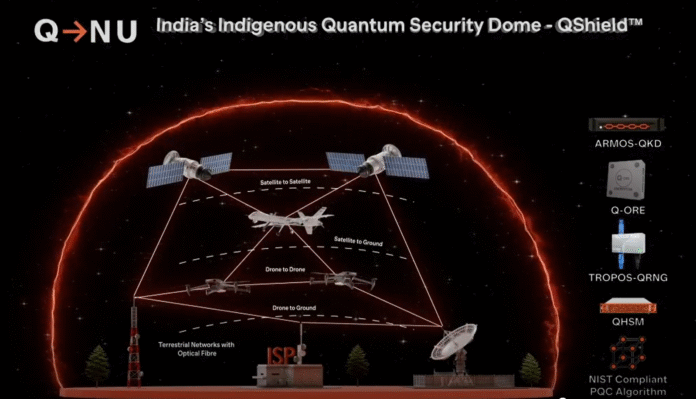
Armos (QKD System): This flagship Quantum Key Distribution solution generates unbreakable encryption keys using quantum physics principles, ideal for securing submarine communications, satellite links, command networks, and tactical systems. The systems delivered to the Indian Navy represent one of the most significant deployments of quantum security technology in the country.
Tropos (QRNG): This Quantum Random Number Generator creates truly random numbers using quantum mechanics, serving as the new “Root of Trust” for all security solutions. With high entropy, it secures wireless communications and prevents intelligence leaks without compromise.
QShield Platform: Launched on World Quantum Day 2025, this is the world’s first unified quantum-safe cryptography platform that enables seamless management across cloud, on-premises, and hybrid environments, offering end-to-end encryption for data in transit and at rest.
Top 3 Quantum Security Use Cases
Quantum-Secure Command, Control and Mission Networks
The Challenge: Shore-to-ship, ship-to-ship, and fleet-to-theatre command links transmit mission orders, sensor fusion feeds, targeting data, and blue-force tracking information where integrity and confidentiality directly influence combat outcomes. Traditional encryption is vulnerable to interception and future quantum computer attacks.
The Solution: The deployment of QKD systems protects these critical communication channels against interception and decryption. Using Armos QKD systems in a hub-and-spoke configuration, the Navy can create unconditionally secure communication networks where any interception attempt immediately alerts both parties.
Protection of Classified R&D, Test Ranges and Logistics Data
The Challenge: Naval R&D labs, dockyards, test ranges, and the Advanced Technology Vessel program exchange highly sensitive design data, weapons performance information, submarine reactor specifications, and supply-chain details that must remain confidential for decades. A breach today could compromise future capabilities.
The Solution: Quantum-secure networks using QKD-protected links and quantum-enhanced random number generators can ring-fence these facilities so that design IP and logistics data never traverse in weakly protected form. The combination of hardware-based QKD for key distribution and software-based PQC provides layered defence against both current and future quantum threats.
- Secure Multi-Stakeholder Maritime Domain Awareness and Joint Operations
The Challenge: The Navy increasingly operates in coalitions and with civil agencies through initiatives like the Information Fusion Centre–Indian Ocean Region (IFC-IOR) and QUAD’s maritime domain awareness programmes, which require sharing sensitive shipping data, threat intelligence, and operational information across multiple stakeholders.
The Navy’s aggressive indigenisation push sees a new warship joining the fleet every 40 days, with over 90 per cent indigenisation in hull components. This “builder’s navy” ethos now extends to its digital backbone through sovereign quantum encryption
The Solution: Quantum-secure overlay networks can help the Navy create graded sharing environments where critical feeds remain protected against advanced cyber espionage while enabling real-time collaboration. The QShield platform enables seamless quantum-safe cryptography management across diverse computing environments, allowing different security levels for different partners.
Why This Matters for Aatmanirbhar Bharat and Viksit Bharat 2047
A developed maritime power is defined not just by the size of its fleet but by the resilience of its digital backbone—data, networks and cryptography—which now sit at the heart of deterrence, war-fighting and peacetime presence operations.
By combining indigenous shipbuilding (INS Vikrant, Arihant-class submarines, P-75(I) program) with home-grown quantum-secure communication networks, the Indian Navy is creating an Aatmanirbhar security stack that:
Reduces dependence on foreign black-box systems that could contain backdoors.
Better protects national secrets from current and future quantum threats.
Enables sovereign control over the most sensitive security technologies.
Drives economic growth through defence innovation and high-tech job creation.
Positions India as a quantum security exporter to allied nations.
According to NITI Aayog, India’s quantum technology market is projected to reach $1.2 billion by 2030, with quantum security applications accounting for 62 per cent of that value, creating 45,000 specialised jobs.
From securing command networks to protecting classified R&D data, quantum solutions are answering the Navy’s most critical vulnerabilities. The deployment of QNu Labs’ Armos and Tropos systems creates a layered defence against both current and future cyber threats.
Charting the Course to Maritime Supremacy
As India observes Navy Day 2025, the celebration extends beyond commemorating the 1971 victory to embracing future possibilities. The Indian Navy’s twin focus on indigenous shipbuilding and quantum-safe cybersecurity infrastructure represents a holistic approach to maritime security in the quantum age.
Admiral Tripathi’s vision for Viksit Bharat recognises that true maritime power in the 21st century demands more than steel and firepower; it requires unbreakable communication security, technological self-reliance, and the foresight to defend against tomorrow’s threats today.
With indigenous platforms like INS Vikrant projecting power across oceans, Arihant-class submarines completing the nuclear triad, and quantum security solutions protecting the Navy’s digital nervous system, India is not just building a self-reliant navy; it’s pioneering a new model of quantum-secured maritime dominance.
As the Indian Navy continues its journey toward complete self-reliance by 2047, partnerships with pioneering companies ensure that India’s maritime communications remain impregnable, its strategic secrets unbreachable, and its position as the preferred security partner in the Indo-Pacific unassailable.
The message is clear: In the quantum age, national security begins with quantum security.

The writer is Chief Marketing Officer at QNu Labs, India’s pioneering quantum cybersecurity company incubated at IIT Madras. An IIM-Calcutta alumnus with 22+ years of global marketing leadership, she has led quantum security thought leadership initiatives positioning India’s “Made in India, Made for the World” quantum capabilities across defence, government, and enterprise sectors globally
