

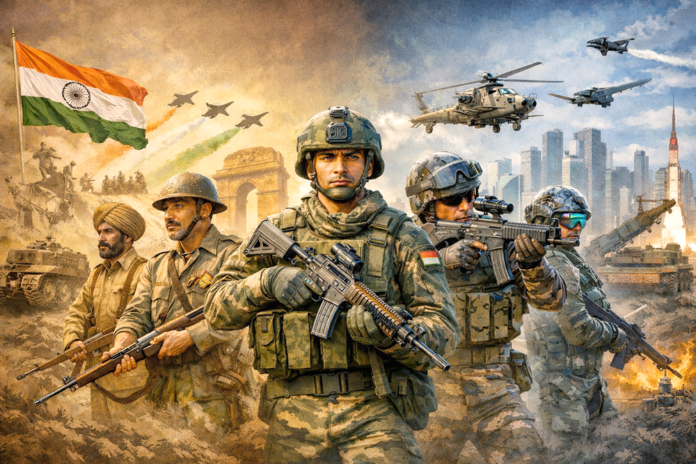
The Indian Army occupies a distinctive position among contemporary military institutions. It is not merely a product of post-colonial state formation but an inheritor of a civilisational military tradition that stretches back millennia. Ancient Indian strategic thought, articulated in texts such as the Mahabharata, Ramayaṇa, Kautilya’s Arthashastra, Kamandaka’s Nitisara and the Thirukkural, presents a sophisticated understanding of war, diplomacy, leadership, intelligence and ethics. These traditions emphasise discipline, adaptability, moral restraint and the integration of military power with statecraft.
In the present era, the Indian Army is undergoing a comprehensive transformation driven by shifting geopolitical realities, rapid technological change and evolving societal expectations. This transformation is not confined to hardware acquisition or organisational restructuring; it encompasses doctrinal innovation, cultural adaptation and ethical continuity. As former Chief of Army Staff (COAS) General Manoj Mukund Naravane observed, “The Indian Army modernises not to wage war, but to deter it, while remaining firmly anchored in its timeless ethos.” This synthesis of tradition and modernity defines the Army’s current trajectory.

Army Modernisation: Towards a Future-Ready Force
Army modernisation has become a strategic imperative in response to India’s complex security environment, characterised by persistent tensions along the western and northern borders, the prospect of collusive threats and the increasing salience of non-traditional and hybrid challenges. The declaration of 2025 as the Year of Reforms signalled a deliberate effort to recalibrate defence planning, acquisition and force structuring.
Defence Minister Rajnath Singh says that the “modernisation of the armed forces is not an option but a necessity for safeguarding India’s sovereignty and strategic interests… true strategic autonomy comes when a nation can design, develop and sustain its own defence capabilities”
Defence Minister Rajnath Singh has consistently framed modernisation as essential to national security, noting that the “modernisation of the armed forces is not an option but a necessity for safeguarding India’s sovereignty and strategic interests.” This political articulation has translated into sustained capital allocations and institutional reforms aimed at improving efficiency, accountability and operational readiness.
Indigenisation and Strategic Autonomy
A defining feature of contemporary modernisation is the emphasis on self-reliance under the Aatmanirbhar Bharat framework. Indigenous design, development and manufacturing have been prioritised to reduce import dependence and enhance resilience against external supply disruptions. Indigenous artillery systems, armoured vehicles, air defence assets, ammunition and command-and-control systems increasingly constitute the Army’s core capabilities.
Rajnath Singh has underscored the strategic logic of this approach by arguing that “true strategic autonomy comes when a nation can design, develop and sustain its own defence capabilities.” Near-complete indigenisation of ammunition is particularly significant, as it directly enhances wartime sustainability and operational endurance — factors often underestimated in peacetime planning.

Soldier-Centric Capability Development
The Army’s modernisation programme balances high-end strike capabilities with investments in the individual soldier. The induction of advanced attack helicopters, long-range precision missiles, loitering munitions and unmanned aerial systems has strengthened deep-strike and intelligence, surveillance and reconnaissance (ISR) capabilities. Parallel investments in modern small arms, ballistic protection, night-fighting equipment and lightweight logistics systems enhance survivability and combat effectiveness at the tactical level.
Former COAS General Bipin Rawat encapsulated this philosophy when he remarked, “Technology must empower the soldier on the ground; the man behind the machine remains the most critical element of combat.” This focus is particularly relevant given India’s diverse operational environments, which demand adaptability across high-altitude, desert, jungle and urban terrain.

A defining feature of contemporary modernisation is the emphasis on self-reliance under the Aatmanirbhar Bharat framework. Indigenous design, development and manufacturing have been prioritised to reduce import dependence and enhance resilience against external supply disruptions
Structural Reforms and Integrated Battle Groups
Among organisational reforms, the development of Integrated Battle Groups (IBGs) represents a significant conceptual shift. IBGs are designed as agile, self-contained formations integrating combat and combat-support elements under a unified command. Tailored to specific theatres, they are intended to enable rapid mobilisation, flexible response options and escalation control.
Army leadership has repeatedly emphasised the relevance of IBGs to future conflict. As articulated by successive COAS, future conflicts will demand speed, synergy and surprise. By moving away from rigid, division-centric structures, IBGs align the Army with contemporary concepts of manoeuvre warfare and joint operations, while reinforcing deterrence through demonstrated responsiveness.
Technology Absorption and the Changing Character of War
While modernisation provides material capability, technology absorption shapes the Army’s cognitive and operational edge. The declaration of the Year of Technology Absorption and its extension into a Decade of Transformation reflects the recognition that future conflicts will be increasingly data-driven, multi-domain and time-compressed. This was exemplified by Operation Sindoor, which lasted just four days but caused significantly more damage to Pakistani military assets than the 85-day Kargil War.
General Manoj Pande, during his tenure as COAS, highlighted this shift by noting that “the future battlefield will be data-centric, transparent and unforgiving.” Artificial intelligence, machine learning, autonomous systems, cyber capabilities and space-enabled assets are therefore central to the Army’s transformation agenda.
Innovation Ecosystem and Indigenous Solutions
The Army has moved beyond a buyer-vendor model to foster an innovation ecosystem involving defence public sector units, private industry, startups, academia and research institutions. Indigenous solutions such as swarm drones, robotic logistics platforms, AI-enabled surveillance systems and counter-drone technologies demonstrate the potential of this collaborative approach.
Unmanned systems and robotics have assumed particular importance in reconnaissance, logistics and force protection, especially in high-altitude and contested environments where human endurance is severely tested.
The Army’s modernisation programme balances high-end strike capabilities with investments in the individual soldier. Parallel investments in small arms, ballistic protection, night-fighting equipment and lightweight logistics systems enhance survivability and combat effectiveness at the tactical level
Networking, Data Centricity and Joint Operations
The designation of 2026 as the Year of Networking & Data Centricity signals a doctrinal shift towards integrated, network-enabled warfare. The objective is to link sensors, shooters and decision-makers across domains through secure indigenous networks, enabling real-time situational awareness and faster command decisions.
As senior Army leaders have noted, “information superiority,” rather than numerical superiority, will be decisive in future conflicts. Forces achieving data and information superiority can operate at machine speeds, integrate autonomous systems, and maintain interoperability across coalitions. Neglecting it leaves armies reactive and vulnerable, as seen in evolving informationised warfare threats targeting networks and C4ISR. Victory hinges on turning raw data into actionable decisions, not just arsenal size. This data-centric approach also enhances jointness, enabling seamless coordination with air and naval forces in multi-domain operations.
Doctrinal Evolution and Indigenous Strategic Thought
Beyond structure and technology, the Indian Army’s transformation involves a re-examination of its doctrinal foundations. Initiatives such as Project Udbhav seek to derive contemporary relevance from India’s classical strategic texts. Launched by the Indian Army, this initiative studies classical Bharat texts — Arthashastra, Mahabharata, Bhagavad Gita — to adapt ideas like multi-domain awareness and psychological operations. The Arthashastra’s emphasis on preparedness, intelligence, alliances and calibrated force offers insights directly applicable to modern deterrence and hybrid warfare.
The designation of 2026 as the Year of Networking & Data Centricity signals a doctrinal shift towards integrated, network-enabled warfare. The objective is to link sensors, shooters and decision-makers across domains for real-time situational awareness and faster command decisions
Senior military scholars have argued that India does not need to import strategic culture when its own civilisational heritage offers a comprehensive framework for war and peace. This indigenisation of doctrine enhances strategic coherence and cultural legitimacy.
Ethics, Restraint and Strategic Credibility
A consistent theme in ancient Indian military thought is dharma — the moral and ethical framework governing the conduct of war. Classical texts such as the Mahabharata and the Arthashastra emphasise proportionality, discrimination between combatants and non-combatants, and the avoidance of unnecessary suffering. Far from being merely philosophical ideals, these norms sought to ensure that the use of force remained a tool of statecraft rather than an expression of vengeance or excess.
This ethical tradition continues to inform the Indian Army’s contemporary approach to military operations. As former Chief of Army Staff General MM Naravane observed, “The Indian Army fights with strength, but also with restraint and responsibility.” In practice, this restraint is reflected in calibrated responses, adherence to rules of engagement, and an institutional emphasis on minimising civilian harm — even when confronting persistent provocation or asymmetric threats.
In a nuclearised strategic environment, such restraint carries significant strategic value. Escalation control becomes paramount when conventional conflicts risk crossing thresholds that could trigger wider or even catastrophic outcomes. By demonstrating disciplined use of force, India reinforces its posture as a responsible nuclear power, reducing the likelihood of miscalculation while retaining credible deterrence.
Moreover, ethical restraint enhances international legitimacy and diplomatic leverage. In an era of real-time global scrutiny, adherence to ethical norms strengthens India’s standing with partners and reinforces confidence in its crisis-management behaviour. Strategic credibility, therefore, is not derived solely from military capability, but from the demonstrated ability to wield power judiciously. In this sense, India’s ethical military tradition functions not as a constraint on effectiveness, but as a force multiplier — supporting stability, deterrence and long-term national security objectives.
Nari Shakti: Gender Inclusion and Operational Effectiveness
The integration of women under the banner of Nari Shakti (Women Power) represents a transformative social and institutional shift. The grant of Permanent Commission to women officers and their increasing presence in command, staff and operational roles reflect a move towards genuine gender neutrality.
Defence Minister Rajnath Singh has framed this change as one of capability rather than symbolism, stating that “women’s empowerment in the armed forces enhances both operational effectiveness and national progress.” Entry through the National Defence Academy and service in forward and high-altitude areas indicate that gender integration is becoming institutionalised rather than exceptional.
Military scholars have argued that India does not need to import strategic culture when its own civilisational heritage offers a comprehensive framework for war and peace. This indigenisation of doctrine enhances strategic coherence and cultural legitimacy
Conclusion: Ready for Tomorrow
The Indian Army’s evolution from tradition to transformation reflects a carefully calibrated response to contemporary strategic realities. Modernisation and indigenisation are enhancing material capability and strategic autonomy; technology absorption is reshaping operational concepts; doctrinal innovation grounded in indigenous wisdom is forging a distinct strategic identity; and Nari Shakti is redefining the human dimension of military power.
As General Rawat aptly noted, “India’s armed forces must remain rooted in their traditions even as they leap into the future.” The Indian Army’s ongoing transformation thus represents not a break from the past, but a continuity of purpose — an institution drawing strength from its civilisational heritage while preparing decisively for the wars of the future.

–The writer is a globally cited defence analyst based in New Zealand. The views expressed are of the writer and do not necessarily reflect the views of Raksha Anirveda
