

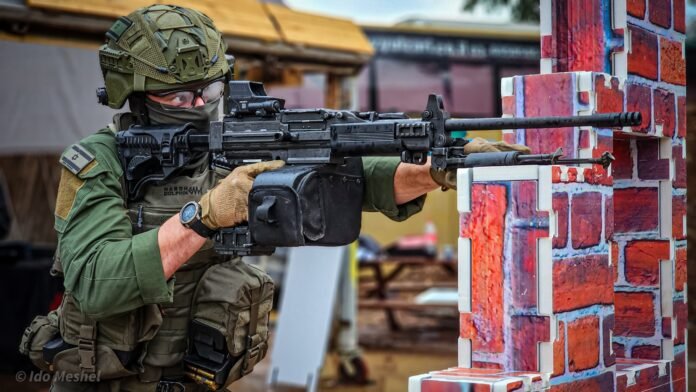
New Delhi: India is currently engaging in discussions with Israel Weapon Industries (IWI), a foremost small-arms manufacturer, to explore the integration of the ARBEL computerised weapon system into Indian forces’ small arms.
The ARBEL is a revolutionary AI-based computerised fire control system developed by Israel Weapon Industries (IWI) and India’s Adani Defence.

The ARBEL system is acclaimed as the world’s first fully computerised fire-control system for small arms, promising to revolutionise battlefield accuracy and lethality through advanced technology. The ARBEL can be integrated with any small-arms platform and is one of the only systems that does not require a specific optical component to function.
The system developed by IWI incorporates cutting-edge sensors combined with real-time ballistic computation and target-acquisition capabilities.
This allows soldiers to enhance their hit probability dramatically across diverse and challenging combat environments. The technology evaluates the weapon’s movement and the trigger status, enabling it to determine the tactical scenario and aiming patterns in real time.
Key to the ARBEL system’s functionality is its Micro Electro Mechanical System (MEMS) algorithm, which calculates the optimal firing solution in milliseconds.

When a soldier fires the first shot and continues to hold the trigger, the system analyses behavioural patterns and releases subsequent rounds only when there is a high probability of a successful hit. This selective firing mechanism improves ammunition efficiency and operational effectiveness on the battlefield.
Importantly, the ARBEL system is versatile; it can be integrated with virtually any small-arms platform. Unlike traditional fire-control systems, it does not require a dedicated optical component, broadening its applicability across differing weapon types. This flexibility holds significant operational value for India’s diverse array of infantry weapons.

India’s defence and security forces have a history of procuring several weapon systems from IWI, including the Tavor TAR-21 and its variant, the IWI X95 assault rifles. They also utilise sniper rifles from the Galil Sniper Rifle family and the Negev NG-7 light machine gun.
Recent contracts have involved the acquisition of thousands of Negev machine guns, aimed at enhancing the firepower available to frontline troops and paramilitary units.
Shuki Schwartz, CEO of IWI, confirmed that initial discussions are underway, signalling a growing Indo-Israeli defence collaboration. He emphasised that over the past two decades, IWI has steadily expanded its presence in India’s defence sector by equipping various organisations with advanced weaponry, aligned with India’s “Make in India” initiative.
This partnership has facilitated both technology transfer and manufacturing expansion within the country.
IWI has already commenced local production efforts in India, notably manufacturing barrels domestically. Schwartz further indicated an openness to deepen technological cooperation depending on India’s evolving defence needs and market demands. This openness suggests potential future collaborations that could see more sophisticated weapon systems and components produced indigenously.
The ARBEL system represents a strategic technological leap for Indian small arms, combining software intelligence with mechanical precision. If successfully integrated, it would significantly enhance the combat capabilities of Indian infantry, especially in complex and fast-paced scenarios where split-second decisions determine survival and mission success.
Given current geopolitical dynamics and India’s drive for indigenous technology coupled with strategic alliances, this engagement with IWI highlights a pragmatic approach to bolstering India’s defence strength through selective foreign partnerships that complement domestic manufacturing and innovation ambitions.

