

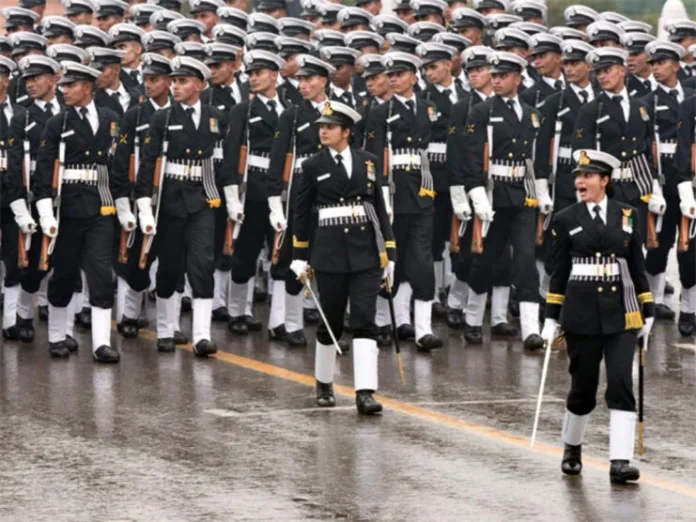
New Delhi: Chief of the Naval Staff, Admiral R Hari Kumar on December 1 said that Indian Navy’s ships, submarines, and aircraft have sustained a high operational tempo in the strategic waters – undertaking missions and tasks encompassing military, diplomatic, constabulary and benign roles in the last one year.
Addressing a press conference ahead of Navy Day, he lauded the Agnipath scheme and said its implementation has been a much-needed, transformational change. “More than 1,000 women ‘Agniveers’ have been incorporated into the force. Our first batch of ‘Agniveers’ graduated from the premier-winning establishment, INS Chilka, in March this year. And importantly, this batch of Agniveers includes 272 female Agniveer trainees as well,” Admiral Kumar said.

“And going further, the second batch of ‘Agniveers’ had a total of 454 women and I want to say that with the third batch, which has just been inducted, we have now crossed over 1000 women affiliates in the navy,” he added. Admiral Kumar asserted that these statistics stand testament to the Indian Navy’s philosophy of all roles and all ranks with regard to the deployment of women in the service, both for officers and for personnel below the rank of officer.
“We also appointed the first woman commanding officer of an Indian naval ship. It has been our effort to constantly challenge the status quo to ensure that the navy remains on an aspirational and dynamic trajectory into the future,” said Admiral Kumar.
The Navy Chief asserted that India is the resident power in the Indian Ocean region, notwithstanding the growing Chinese presence in the area. “The oceans are considered to be a common heritage; they can be used for the legitimate economic aspirations of any nation. So in that regard, if you look at China, it may have a legitimate reason to be present in the Indian Ocean region for economic activities. But we, as the resident naval power in the Indian Ocean, keep an eye on what all is happening there,” he said.
“We try to keep the extra regional forces that are present in the region under surveillance and keep a watch on their activities–what are they engaged in, what are their intentions and so on. So, that is why we deploy our surveillance assets–ships, submarines, aircraft, UAVs and others. So they’re deployed regularly to keep our area of interest and observation,” said Admiral Hari Kumar.

Speaking on how friendly operations and exercises with friendly foreign countries help the Indian Navy, the Chief of Naval Staff said that the task of the Indian Navy is to protect, preserve, promote, and pursue Bharat’s national interest in the maritime domain, wherever they lie. “Our interests are there in the Indian Ocean region and beyond when you look at the Indo-Pacific. So our ships, submarines, and aircraft are deployed accordingly. We try to keep our area of interest under surveillance.”
At the press conference, Admiral Kumar also talked about the naval air surveillance part and said that, looking at the surveillance aspect, each of the platforms comes with a particular type of capability. “When you talk of the P-8I, while it has a secondary role for surveillance, it is essentially a submarine warfare aircraft. It is basically an asset that is meant to detect localised and targeted submarines. But when it is not engaged in the task, it can also be used for surveillance,” he said.

He also mentioned numerous other primary assets for surveillance but he stated that when an entire ocean area is looked upon, assets with different capabilities will be required. “So we have to divide the area that we want to keep under surveillance with different types of assets,” he added.
The Indian Navy has “remained a ‘Combat-ready, Credible, Cohesive, and Future Proof’ force enabled by what we call our ‘ships first’ outlook where every single action that we take is aimed to enable our women and men in operational units to perform their duties very well,” Admiral R Hari Kumar said.
“On the operational front, the Navy’s sheer footprint of deployments has been satisfying as its ships have been persistently present across the Indo Pacific. Our units were mission deployed across the Indian Ocean Region and beyond, to protect and promote our national interests,” he said.

