

Tel Aviv: The 2026 edition of Defense Tech Expo opened on February 17 – standing out as the epicenter of a unique “combat-proven” philosophy. The event blends commercial showcase with a live study of the battlefield-to-industry feedback loop as it brings to the centre stage doctrine-technology cycle where systems are refined under live fire.
The importance of the event can be gauged with the presence of high-level strategic leadership, including Ministry of Foreign Affairs personnel, and representatives of both big industries (IAI, Rafael, Elbit) and Armed Forces.

Israel Aerospace Industries (IAI) stand dominates the exposition area. Full of drones of every type and dimension, loitering munitions, autonomous ground vehicles (UGV), C-UAV systems and AI based software solutions for battlefield and homeland security applications, it reflects both Israeli Defence industry expertise and the main features of contemporary and future warfare.
At the expo, one can instantly notice Israel’s fundamental shift – where national security policy is increasingly dictated by the speed of technological iteration. At the core of the event stands the vibrant presence of Small and Medium Enterprises (SMEs) and startups depicting the sound manifestation of technological innovation rush. Interestingly, almost all of the showcased systems at the expo are already in service with Israeli Armed Forces or Police Forces.
Lined with an outstanding conference programme that bridges the gap between grand strategy and tactical reality, the opening day of the Defense Tech Expo set the tone with high-profile speakers taking the stage to discuss the future of defence and national security in an increasingly volatile regional and global landscape.
Showcasing the Israeli model that thrives on a fluid revolving door between the armed forces and the private sector, the exhibition area also highlighted the symbiotic relationship between IAI, Rafael, and Elbit -and a sprawling network of Small and Medium Enterprises (SMEs) and startups, that form the backbone of the Israeli defence ecosystem.

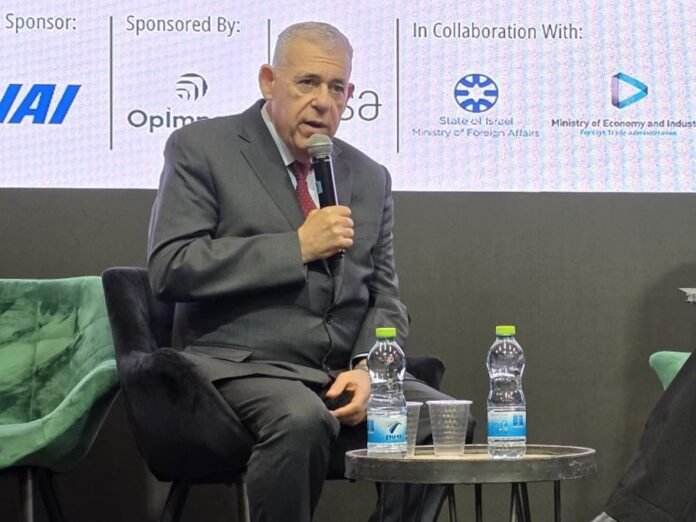
As part of an interview held on February 17 with IAI President & CEO Boaz Levy on the main stage at the Defense Tech Expo conference, Levy noted: “Israeli technology has proven to be among the best in the world. It is well adapted to the missions we face in the Middle East. The Israeli public should be aware that the Ministry of Defence, the IDF, and the defence industries are working closely to provide the best possible solutions for the security of Israel.”
Levy further added: “IAI currently delivers a wide range of solutions – from space to the pilots in the cockpit and down to the soldiers on the battlefield. When we look to the future, we see more autonomous systems, greater artificial intelligence capabilities within our products and beyond, and in command and control centres that transfer the information to the battlefield. The changes we see are tremendous.”

Levy also noted that there may be additional surprises in Israel’s future conflicts: “IAI develops new capabilities every day, and we are working to bring them to operational readiness.”
Regarding the aerial threats Israel is facing and the development of the Arrow 4 Air defence system, Levy emphasised, “When we develop a new system, we focus on solutions for future threats, not current threats. This is how we stay ahead of the ever-evolving threats. Accordingly, the Arrow 4 Air Defence system, which will replace Arrow 2, will enter operational deployment. Together, the Arrow 3 and Arrow 4 systems will deliver advanced interception capabilities against ballistic missile threats. With Arrow 4, we will increase Israel’s interception success rates.”
Progressing into its second day, the event’s focus will be on the technical enablers and the role of Big Data and autonomous systems in achieving tactical overmatch. The primary takeaway for international delegations will be the interconnection between technological development and the transformation of military doctrine. Taking note of the impressive hardware display, understanding the true innovation that lies in the underlying mechanism – allowing a combat-proven requirement to be translated into a software update or a hardware modification will be of keen interest.

