

Hyderabad: Having established itself in the defence sector for manufacture of aircraft, Hindustan Aeronautics Limited (HAL) is shifting its focus toward the civil aviation sector with the development of a diverse portfolio of passenger aircraft and helicopters.
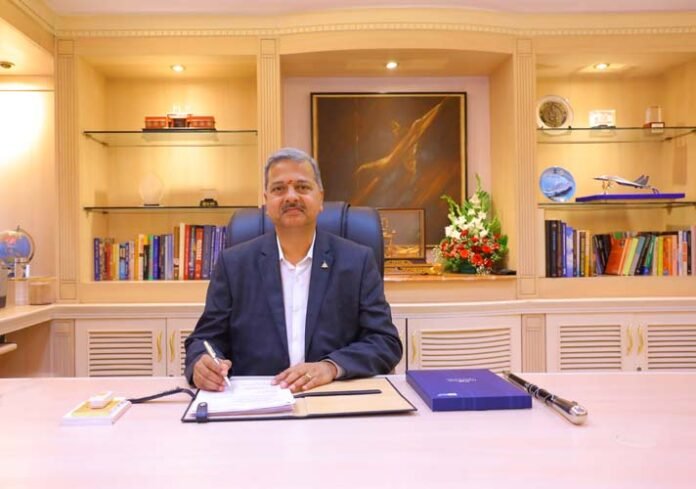
Speaking to on the sidelines of the biennial event Wings India 2026, HAL Chairman DK Sunil stated that the company aims to establish a larger civil component in its manufacturing lineup to enhance national self-reliance.

“We build our military aircraft, so why not build civil aircraft also? That is the vision with which we are going. Since we are a government-owned company, the vision is that we should become Aatmanirbhar in Civil aircraft also,” he added.
Expanding on this, he said “we are already a manufacturer of helicopters, transport aircraft, fighters… We should have a larger civil component in our portfolio.” He noted that the company is leveraging its experience in defence to meet commercial needs.
The nation’s premier defence aerospace manufacturer is now actively expanding into civil aviation sector and considering the plans of the government to boost the air connectivity, the aerospace major is currently working on the Dhruv NG, a civil variant of the Advanced Light Helicopter, and the Hindustan 228, which is an 18-seater aircraft. Additionally, the company has introduced the SJ-100, a regional jet designed to seat 103 passengers.
The plans of this major aerospace include civil aircraft, passenger aircraft and related services.

According to the Chairman, the final assembly of these aircraft will take place in Nashik, while the Kanpur facility will produce necessary parts. The manufacturing process will also integrate a broad network of private vendors from Nashik, Bangalore, and Hyderabad.
“It’s going to be a combination of existing facilities we are going to leverage, as well as work with our private partners to see that we can keep the cost of investments low so that it will translate into a lower ticket price for the aircraft,” Sunil explained.

Considering the growing demand for air travel and prices comparable to railways, and time saved, there is immense scope for aircraft.
This push for domestic manufacturing aligns with broader national goals for aviation expansion. Earlier, while delivering a virtual address at the Wings India 2026 aviation summit, Prime Minister Narendra Modi announced that India is on track to establish a network of over 400 airports by the year 2047.
“In India, air travel is no longer exclusive; it’s becoming inclusive. Our mission is to make air travel easily accessible to every Indian citizen. That’s why we have connected Tier 2 and Tier 3 cities with airports. In 2014, India had 70 airports. Today, the number of airports in India has increased to more than 160. We have activated more than 100 aerodromes in the country and, along with this, launched affordable flight schemes for our citizens… It is estimated that by 2047, India will have more than 400 airports. This will be a very large network. Not only that, our government is also working on the next phase of the UDAN scheme. This policy will further strengthen regional and affordable air connectivity,” said the prime minister.
As HAL leadership publicly stated that the company wants to increase civil aviation portion of its revenue from the current four to five percent to 25 percent within the next ten years.
The aim is to build a civilian aerospace portfolio alongside its traditional defence project.
The key pillars of this strategy: expanding certified civil aviation products like aircraft and helicopters suitable for passenger and utility roles.
Developing civil helicopter business based on derivatives of HAL’s existing platforms.
Entering regional passenger aircraft market with partnerships, leasing and domestic assembly.
The central part of HAL’s civil aviation strategy is collaboration with Russia’s United Aircraft Corporation (UAC) to build the SJ-100, a 90-103 seat regional passenger jet in India.
HAL inked MOU with Russia’s UAC to produce SJ-100 aircraft for domestic operators. HAL expects strong demand for over 200 aircraft in this regional jet category driven by India’s domestic connectivity goals.
Hindustan Aeronautics Limited (HAL) will place a stronger emphasis on the civilian market, targeting it to contribute 25% of its total turnover over the next 10 years, its Chairman D K Sunil said on Wednesday. This will entail leasing and domestic manufacturing of Russia’s SJ 100, he said.
“We will focus on increasing our civil footprint and the target is that about 25% of our turnover should come from civil aviation over the next 10 years,” Mr. Sunil said at a press conference at the Hyderabad Airshow.
HAL plans to buy 10 of the SJ-100 aircraft in the beginning, and over a span of next three years start manufacturing the same in the country.
Meanwhile, the aerospace major said that during the interim, it will learn from the feedback received from airline customers on SJ-100’s reliability, maintenance and ground support. In the beginning semi-knockdown units would be brought into the country, and later domestic manufacturing. Assembling and manufacturing facilities were already available at Nasik and Nagpur. The investment cost has not yet been determined.
“The aircraft will be our mainstay for UDAN scheme,” the HAL Chairman said. The aircraft has a range of 3,500 km and is capable of flying for six hours.
The PSU has also bagged its first order of 10 Dhruva- NG helicopters from Pawan Hans for its offshore flight operations for ONGC. The certification process for the helicopter is also expected to be completed soon, and the deliveries are expected in 2026-2027, and orders are also expected from BSF.
“This is a twin engine helicopter and is much more safe and reliable. This is its biggest pull considering the recent helicopter crashes seen in the hilly regions in the north,” Sunil said.

– The writer is a senior journalist and media consultant. The views expressed are of the writer and do not necessarily reflect the views of Raksha Anirveda.
