

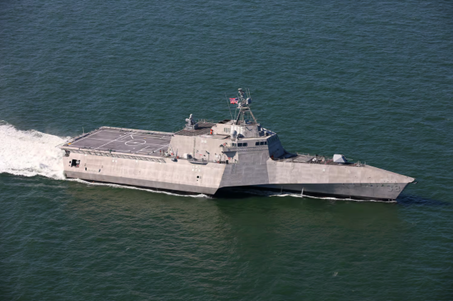
Evendale, OH. GE Aerospace’s Marine Engines & Systems celebrates a significant milestone as the USS Pierre (LCS 38) was commissioned on November 15, in Panama City, Florida. This final Littoral Combat Ship (LCS) marks the completion of GE Aerospace’s delivery of 38 LM2500 marine gas turbine engines powering all 19 ships in the LCS programme—each vessel equipped with two engines for reliable, mission-critical propulsion.
“The commissioning of USS Pierre marks the successful conclusion of the LCS programme and showcases the continuous innovation GE Aerospace has delivered throughout this partnership,” said Lisa Wade, General Manager of Mobility Engines & Marine. “The composite enclosure and electric start technologies pioneered on these ships will serve as the foundation for next-generation naval propulsion systems, demonstrating our commitment to advancing sailor safety, operational efficiency, and mission readiness.”

The LCS is a fast, agile, mission-focused platform designed for operations in near-shore environments. The USS Pierre represents the culmination of continuous innovation throughout the LCS programme, featuring GE Aerospace’s advanced lightweight composite enclosure and RINA MIL-certified electric start system—technologies that are redefining naval propulsion standards for the next generation of warships.
Revolutionary Composite Enclosure Technology
First introduced to the US Navy fleet on the USS Santa Barbara (LCS 32) on March 27, 2023, GE Aerospace’s composite enclosure has transformed engine room design and sailor safety. Fully certified in 2019 by the US Navy with MIL-S-901D Grade A shock qualification, the composite enclosure delivers multiple operational advantages:
- 50% weight reduction: 2,500 kg (5,500 lbs) lighter than steel predecessors, providing ship designers flexibility for increased payload, fuel, or systems
- 60% quieter operation: Dramatically reduced engine room noise compared to original steel enclosures
- Cooler engine room temperatures: Reduced wall temperatures by 25°F to 50°F, rejecting less heat into the engine room
- Enhanced durability: Corrosion-resistant and less maintenance with single-piece carbon fiber construction
- Improved safety: Integrated water mist fire suppression capability
- Superior access: Enhanced crew access to engine inlet and lightweight main door for easy handling; engines can be removed and reinstalled through the inlet path
Electric Start System: A Naval Propulsion Breakthrough
The USS Pierre also features GE Aerospace’s electric start system (ESS), the only US mil-spec certified ESS for marine and naval applications. This system delivers significant advantages over traditional hydraulic starting systems:
- 86% weight savings: 6,500 pounds lighter than hydraulic alternatives
- 74% volume savings: Requires 150 ft³ less space
- Proven reliability: Over 100,000 hours of successful operation in industrial installations
- RINA MIL certified: Shock design to MIL-DTL-901 standards

