
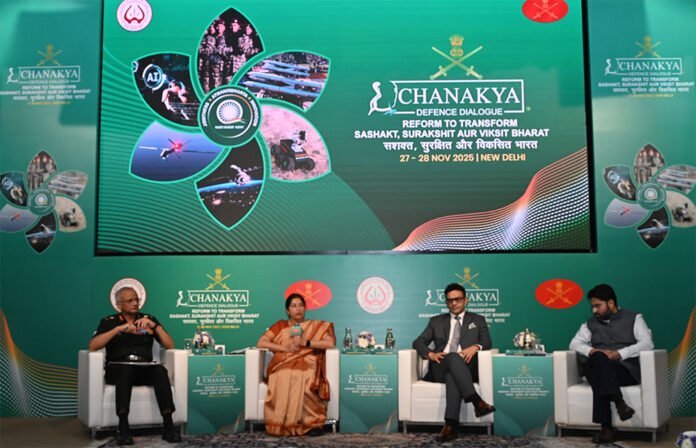
During the 2025 Chanakya Defence Dialogue, Army Chief General Upendra Dwivedi announced a three-phase plan to transform the Indian Army into an integrated, AI-driven, network-enabled, future-ready force by 2047. Aligned with the government vision of Viksit Bharat 2047: Phase 1 (until 2032) – accelerate transitions in capability development, force structure, and operational readiness; Phase 2 (until 2037) – consolidate gains achieved in the first phase; Phase 3 (until 2047) – leap to a fully integrated force designed for next-generation warfare.
General Dwivedi emphasised: self-reliance – in defence manufacturing, space capability, and technology absorption; innovation – enterprise-level impact in AI, cyber, quantum, and autonomous systems; adaptation to the larger ecosystem; integration – deeper military-civil fusion, promoting synergy among academia, industry, and the Armed Forces. From the looks of it, combined Phases 1 and 2 (until 2037) cover transitions in capability development, force structure, and operational readiness – an extended period of what the Army calls a Decade of Transformation.

Militaries alone cannot cope with the new multifaceted threats that have emerged with globalisation. India’s national security concerns demand that all interests and institutions of national power are brought to work and synergised for a Comprehensive National Power (CNP) response through Effect-Based Operations (EBOs). The hybrid conundrum includes: conventional warfare; cyber warfare; political warfare; irregular warfare; asymmetric and no-contact warfare; information warfare; psychological operations; terror, sabotage, subversion and criminality with advanced technologies. India ranks 14th in the Global Terrorism Index 2025.
India is ranked 105th in the Global Hunger Index; 130th in the Human Development Index, 126th in the World Happiness Report, 151st in the World Press Freedom Index, and 115th in the Global Peace Index. It makes India an open battlefield, exploitable by forces inimical to India, both foreign and within
As of March 2025, 45 organisations in India were categorised as terrorist organisations and 22 groups were unlawful under the Unlawful Activities (Prevention) Act (UAPA), 1967 – totalling 67. The South Asia Terrorism Portal (SATP) lists 180 groups that have operated within India over the last 20 years. We are covering up the raging pollution in India by not recognising foreign standards, despite being ranked 176th in the Global Environmental Index and 99th in the Sustainable Development Index. Concurrently, India is ranked 105th in the Global Hunger Index; 130th in the Human Development Index, 126th in the World Happiness Report, 151st in the World Press Freedom Index, and 115th in the Global Peace Index; denying all of which is naïve since it makes India an open asymmetric battlefield, exploitable by forces inimical to India, both foreign and within.
Pakistan’s proxy war on India is supported by China and the US, while India is in the crosshairs of global terrorist organisations like al-Qaeda/AQIS. America’s support for the Gen-Z unrest in Nepal, regime change in Bangladesh and embrace of Pakistan leaves no doubt that it wants to undermine India’s rise. There have been calls from Afghanistan, Pakistan and Bangladesh for Ghazwa-e-Hind (GEH). The Taliban and al-Qaeda are in mutual support, plus ISIS/ISKP and many other terrorist organisations are operating in Afghanistan. In Pakistan, Jaish-e-Mohammed (JeM) has announced the formation of its women’s wing called ‘jamaat-ul-Mominaat’ and Masood Azhar says 5,000 women suicide bombers are being trained. The Indian Army will be most affected by sub-conventional attacks from multiple fronts; a proactive counter-strategy needs to be put in place.
Despite the so-called thaw in India-China relations, there is no chance of a pullback of PLA troops along the LAC. India pushes for border talks to keep people’s hopes alive, while China is doing so more to humour the Indian government. China detaining a native woman from Arunachal Pradesh in Shanghai proves this
The banned Meitei Insurgent group People’s Liberation Army of Manipur (PLA – Manipur) has released a video clip of its drone attack on a 3 Assam Rifles (AR) Mobile Unit, using drones to drop bombs in Kamjong District of Manipur (Operation ‘LANG-OL’), in which four AR personnel, including a JCO, were injured. According to sources, the drone attack was well-planned and was in retaliation to a drone attack on a PLA camp a few days back. It shows the challenges for ground forces in the new age of warfare. They have also released a press note officially confirming their involvement in the ambush at Nambol on 33 AR. Most insurgent-terrorist groups in the northeast have procured advanced attack drones from China and also counter-drone measures. Bangladesh and Pakistan are also receiving drones from China and Turkey. The Army must wargame this threat on a 2-3-3.5 and adopt new tactics. China had already ordered one million AI-enabled loitering munitions for use by 2026. Presently, the Army is not even ready for drone terrorism, according to a former Northern Army Commander.

According to Army Chief General Dwivedi, the Indian Army aims to be future-ready by 2047, transitioning into a fully integrated force designed for next-generation warfare upon completing Phases 1 and 2 by 2037. However, the CDS Gen Anil Chauhan lamented the slow procurement process at the Chanakya Dialogue, despite being part of the MoD, and a must-read article points out how India is botching its military.
But what happens in the intervening period if war is thrust upon us? We must acknowledge that China is our primary enemy, notwithstanding that it has drawn Pakistan, Nepal, Bangladesh and Sri Lanka into its strategic sphere. Despite the so-called thaw in India-China relations, there is no chance of a pullback of PLA troops along the entire length of the LAC, and the ongoing border talks between the special representatives of both countries are unlikely to yield any tangible results. In fact, India keeps pushing for these talks to keep hopes of the indigenous population alive, while China is doing so more to humour the Indian government. The latest incident of China detaining a native woman from Arunachal Pradesh for many hours at Shanghai, rubbishing her Indian passport, proves this.

China annexed Aksai Chin because it wanted to secure depth for the China National Highway 219 (G-219), which was then under construction. China is now constructing its second expressway (G-695), which is planned to touch Galwan, Hot Springs and Pangong Tso by 2035. China would like to provide depth to G-695 by attempting to grab more of Ladakh
Pakistan and Bangladesh may act as Chinese proxies, but we must acknowledge that China is and will remain our primary enemy, laying claim to large chunks of Indian territory, including 90,000 sq km of Arunachal Pradesh.
China annexed Aksai Chin because it wanted to secure depth for the China National Highway 219 (G-219), which was then under construction. China is now constructing its second expressway (G-695), which is planned to touch Galwan, Hot Springs and Pangong Tso by 2035. Looking at the pace of China’s development of border infrastructure, the completion of China’s National Highway G-695 could even be advanced by a year or two. Naturally, China would like to provide depth to G-695 by attempting to grab more of Ladakh.
Beijing’s strategy includes growing power asymmetry and calibrated economic engagement. Looking at the pace at which China is focusing on power asymmetry, US President Donald Trump’s new National Security Strategy (NSS) has recalibrated its stance on Taiwan, acknowledging that America could be overmatched militarily in defending the island. Indian propaganda that we are catching up with China is more to impress the indigenous population, whereas we are probably two decades behind Chinese military-technological developments. Additionally, the Indian Army and the Indian hierarchy would do well to read the book ‘Mind Wars: The New Battlefield of Information Warfare’, authored by veteran Maj Gen PK Mallick, that covers shaping of narratives, manipulation of public opinion, and strategic exploitation of information ecosystems – through narratives, perception management, cyber-enabled influence, and cognitive manipulation; especially when India faces a hybrid threat from both state and non-state adversaries.
Looking at China’s military-technological developments, Donald Trump’s new National Security Strategy acknowledged that the US could be overmatched militarily in defending Taiwan. Indian propaganda of catching up with China is more to impress India’s population; we are probably two decades behind China
If China wants to realise its claims to Indian territories, why would it wait for the Indian Army to get future-ready by 2047? How would it force a conflict in India, say in Eastern Ladakh, to provide depth to the G-695 highway? We could expect crippling of critical infrastructure, killing all communications (less quantum communications using fibre optics) in an EMP attack before the war begins. The airfields at Leh, Thoise and Nyoma could be hit in the first wave, like India targeted Pakistan Air Force infrastructure during Operation ‘Sindoor’. China will use all its weaponry, including tactical nuclear weapons, to break the crust of Indian defences. This is just one example, but the Indian Army needs to wargame every possible conflict scenario and how it will respond, considering the Indian Army Chief in 2020 was told not to fire at the PLA.
Finally, to counter the China-Pakistan collusive hybrid war, India should establish multiple ‘Deep Coalitions’ in the same way China uses them under its ‘Unrestricted Warfare. The Indian Army has a role to play in this.

The author is an Indian Army veteran. The views expressed are of the author and do not necessarily reflect the views of Raksha Anirveda
