

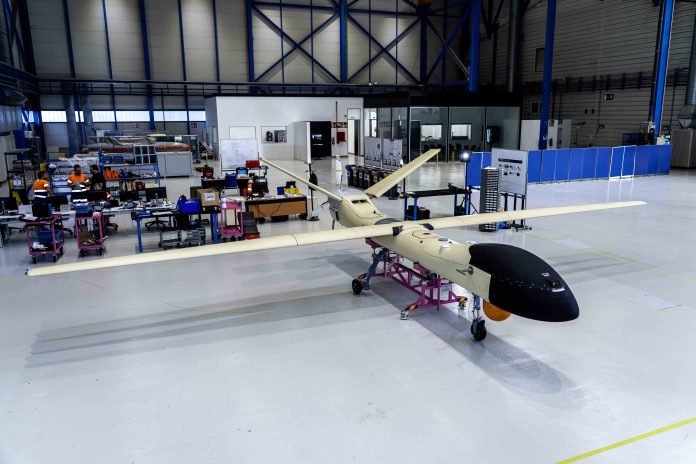
Madrid, Spain / Le Bourget, France. The assembly of the first SIRTAP prototype – Airbus’ high-performance tactical uncrewed aerial system – has concluded and the aircraft is ready to start the ground-tests campaign at the Airbus Defence and Space facilities in Getafe, Spain.
The ground testing – comprising structural evaluations, main-systems components and software testing – is due to take place over the next months and will finish with the maiden flight, scheduled by the end of 2025 at Spain’s National Institute of Aerospace Technology’s (INTA’s) Unmanned Systems Test Centre (CEUS) in Huelva, south-west Spain.

The subsequent SIRTAP flight-test campaign at CEUS will run throughout 2026 and will be essential in obtaining the airworthiness type certification and ensure that the aircraft meets the highest safety and performance standards, leading to the delivery of the first system to Spain in 2027.
“This new technical achievement for SIRTAP demonstrates Airbus’ agility to drive technological innovation with our aerospace industry partners in a timely manner in accordance with our vision,” said Jean-Brice Dumont, Head of Air Power at Airbus Defence and Space. “Designed and manufactured in Spain, SIRTAP will strengthen national sovereignty and will be a benchmark in the tactical unmanned aerial systems segment worldwide. It is another important brick in our ambition to shape a European ecosystem in defence aerospace.”
In November 2023, the Spanish Ministry of Defence acquired nine systems, each consisting of three remotely-piloted aircraft and a ground-control station. A total of 27 drones and nine ground-control stations will reinforce the tactical capabilities of the Spanish Armed Forces. In addition, Airbus Defence and Space will supply two simulators for training Spanish operators, having already passed the Critical Design Review, which marks the completion of their architecture and design.
SIRTAP represents a strategic commitment to innovation and national industrial collaboration, while offering an exportable platform thanks to its ITAR-free design. Its development and potential evolution towards different versions, such as the naval version or weapons integration, will also contribute to strengthening industrial capabilities in the field of remotely-piloted vehicles.


