

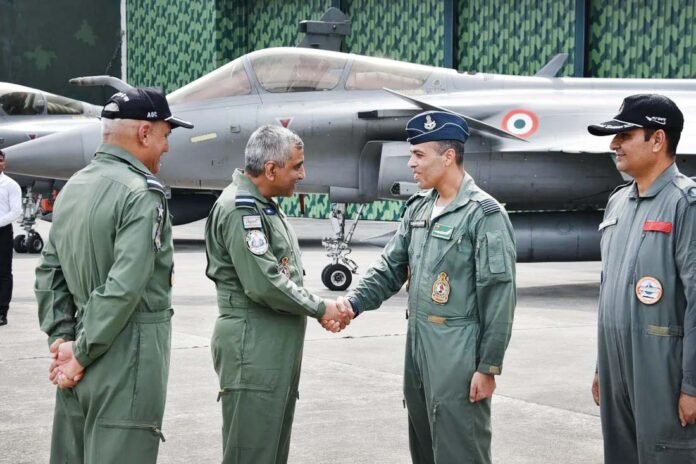
New Delhi: Air Marshal Ashutosh Dixit recently made a significant admission regarding India’s fifth-generation fighter jet programme, highlighting a critical 10-year gap before India achieves operational capabilities with such aircraft, according to a podcast on ANI by Air Marshal Ashutosh Dixit.
He noted that while India has been planning and developing fifth-generation fighter technologies since around 2014, the reality is that an actual fifth-generation combat aircraft will only be available for service roughly a decade from now. This gap challenges India’s current air power readiness in the face of rapidly advancing regional threats.

Since 2014, the Indian Air Force has been defining operational requirements for a fifth-generation fighter in close consultation with defence research organisations. Last year, the government sanctioned the Advanced Medium Combat Aircraft (AMCA) development project, which aims to integrate sixth-generation technologies into a fifth-generation platform.
In parallel, upgrades to the Tejas MK-2 are intended to serve as technology maturation steps. However, critical issues such as indigenous engine development remain unresolved, contributing to the extended timeline for a combat-ready platform. Interim, the Indian Air Force (IAF) is actively exploring solutions to bridge the critical 5th-generation fighter capability gap that will persist until the indigenous Advanced Medium Combat Aircraft (AMCA) enters service, estimated in 8 to 10 years.
This exploratory phase emphasises stealth technology, advanced sensor fusion, and ultra-long-range air-to-air missile integration, although specific platforms remain undisclosed to the public. Air Marshal Ashutosh Dixit has confirmed ongoing studies focusing on these areas to ensure India is not left vulnerable in the meanwhile.
India’s AMCA project represents a strategic leap towards self-reliance with a stealth-enabled, twin-engine fighter boasting next-generation features such as modular open system architecture, sensor fusion, and AI-assisted mission management.

Despite rapid development efforts, realistic induction timelines place operational status around 2035, delaying India’s entry into the limited club of nations with indigenous 5th-generation combat aircraft. The delay necessitates pragmatic interim steps to maintain aerial deterrence and modernisation against regional threats that possess advanced stealth fighters like China’s J-20 and J-35.
To address this capability gap, the IAF is considering acquiring two to three squadrons of foreign 5th-generation fighters such as the Russian Sukhoi Su-57 or the American F-35 Lightning II. Leasing or short-term acquisition of these platforms is seen as a practical stopgap, offering stealth capabilities, advanced sensors, and compatibility with long-range beyond-visual-range air-to-air missiles (AAMs). This approach balances immediate operational needs with the strategic goal of nurturing India’s indigenous defence industrial base without overextending import dependence.

Parallel to platform acquisition strategies, the IAF and DRDO are championing the development of next-generation air-to-air missile systems, such as the Astra MK-2 and MK-3, focusing on ultra-long-range engagement envelopes. These advanced missiles will complement stealth fighter capabilities, offering India a decisive edge in air dominance by enabling first-shot, beyond-visual-range kills against enemy aircraft. This missile development is integral to interim and future force multipliers for IAF’s evolving combat fleet.
The interim 5th-gen capability pursuit aligns with lessons from recent operations where precision, sensor networks, AI-enabled warfare, and unmanned system integration were pivotal. The AMCA itself is designed to operate alongside unmanned drones, showcasing a doctrinal shift towards networked, autonomous, and stealth-centric air combat.
Until the AMCA arrives, the IAF’s multi-pronged approach—combining selective foreign acquisitions with indigenous missile and sensor advances—aims to sustain and progressively enhance India’s air combat capabilities in a contested regional security environment. This phased strategy manifests the IAF’s commitment to maintaining qualitative over match and readiness, leveraging stealth designs, sensor fusion, AI, and long-range armaments as pillars of future aerial warfare, despite the decade-long wait for full indigenisation of 5th-generation fighter technology.

