

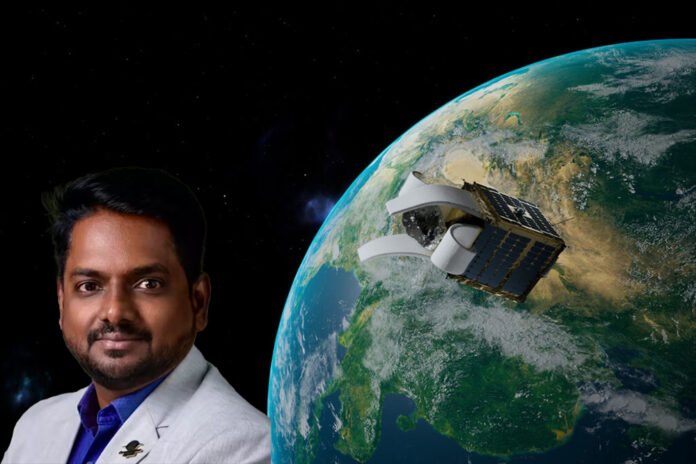
New Delhi: On October 4, 1957, the erstwhile Union of Soviet Socialist Republics, launched the world’s first man-made satellite into orbit. Almost seven decades later, there are about 12,000 operational satellites orbiting the earth; but the exponential number of satellite launches for providing critical services has over the years created a dilemma — space debris. The dilemma provides an opportunity and an Indian space technology startup, Cosmoserve Space, founded by a former Indian Space Research Organisation (ISRO) scientist, has ambitions to undertake space debris removal operations.
“The (satellite) launch costs have come down, the application usage of space has increased. So, the launches are exponentially increasing and this problem is going to only worsen,” said Chiranjeevi Phanindra B, Founder and CEO, Cosmoserve Space.

Phanindra, who represented ISRO at the Inter Agency Space Debris Coordination Committee, a global platform for space debris mitigation comprising 13 space agencies, highlighted that there are about 50,000 large and several millions of small objects in orbit which pose risk to operational satellites.
Cosmoserve Space’s objective is to develop a soft robotic arm which will capture space debris objects, biomimicking Venus flytrap, a carnivorous plant, which catches its prey by trapping and locking them between its leaves.
“The technology which we are primarily working on is the soft robotic arms, which is inspired from nature, this carnivorous plant, Venus flytrap. So, with that we will be able to capture any size and shape in space,” said Phanindra, outlining that the first in-space demonstration is planned towards the end of next year.
“The proprietary technology of soft robotic arms and the satellite intelligence, which is the advanced artificial intelligence to detect an object and plan the path towards that object, those we are developing in-house in Cosmoserve Space,” said Phanindra. For launch vehicles and propulsion systems, the startup plans to collaborate with other entities.

Once the space debris is captured in space, the product will undertake re-entry manoeuvres into the atmosphere and towards designated zones in the Pacific Ocean region. According to Phanindra, the high temperature due to atmospheric drag on re-entry will melt the space debris retrieved and everything will evaporate in the atmosphere.
In recent years, there has been increased demand and launch of constellations of satellites in the Low Earth Orbit (LEO) for providing internet services such as those provided by Starlink and OneWeb. A new rule in the US on ‘end of life service’ of satellites is also set to create a market for space debris recovery. As per a recent norm set by the US’ Federal Communications Commission (FCC), satellite operators need to ‘deorbit’ their satellites after the end of their operations and has brought down the disposal period from earlier 25 years to 5 years. According to the FCC, a vast majority of those are commercial satellites operating at altitudes below 2,000 km—the upper limit for LEO.

“Every other country is currently following the 25-year rule. It states that any satellite operator putting their satellite into space, they have to bring back their satellite within 25 years of its end of life. This is called ‘end of life service’. But because major launches are happening from the USA, the country has cut short the period to 5 years,” said Phanindra, highlighting that the US will be the main target market for the startup and the startup has initiated discussions with some of the constellation satellite operators.
“In some cases they (satellite operators) will be able to bring back their satellites on their own. But in the majority of cases they will need service providers like us who will go and pick up the dead satellite and bring it down. So that is how the commercial aspect of it is evolving,” he added.
Apart from retrieving ‘end of life service’ satellites there is also demand for non-satellite space debris which pose a threat to operational satellites, outlined Phanindra.
Incubated at Hyderabad-based innovation and business centre, T Hub, the startup has so far raised $3.17 million from investors such as Alan Rutledge and Ram Sriram, one of the founding members of Google. Other investors include venture capital fund AUM Ventures and US-based Shakti.
“The money will be utilised to build the team and then validate the technology on ground and do the in-space demonstration by the end of next year,” said Phanindra, outlining the next round of funding is planned after the concept is validated after the first in-space demonstration.
While Phanindra’s former employer ISRO is yet to fund any active space debris retrieval programme, he highlighted that Japanese, European and other space agencies are actively engaged and the startup plans to engage with them for such missions in the future.

