

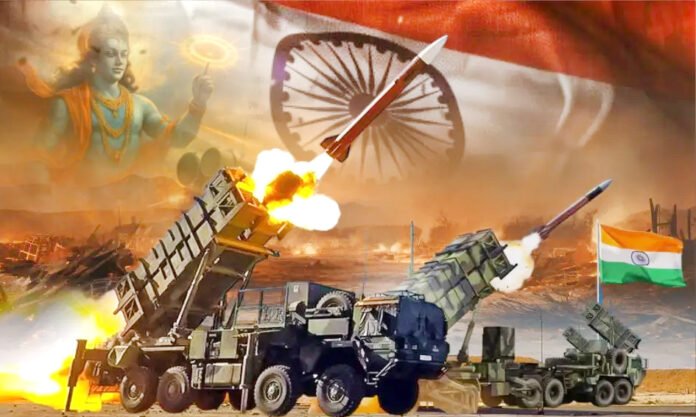
Mission Sudarshan Chakra, unveiled by Prime Minister Narendra Modi from the Red Fort on August 15, 2025, marks a bold commitment to fortify the nation’s skies. In an increasingly unstable geopolitical climate, this initiative seeks to create a seamless, multi-layered shield against aerial and missile threats, integrating surveillance, interception, and counter-strike capabilities. With a target for nationwide rollout by 2035, the mission takes its name and symbolic ethos from Lord Krishna’s legendary discus—a weapon of precision and ultimate defence.
More than a military project, Sudarshan Chakra is framed as a pillar of national sovereignty and economic resilience. It answers critics who see it as a costly diversion from pressing social needs by arguing that true development requires security. If managed with financial care and innovative drive, this undertaking could reshape India’s standing in global security.

Why India Needs an Unbreakable Shield
The driving force behind Sudarshan Chakra is India’s precarious security environment. With nuclear-armed neighbours Pakistan and China continuously advancing their missile and drone capabilities, the threat is clear and present. Recent history—from the Balakot airstrikes in 2019 to the Galwan Valley clash in 2020—has exposed vulnerabilities to cross-border raids, swarming drones, and hypersonic weapons. This has prompted a strategic shift from reactive postures to proactive, integrated defence architectures.
Geopolitically, China’s Belt and Road Initiative and Pakistan’s proxy tactics necessitate a robust deterrent. The shield is envisioned to protect not just military assets but the very backbone of the nation: urban centres, transport networks, hospitals, and places of worship that together shelter over 1.4 billion people.
Economically, the mission dovetails with the Aatmanirbhar Bharat (Self-Reliant India) campaign. It promises to generate high-tech employment and reduce a costly reliance on imports. While defence imports have fallen from 71 per cent in 2014 to 36 per cent a decade later, dependencies remain. Critics rightly point to the strain on public finances—the defence budget for FY 2025-26 stands at ₹6.21 lakh crore amidst a 7.5 per cent GDP growth forecast.
More than a military project, Sudarshan Chakra is framed as a pillar of national sovereignty and economic resilience. It answers critics who see it as a costly diversion from pressing social needs by arguing that true development requires security
However, the argument for the shield includes a compelling multiplier effect: secure borders underpin economic stability. One can look to Israel’s Iron Dome; despite its high cost, it has protected economic activity and is estimated to have saved tens of thousands of pounds per intercepted rocket.

The Evolutionary Journey
India’s path to this ambitious mission is a story of adaptation forged through adversity. Post-independence technology denials, partly due to non-alignment and later nuclear tests, spurred home-grown programmes like the Integrated Guided Missile Development Programme in the 1980s. The Kargil War in 1999 laid bare gaps in air defence, leading to key acquisitions.
Yet, it was the terror attacks in Uri (2016) and Pulwama (2019) that truly accelerated modernisation. This momentum culminated in Operation Sindoor in May 2025—a counter-terror campaign that successfully utilised indigenous systems like the S-400 to down Pakistani aircraft and neutralise drone swarms, all while avoiding nuclear escalation. This operational success validated the concept of layered defence and directly paved the way for Sudarshan Chakra’s announcement just three months later.

Global trends have also played a role. The US-China rivalry and the explosive growth of the drone market, projected to reach $42 billion globally by 2025, have forced India’s strategic thinking to evolve. While some detractors dismiss the mission as political theatre, pointing to past delays like those with the Tejas fighter, this view overlooks a maturing defence ecosystem.
Sanctions and conflicts have sharpened India’s R&D focus, with the Defence Research and Development Organisation’s (DRDO) budget growing 15 per cent annually since 2014. This investment is paying off, positioning India as a defence exporter with sales worth $2.63 billion in 2024-25.
Current Strengths: A Formidable Foundation
Today, India’s air and missile defence capabilities provide a solid, if uneven, base for the mission. The nerve centre is the Integrated Air Command and Control System (IACCS), which fuses data from radars and sensors to create a single, coherent air picture—a capability proven during Operation Sindoor.
Economically, the mission dovetails with the Aatmanirbhar Bharat (Self-Reliant India) campaign. It promises to generate high-tech employment and reduce a costly reliance on imports. While defence imports have fallen from 71 per cent in 2014 to 36 per cent a decade later, dependencies remain
Key hardware assets include:
- The indigenous Akash missile system, with a 25-30 km range and a 97 per cent hit probability in tests.
- The Medium-Range Surface-to-Air Missile (MRSAM), developed with Israel, boasting a 70 km range.
- The formidable Russian S-400 Triumf, with an engagement range up to 400 km and the ability to track 80 targets simultaneously. Five squadrons were operational by 2025.
Recent advances are promising: the DRDO’s D4 counter-drone system, laser-directed energy weapons, and progress on Ballistic Missile Defence (BMD) Phase-II, which successfully intercepted a 5,000 km-range missile in July 2024. Project Kusha is developing Long-Range SAMs (150-350 km), and over ₹5,000 crore has been allocated to secure Delhi’s airspace with an integrated system.
The cost advantage is significant. An Akash unit costs around $2 million, compared to $10 million for similar imported systems. However, when stacked against China’s HQ-9 (200 km range) or the American Patriot (160 km), India’s systems win on affordability but lose on scale—only 37 Akash squadrons have been inducted against an assessed requirement of 100.
Persistent Gaps
For all its strengths, the mission faces serious hurdles that could undermine its success.
- The Integration Challenge: The biggest obstacle may be bureaucratic and technical silos. Systems like the Army’s Akashteer and the Air Force’s IACCS need to work as one for a real-time response. A 2025 report by the Comptroller and Auditor General (CAG) criticised persistent delays in establishing joint commands, highlighting this tri-service coordination problem.
- The Funding Gap: While the mission’s total budget is not public, Project Kusha’s estimated ₹26,000 crore seems modest against the US’s annual $10 billion missile defence spend. This relative shortfall limits investment in next-generation areas like hypersonic defence and space-based interceptors.
- Geography and Coverage: India’s vast 3.2 million sq km territory is a defender’s nightmare. Current sensor deployments focus on borders, leaving the hinterland vulnerable, as seen in drone incursions over Punjab in 2024. Covering the entire nation will require thousands of additional sensors and interceptors.
- Technological Shortfalls: Indigenous systems still lack mature countermeasures against advanced threats like stealth aircraft and coordinated swarm attacks. Radars like the Arudhra (300 km detection range) are capable but lag behind global leaders in integrating artificial intelligence for faster decision-making.
India’s path to this ambitious mission is a story of adaptation forged through adversity. Post-independence technology denials, partly due to non-alignment and later nuclear tests, spurred home-grown programmes like the Integrated Guided Missile Development Programme in the 1980s. The Kargil War in 1999 laid bare gaps in air defence, leading to key acquisitions
Some argue that ‘frugal innovation’ is India’s strength, pointing to the massive cost saving of Akash over S-400 squadrons. However, without solving the integration and scale problems, India risks dangerous vulnerabilities in a prolonged conflict.
The Road to 2035: Vision and Hurdles
The ambition for Mission Sudarshan Chakra is transformative: a fully indigenous, AI-driven national shield by 2035. This shield would integrate kinetic weapons (missiles), non-kinetic tools (lasers, electronic warfare), and cyber capabilities for true multi-domain dominance. The roadmap includes testing the M1 interceptor (150 km range) in 2026, scaling to the M3 by 2028, and achieving initial operational capability by 2028-29.
The potential benefits are vast. The system is projected to match S-400 performance at half the cost, boost defence exports to $5 billion a year by 2030, and create half a million manufacturing jobs. International partnerships, particularly with Israel on missile defence, could fast-track development of hypersonic counters, cementing India’s role as a net security provider in the Indo-Pacific.
Nevertheless, optimism must be tempered with realism. Historical delays, like those in the BMD programme, could push timelines back.
The solution lies in greater involvement of the private sector—firms like Tata and L&T have already pledged significant investment—and a sustained increase in R&D funding. Some analysts suggest that success ultimately depends on boosting R&D expenditure to 2 per cent of GDP and fostering deeper public-private synergy. There is already talk in early 2026 of extending the shield to space-based sensors for earlier warning, hinting at a future hybrid defensive-offensive posture.
Mission Sudarshan Chakra symbolises India’s determined ascent from a major defence importer to an innovator, a journey compelled by existential threats and hardened by experience. The current capabilities provide a foundation, but the mission’s success hinges on tackling the twin demons of integration and funding. If these are overcome, the vision of an impenetrable shield by 2035 is within reach
An Imperative Journey
Mission Sudarshan Chakra symbolises India’s determined ascent from a major defence importer to an innovator, a journey compelled by existential threats and hardened by experience. The current capabilities provide a foundation, but the mission’s success hinges on tackling the twin demons of integration and funding. If these are overcome, the vision of an impenetrable shield by 2035 is within reach. This would deliver not just security, but greater strategic autonomy and global influence. More than a military asset, Sudarshan Chakra embodies the resolve of a nation preparing to secure its future in a multipolar world.

The writer is Special Advisor for South Asia at Parley Policy Initiative, Republic of Korea. He is a regular commentator on the issues of Water Security and Transboundary River issues in South Asia. The views expressed are of the writer and do not necessarily reflect the views of Raksha Anirveda
