


In the frigid heights of the Himalayas, where borders are as contested as the thin air is unforgiving, China has once again staked a provocative claim. On January 12, 2026, Beijing’s Foreign Ministry spokesperson Mao Ning asserted that the Shaksgam Valley “belongs to China”, defending infrastructure projects in the region as “fully justified”.
Shaksgam Valley, a remote but strategically vital strip of land in northern Kashmir, was illegally ceded by Pakistan to China in 1963 under a boundary agreement that India has never recognised. India’s Ministry of External Affairs swiftly rebuked the claim, reiterating that Shaksgam is an “integral and inalienable part of India” and protesting any third-party activities there.

This exchange isn’t an isolated flare-up; it’s the latest chapter in China’s relentless campaign to redraw maps, rename places, and erode India’s sovereignty through psychological and territorial aggression.
The Shaksgam Valley dispute harks back to the post-colonial reconfiguration of South Asia. Historically part of the princely state of Jammu and Kashmir, the valley was occupied by Pakistan after the 1947 partition and handed over to China in exchange for border alignment and economic ties.
The Shaksgam Valley dispute harks back to the post-colonial reconfiguration of South Asia. Historically part of the princely state of Jammu and Kashmir, the valley was occupied by Pakistan after the 1947 partition and handed over to China in exchange for border alignment and economic ties
Today, it forms a critical link in the China-Pakistan Economic Corridor (CPEC), Beijing’s flagship Belt and Road Initiative project, which India opposes for traversing disputed territory. China’s recent infrastructure push—roads, military-grade facilities, and potential outposts near the Siachen Glacier—raises alarms about a two-front threat, encircling India from both Pakistan and China.
Indian Army Chief has firmly rejected these claims, calling the 1963 pact “illegal” and emphasising India’s historical and legal rights.

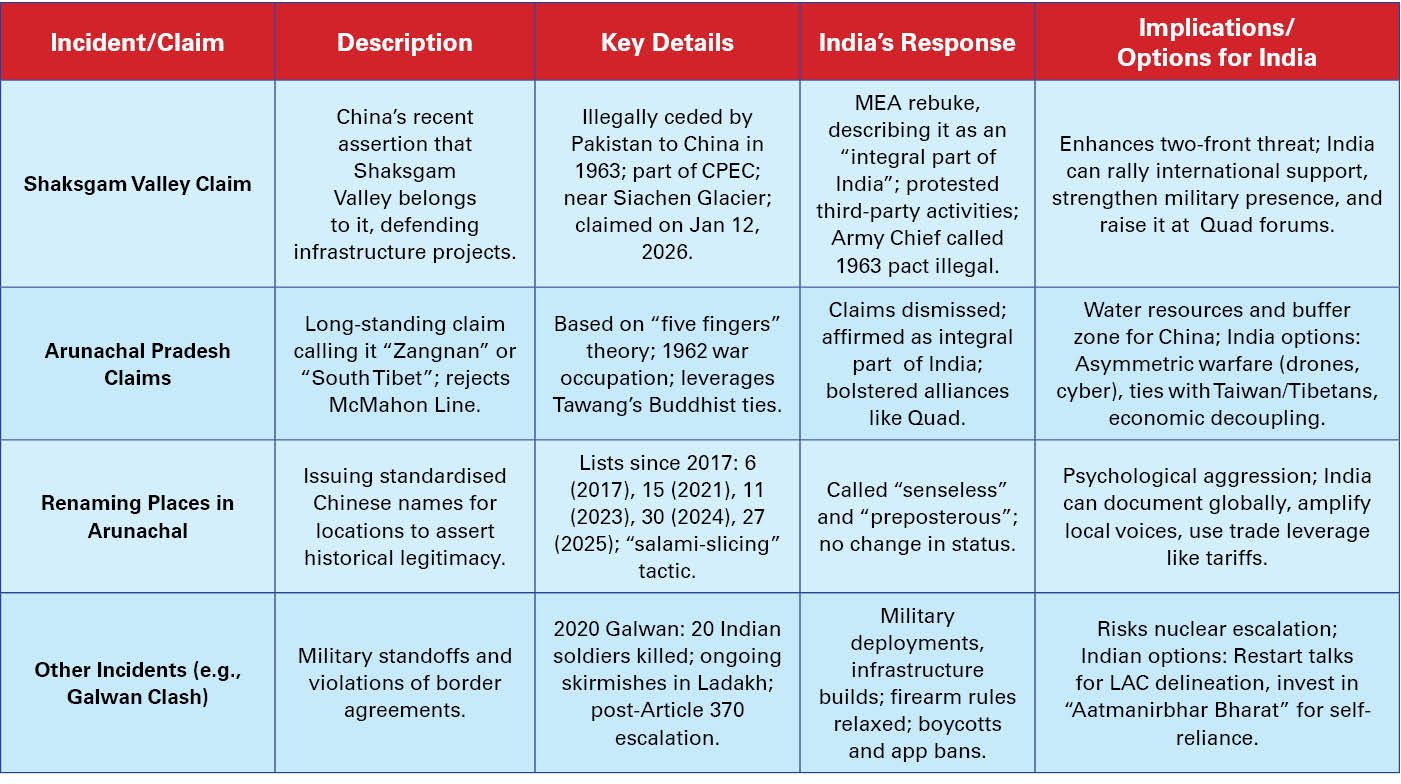
Yet, Beijing’s response has been defiant: “The territory you mentioned belongs to China.” This audacity mirrors China’s long-standing claims on Arunachal Pradesh, a northeastern Indian state that Beijing dubs “Zangnan” or “South Tibet.”
Rooted in imperial-era assertions of Tibetan suzerainty, China’s position rejects the 1914 McMahon Line, drawn during the Simla Convention between British India and Tibet—a pact Beijing deems invalid since it was not a signatory.

Mao Zedong’s “five fingers” theory famously likened Tibet to a palm, with Arunachal as one of its digits, justifying expansionist aims. Over decades, this has escalated from verbal claims to military incursions, like the 1962 Sino-Indian War, where China briefly occupied parts of Arunachal before withdrawing.
More insidious is China’s tactic of renaming places to manufacture historical legitimacy. Since 2017, Beijing has issued five lists standardising Chinese names for Arunachali locations: six in 2017, 15 in 2021, 11 in 2023, 30 in 2024, and 27 in May 2025, covering mountains, rivers, and settlements.
India has dismissed these as “senseless” and “preposterous”, affirming Arunachal’s integral status with India. This cartographic aggression isn’t mere symbolism; it’s part of a broader “salami-slicing” strategy to normalise claims through incremental actions, much like in the South China Sea.
Rooted in imperial-era assertions of Tibetan suzerainty, China’s position rejects the 1914 McMahon Line, drawn during the Simla Convention between British India and Tibet—a pact Beijing deems invalid since it was not a signatory
The pattern extends to personal harassment, underscoring China’s contempt for Indian sovereignty. In November 2025, Prema Wangjom Thongdok, an Indian citizen from Arunachal Pradesh transiting through Shanghai airport en route to Japan, endured an 18-hour ordeal. Chinese officials deemed her passport “invalid” because it listed Arunachal as her birthplace, mocking her with chants of “Arunachal China, not India” and suggesting she apply for a Chinese passport. Denied food and water initially, she was released only after Indian consular intervention. Beijing denied “harassment,” claiming procedures were lawful, but reiterated that it “never recognised Arunachal Pradesh.”
This incident echoes past denials of visas or stapled visas to Arunachalis, treating them as disputed citizens. These provocations aren’t random; they form a mosaic of aggression.
From the 2020 Galwan Valley clash, which killed 20 Indian soldiers and an undisclosed number of Chinese, to ongoing standoffs in Ladakh’s Depsang and Demchok, China has repeatedly violated border agreements.
India has dismissed these as “senseless” and “preposterous”, affirming Arunachal’s integral status with India. This cartographic aggression isn’t mere symbolism; it’s part of a broader “salami-slicing” strategy to normalise claims through incremental actions, much like in the South China Sea
Beijing’s playbook: build infrastructure, deploy troops, and claim “historical rights” while rejecting colonial-era boundaries it deems unequal. In Arunachal, it leverages Buddhist ties to the Tawang Monastery, the birthplace of the sixth Dalai Lama, to bolster its claims.
Meanwhile, India’s abrogation of Article 370 in 2019, reorganising Jammu and Kashmir, irked China, prompting retaliatory border buildups. Why this persistence? China’s actions stem from a mix of strategic insecurity and hegemonic ambitions.
Controlling the Shaksgam Valley bolsters CPEC security and access to the Karakoram Pass, while Arunachal offers water resources from the Brahmaputra and a buffer against Tibetan unrest. Domestically, it fuels nationalism; internationally, it tests India’s resolve amid US-China rivalry. Yet, this risks escalation in a nuclear neighbourhood, where miscalculation could spiral out of control.
India has several options to counter this shadow. First, enhance diplomatic pressure: Rally international support by highlighting China’s revisionism, perhaps through UN forums or alliances like the Quad, framing it as a threat to global norms
India’s responses have been measured but firm. Diplomatically, New Delhi has lodged protests, engaged in border talks (over 20 rounds since 2003), and strengthened alliances via the Quad with the US, Japan, and Australia. Militarily, it has bolstered deployments, relaxed firearm rules along the LAC post-2020, and built infrastructure, such as roads to Daulat Beg Oldie, for rapid mobilisation. Economically, calls for boycotting Chinese goods surged after Galwan, with tighter scrutiny on investments and bans on apps like TikTok.
Looking ahead, India has several options to counter this shadow. First, enhance diplomatic pressure: Rally international support by highlighting China’s revisionism, perhaps through UN forums or alliances like the Quad, framing it as a threat to global norms.
Restart high-level talks with Beijing, as Modi did before 2020, to delineate the LAC and create buffer zones, thereby reducing friction points. Militarily, avoid direct confrontation—India’s options for expulsion are limited due to China’s superior logistics—but invest in asymmetric capabilities: drones, cyber defences, and mountain warfare units. Strengthen ties with Taiwan and Tibetans in exile to mirror China’s sensitivities.
India’s strength lies in its democracy, diversity, and resilience. China may rename maps, but it can’t rename hearts. New Delhi must blend deterrence with dialogue, ensuring that from Shaksgam to Arunachal, India’s red lines remain unbreeched. The Himalayas have witnessed empires rise and fall; India’s sovereignty will endure
Economically, accelerate Aatmanirbhar Bharat to reduce dependence on Chinese imports while leveraging trade—India’s market is vital to China. Impose targeted tariffs or investment reviews, as done post-Galwan.
Culturally and psychologically, amplify the voices of Arunachalis and Kashmiris. The 2025 airport incident sparked outrage, with protesters affirming “Arunachal is India.” India should document and publicise such harassments globally, exposing China’s pettiness.
Ultimately, India’s strength lies in its democracy, diversity, and resilience. China may rename maps, but it can’t rename hearts. New Delhi must blend deterrence with dialogue, ensuring that from Shaksgam to Arunachal, India’s red lines remain unbreeched. The Himalayas have witnessed empires rise and fall; India’s sovereignty will endure.

The writer is Special Advisor for South Asia at Parley Policy Initiative, Republic of Korea. He is a regular commentator on the issues of Water Security and Transboundary River issues in South Asia. The views expressed are of the writer and do not necessarily reflect the views of Raksha Anirveda
