

AYear of Awakening: In 2025, India’s security establishment confronted a stark reality: the strategic environment is no longer cyclical. It is continuously contested. The old pattern of provocation followed by pause has broken down. India now operates in a battlespace where cyber disruption, grey-zone pressure, proxy conflict, economic leverage, great-power realignment and domestic stress intersect without sequence or warning. Endurance, not sentiment, will ultimately determine the outcomes. 2026 will not judge India’s intent; it will judge whether its institutions can move faster than pressure.
The cyber domain exposed how dated India’s assumptions have become. More than one and a half million intrusions were logged within four days of Operation Sindoor. That volume alone marked a change in method. The GPS interference reported at seven airports in November 2025 was not meant to halt operations. It was meant to see how quickly movement, coordination, and public assurance could be unsettled. The issue is not cyber defence in isolation, but how long essential systems can function under pressure.

The deepfake operations targeting the senior military and national leaders, the synthetic narratives injected during Operation Sindoor overclaimed Rafale losses, and the communal-baiting misinformation that followed were not amateur experiments. They were deliberate probes designed to test how fast India fractures psychologically when the information space becomes contaminated at scale. No air defence grid or combat formation can compensate for erosion inside the mind of the state.
A Threat Landscape That Has Outgrown Old Playbooks
2026 will demand a decisive shift from juggling crises to shaping the battlespace. Arming under crisis through emergency procurement will no longer hold good in compressed timeframes.
China will remain the major strategic pressure point and will periodically create friction through grey zone tactics to stretch India economically, militarily and psychologically. Cyber operations, information pressure, maritime posturing, and incremental land assertions are fused into a single method. This is not coercion by escalation but by exhaustion, and it cannot be met with a static defensive posture.
Across the West, Pakistan’s state-sponsored terror continues to mutate. The 10/11 attack underlined two uncomfortable truths: proxy groups can exploit residual gaps in India’s internal grid, and Pakistan’s deep state still views deniability as a strategic weapon. Pakistan’s economic weakness has not diluted its ability to outsource violence. Proxy networks remain central to its strategy, with deniability treated as a weapon rather than a shield. With expanding China–Pakistan military coordination, the risk of a two-front, or effectively a single merged front, can no longer be treated as a contingency. China shapes the environment; Pakistan exploits the seams.

President Trump’s planned visit to Beijing in April 2026 introduces a new variable. For India, reduced friction between Washington and Beijing is not comfort; it is pressure. It frees China to redistribute coercion, reopens space for Pakistan to repackage relevance, and reminds New Delhi that strategic centrality is perishable and must be continually earned
Internally, unresolved fault lines in border regions and the northeast persist, amplified by foreign interference and digital manipulation. Information warfare now penetrates deep into society, distorts perception, and risks unsettling command and governance chains. The rise of radicalisation and institutional subversion is the most corrosive threat of all. This is the ghost within which is quiet, persistent, and lethal if ignored.
Geopolitical Turbulence Impacting Strategic Security
The geopolitical churn and power play have impacted the Indian strategic security environment. The India–Russia relationship is now shaped by Moscow’s Ukraine commitments and economic constraints. Russia wants strategic autonomy but is being pulled deeper into China’s centre of gravity. India values the long arc of defence cooperation, but has to hedge against the shrinking space. Russia remains an important partner, but no longer a strategically insulated one. Defence dependence without strategic insulation is a liability, not legacy capital.

President Trump’s planned visit to Beijing in April 2026 introduces a new variable. A managed thaw suits China by buying time for economic stabilisation and internal consolidation. For India, reduced friction between Washington and Beijing is not comfort; it is pressure. It frees China to redistribute coercion, reopens space for Pakistan to repackage relevance, and reminds New Delhi that strategic centrality is perishable and must be continually earned.
India does not remain insulated from these visits. A thaw in US-China relations alters the flavour of the subcontinental dynamics and India’s centrality in the region. It frees China to redistribute pressure elsewhere. It reopens channels for Pakistan to project relevance to the US. And it forces India to tighten coordination with partners while avoiding the temptation to assume any alignment is permanent.
A Military At Crossroads: Aiming and Arming Challenges
India’s armed forces have shown grit along the LAC and resilience against terror networks. But grit cannot substitute for technological headroom, and resilience cannot replace autonomy over critical systems. India’s defence ecosystem continues to be weighed down by legacy practices that limit its effectiveness. The procurement system remains slow, rule-bound, and out of step with operational urgency. GSQRs chase theoretical perfection and arrive too late to matter. The outcome is predictable: imports by compulsion, dependence on foreign source codes, propulsion systems, sensors, and software, which are the true levers of modern combat power. The private sector remains stuck at low-risk assembly, while PSUs continue to rely on transfer-of-technology models that deliver hardware without intellectual control. Start-ups show ingenuity but struggle to scale because state commitment remains episodic. This gap between promise and permanence is structural, not accidental.
This troika of flawed procurement, shallow manufacturing depth, and limited R&D ownership is India’s biggest barrier to military modernisation.
Rewriting the Security Blueprint for 2026
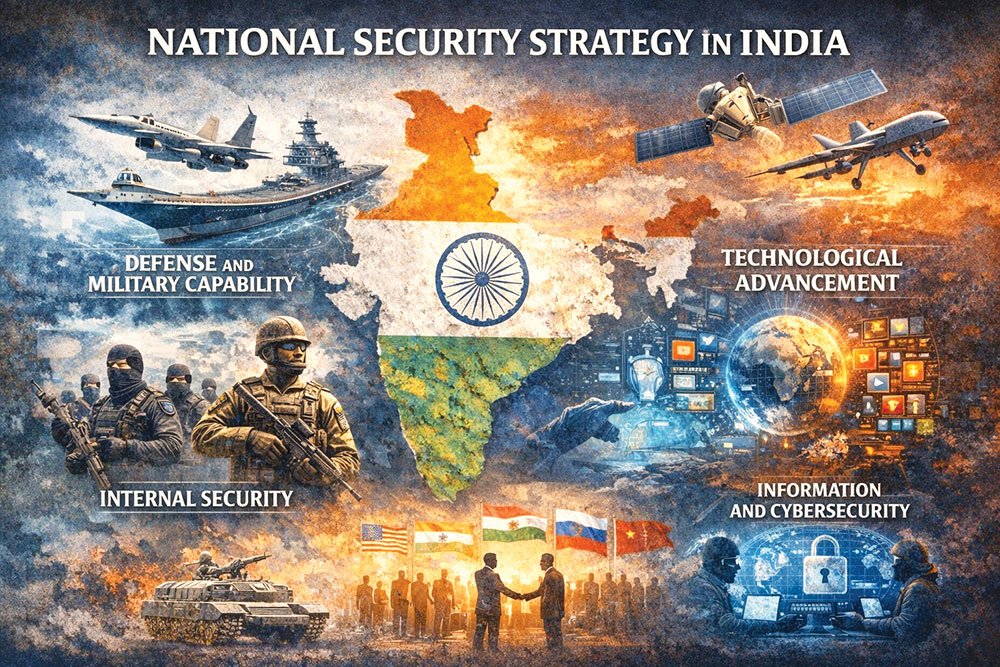
The writings on the wall are clear. India needs institutional and urgent operational readiness for future warfare with a doctrinal construct which is proactive and pre-emptive. Some of the areas that need priority addressing are:-
First, India needs a National Security Strategy that is executable, not aspirational. Without a hard framework, capability development degenerates into disconnected projects. Strategic ambiguity no longer buys flexibility; it creates drift.
Second, Cyber and information warfare must be treated as weapons, not support functions. India needs a unified cyber command with offensive authority, integrated with civilian infrastructure protection. An information-space defence grid must detect, flag, and neutralise hostile narratives in real time and be treated as a core national security asset.
Third, procurement must be de-clogged. Open-ended timelines kill relevance. India’s defence ecosystem is still influenced by legacy practices that no longer fit present conflict conditions. Procurement moves slowly, is driven by procedure, and rarely matches operational timelines, reducing preparedness when rapid response is required. Fourth, deterrence must shift from punishment to denial. India’s posture remains predictable and ground-centric. Denial requires long-range precision, resilient C5ISR, genuine jointness, and an element of unpredictability that India’s adversaries already exploit more comfortably.
Military modernisation must pivot to mastery, not assembly. India cannot future-proof itself by importing platforms and slapping a ‘Make in India’ label on them. What matters is control over software, sensors, propulsion, and core algorithms
Fifth, modernisation must pivot to mastery, not assembly. India cannot future-proof itself by importing platforms and slapping a “Make in India” label on them. What matters is control over software, sensors, propulsion, and core algorithms. That requires a layered defence ecosystem where large integrators anchor complex platforms, mid-tier firms deliver subsystems and components, and startups and academia drive high-risk innovation. Without this depth, India’s defence industry remains ornamental, not strategic.
The Big Choice of 2026
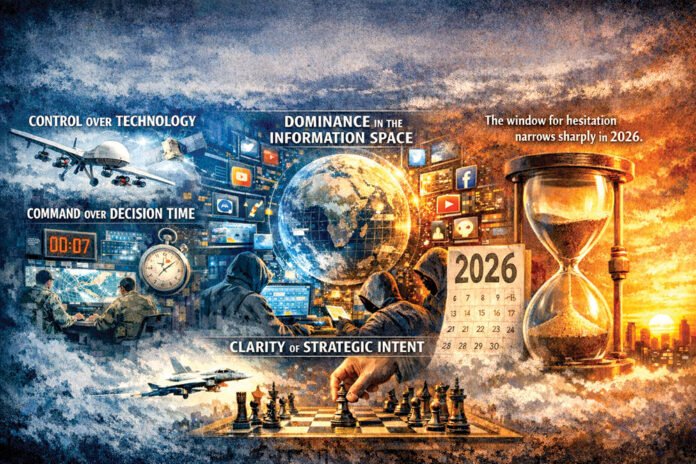
India stands at an inflexion point. It can continue adjusting old frameworks and hope crises remain manageable, or it can rewire its security architecture around speed, ownership, and denial. Surakshit Bharat will not be delivered through slogans or marginal reform. It will rest on control over technology, command over decision time, dominance in the information space, and clarity of strategic intent. The window for hesitation narrows sharply in 2026.

The author, a PVSM, AVSM, VSM has had an illustrious career spanning nearly four decades. A distinguished Armoured Corps officer, he has served in various prestigious staff and command appointments including Commander Independent Armoured Brigade, ADG PP, GOC Armoured Division and GOC Strike 1. The officer retired as DG Mechanised Forces in December 2017 during which he was the architect to initiate process for reintroduction of Light Tank and Chairman on the study on C5ISR for Indian Army. Subsequently he was Consultant MoD/OFB from 2018 to 2020. He is also a reputed defence analyst, a motivational speaker and prolific writer on matters of military, defence technology and national security. The views expressed are personal and do not necessarily carry the views of Raksha Anirveda
